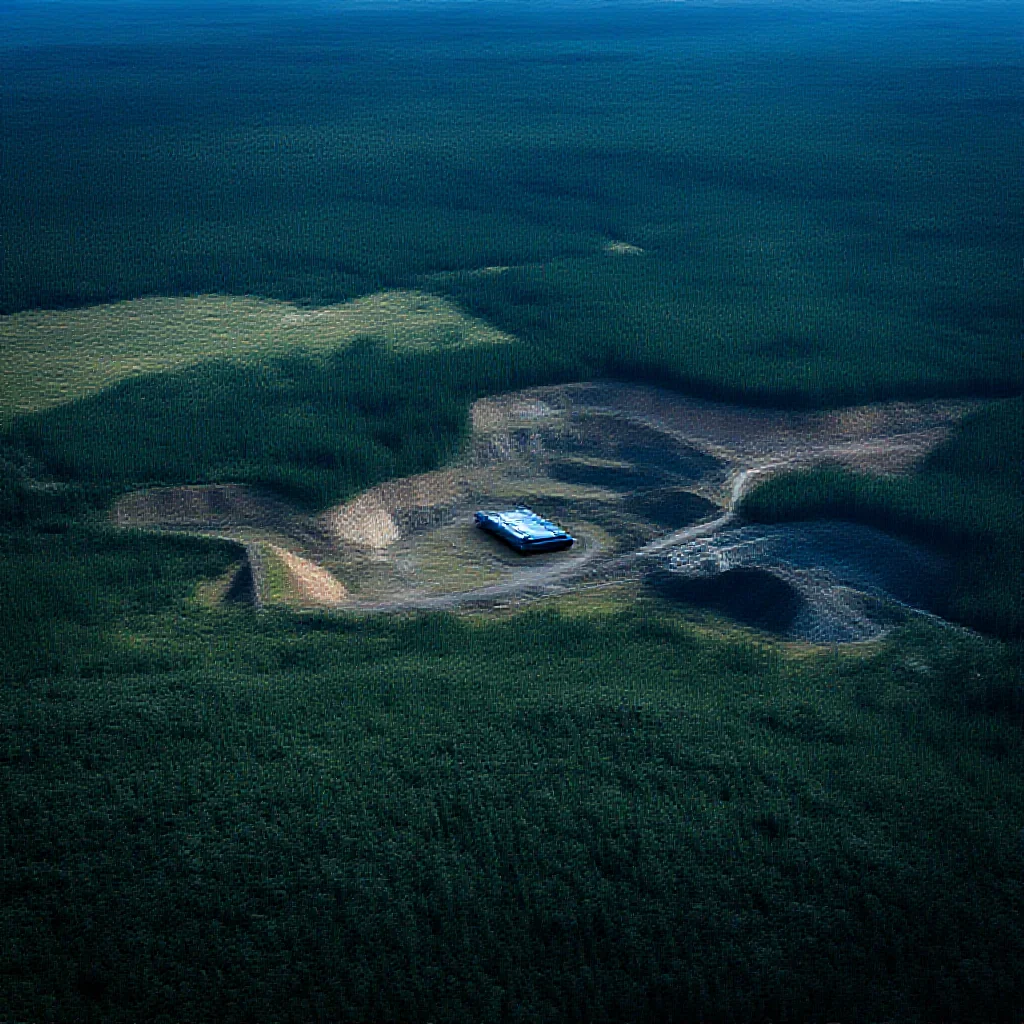
Nouveau Monde Graphite''s $1.275 billion financing package, anchored by
Beyond the Billion-Dollar Deal: How Quebec's Graphite Mine Signals a Shift in Global Battery Supply Chains
Opening Summary
Nouveau Monde Graphite Inc. has secured a $1.275 billion financing package to develop its Matawinie graphite mine in Quebec. The package is anchored by a $297 million equity investment from Japan’s Mitsui & Co., Ltd. and Pallinghurst Bond, supplemented by $575 million in debt from Canadian state entities Investissement Québec and Export Development Canada (Source 1: [Primary Data]). The project, an all-electric open-pit operation, is scheduled to begin production in 2027, targeting an annual output of 103,000 tonnes of graphite concentrate over a 25-year mine life (Source 1: [Primary Data]). This transaction represents a capital-intensive bet on restructuring a critical segment of the electric vehicle (EV) battery supply chain.The Deal Decoded: More Than Money for Matawinie
The financing structure reveals strategic priorities beyond simple project funding. The $297 million equity tranche from Mitsui and Pallinghurst functions as a strategic anchor. Mitsui, a Japanese trading house with deep ties to the automotive sector, is securing a physical offtake stream, not merely providing capital. The substantial $575 million debt portion from Investissement Québec and Export Development Canada serves a dual purpose: de-risking the project for private investors and signaling geopolitical intent through state-backed capital. This model reduces reliance on traditional mining finance, which often views single-asset, pre-production critical mineral projects as high-risk.A core marketing and financial differentiator is the project’s "all-electric" design. This operational model directly targets environmental, social, and governance (ESG) criteria, which are increasingly non-negotiable for Western automakers and battery cell manufacturers. The narrative positions the mine’s output as not only non-Chinese but also produced with a lower carbon footprint, creating a premium product category in the battery materials market.
The Hidden Axis: Graphite as the New Geopolitical Battleground
The investment is a direct response to a concentrated supply chain. China currently controls an estimated 80% of the global production of spherical graphite, the processed form used in lithium-ion battery anodes. This dominance creates a strategic vulnerability for North American, European, and Japanese automotive industries. Mitsui’s involvement is a logical deduction: it is a mechanism for Japan’s industrial base to secure a non-Chinese, stable feedstock for its automakers.The project’s timeline is strategically aligned with macro-level shifts. A 2027 production start and a 25-year operational life (Source 1: [Primary Data]) coincide with the projected ramp-up of dozens of announced battery gigafactories across North America and Europe. This alignment anticipates potential future trade policies, such as stricter rules of origin within the USMCA or similar European frameworks, which could mandate a higher percentage of locally sourced critical minerals for vehicles to qualify for incentives. The mine is not just a source of material; it is an insurance policy against supply disruption and trade friction.
Slow Analysis: The Ripple Effects on a Fragile Supply Chain
A technical audit of the battery supply chain reveals graphite’s underappreciated criticality. While lithium and cobalt receive more attention, graphite constitutes the largest single material component by weight in a typical EV battery anode. The scaling of anode production is a significant bottleneck, making a secure, large-scale source of high-purity graphite concentrate a foundational requirement.The Matawinie mine’s planned 103,000-tonne annual output (Source 1: [Primary Data]) could alter pricing dynamics and negotiation leverage for Western battery manufacturers. It provides a tangible alternative, potentially reducing the risk premium associated with sole-source dependence. However, a critical gap remains in the supply chain. The project produces graphite concentrate, which must then be processed through several high-value steps—micronization, spheroidization, and coating—to become battery-grade anode material. The majority of this value-add capacity currently resides in China. Therefore, the mine solves only the first link in a multi-step chain. Its success will likely necessitate and attract parallel investments in downstream processing facilities in North America, a development not guaranteed by the mine financing alone.
Verification and Credibility: Scrutinizing the Foundations
The project’s stated capacity and timeline are derived from Nouveau Monde Graphite’s definitive feasibility study and related technical disclosures, which are filed and accessible on SEDAR (System for Electronic Document Analysis and Retrieval) as per Canadian securities regulation. This provides a verifiable baseline for the 103,000-tonne and 2027 production claims.The credibility of the financial backers adds substantive weight to the project’s prospects. Investissement Québec has a track record of supporting strategic mineral projects within the province. Mitsui & Co. has a documented history of global investment in battery material supply chains, indicating rigorous due diligence. The "all-electric" claim, while a forward-looking operational target, is grounded in existing technology for heavy equipment electrification, though its full-scale implementation at Matawinie will be a proof-of-concept for the industry.
Neutral Market/Industry Predictions
The closure of this financing package increases the probability of the Matawinie mine reaching production. It will establish Quebec as a significant node in the North American graphite supply network. Market impact will be gradual, with material volumes not influencing global pricing until the latter half of this decade. The project’s primary effect will be to provide a reference price for ESG-compliant graphite, potentially creating a two-tier market.The deal will likely catalyze further investment in mid-stream processing infrastructure in North America, though the scale and speed of that development remain uncertain. Over the 25-year mine life, the strategic value of the asset will be tied less to commodity price cycles and more to the persistence of geopolitical tensions and the strength of Western policies favoring friend-shored supply chains for critical minerals. The mine is therefore a long-term bet on the structural decoupling of battery material supply chains.