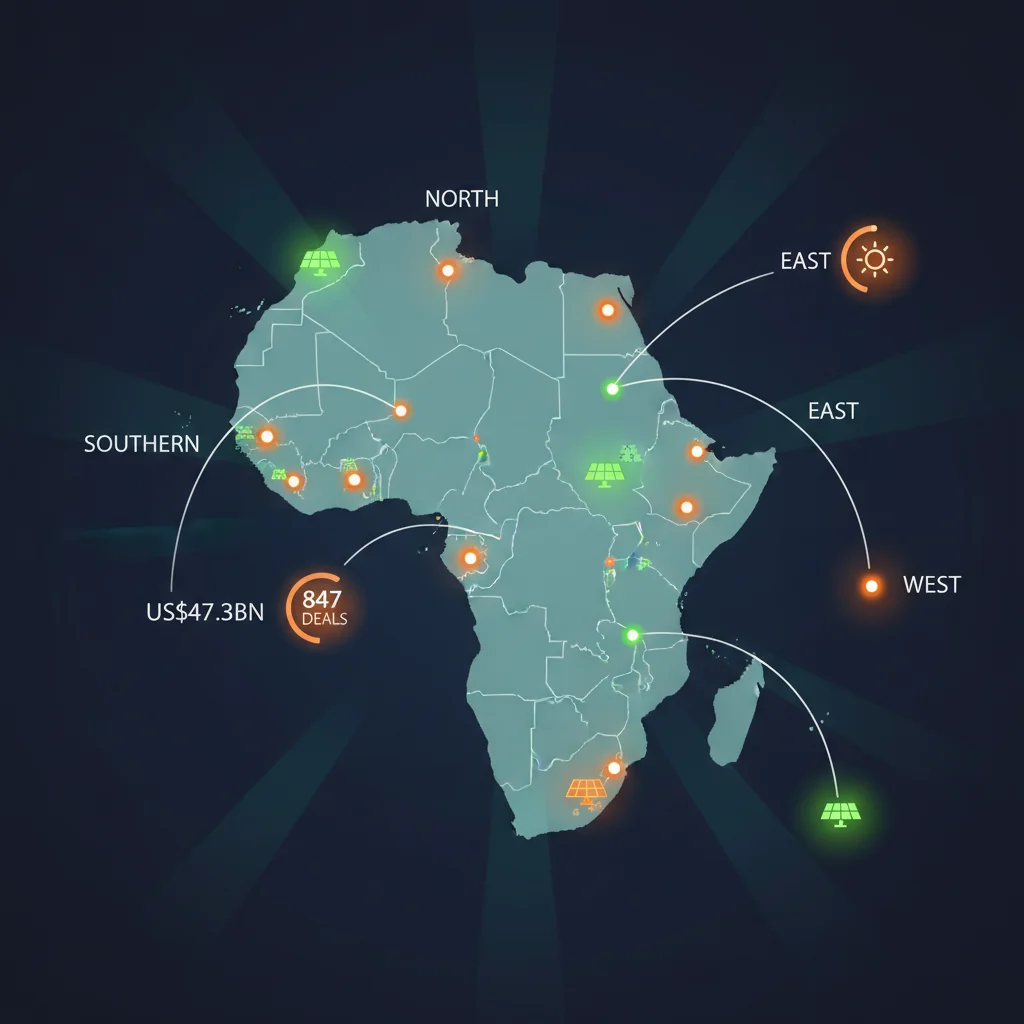
Between 2012 and 2023, private investors deployed US$47.3 billion across
Private Capital in Africa’s Infrastructure: A Decade of Selective Growth and Persistent Gaps (2012–2023)
Between 2012 and 2023, private investors deployed US$47.3 billion across 847 reported infrastructure deals in Africa. This sum represents just 5% of global private infrastructure investment, despite the continent housing 18% of the world’s population. Deal volume more than doubled over the period, but capital flows remain heavily skewed toward energy and digital infrastructure (81% of value), while transport—which accounts for 73% of the financing gap—attracted only US$4 billion. Sustainable investments surged to US$19 billion, with solar dominating. The data reveal a structural mismatch between investor appetite and developmental priorities, driven by sector-specific risk-return profiles, regulatory frameworks, and the limited fiscal capacity of public sector partners.
The Big Picture: A Continent Underinvested
Africa’s infrastructure financing gap is both chronic and well-documented. Sub-Saharan Africa invests approximately 3.5% of GDP in infrastructure each year, roughly half of the 7.1% required to meet the Sustainable Development Goals (SDGs) (Source: AVCA data). Closing this gap could boost GDP growth by an estimated 2% annually. Yet the annual shortfall ranges from US$100 billion for basic needs to US$181–US$221 billion for full SDG alignment.
Private capital has only marginally dented this deficit. Over the 12-year period, US$47.3 billion was deployed across 847 deals—a fraction of the required annual investment. Critically, 95% of infrastructure financing in Africa continues to come from the public sector (Source: AVCA data). The continent’s tax-to-GDP ratio, at 16%, is the lowest globally, severely constraining government capacity to co-invest or provide guarantees that would attract private capital.
The disparity between Africa’s population share and its share of global private infrastructure investment—18% versus 5%—reflects structural barriers that extend beyond capital availability. Currency risk, political instability, weak project pipelines, and limited local capital markets all contribute to the continent’s underinvestment status. The data confirm that private flows are not simply insufficient but also selectively allocated to sectors and regions that offer the most predictable revenue and regulatory environments.
Deal Dynamics: Volume Surges, But Size and Structure Shift
Private sector interest has grown markedly over the period. Average deal volume rose from 43 per year (2012–2015) to 101 per year (2020–2023)—a more than twofold increase (Source: AVCA data). This indicates a broadening of investor engagement, yet the value per deal has not kept pace.
Market bifurcation is evident. 73% of all deals were valued below US$50 million, suggesting a predominance of small-scale, often niche projects. In contrast, 16 megadeals (transactions exceeding US$500 million) captured US$19.4 billion—over 40% of total value (Source: AVCA data). This two-tier market implies that large institutional investors focus on a handful of high-conviction opportunities, while smaller funds and developers operate in a fragmented landscape of smaller projects. The concentration of value in megadeals also heightens vulnerability to project-specific risks and limits diversification.
Financing structures reflect investor preferences for control. Equity accounted for 88% of deal volume, indicating a strong preference for direct ownership and long-term exposure rather than debt or instruments that share risk. Blended finance, while still niche, has gained traction: Sub-Saharan Africa attracted 41% of global blended finance infrastructure deals by volume and 50% by value between 2013 and 2022 (Source: AVCA data). This suggests that concessional capital can crowd in private investment in higher-risk environments, but its scale remains insufficient to bridge the broader financing gap.
Sector Magnetism: Energy and Digital Dominate, Transport Left Behind
The distribution of private capital across sectors reveals a clear hierarchy of investor preference. Energy and Telecom & Digital Infrastructure together captured 81% of total deal value (US$38.2 billion) over the period (Source: AVCA data). These sectors benefit from clear revenue models (power purchase agreements, subscriber fees), improving regulatory frameworks, and scalability—characteristics that align with institutional investor mandates.
Healthcare emerged as the second-most active sector by deal volume (30%), though its value share was far lower. Education attracted US$1.1 billion across 94 deals, representing only 10% of Africa’s education infrastructure financing gap (Source: AVCA data). These sectors remain underserved relative to need.
The most striking mismatch is in transport. Transport infrastructure represents 73% of Africa’s overall financing gap, yet private capital deployed only US$4 billion across 46 deals over the 12 years (Source: AVCA data). Roads, railways, and ports typically involve long gestation periods, high upfront costs, political sensitivity over tariffs, and complex land acquisition issues—factors that deter private investors without substantial public backing.
Regional concentration adds another layer of asymmetry. Southern Africa led in deal volume (27%), while North Africa recorded the highest total deal value (US$9.8 billion) (Source: AVCA data). Multi-region deals—often involving renewable energy projects spanning several countries—reached US$15.2 billion, suggesting that cross-border infrastructure platforms can attract significant capital. Yet the distribution remains uneven, with West and Central Africa lagging in both volume and value.
Sustainable Infrastructure: Solar Leads a Growing but Narrow Base
Sustainable infrastructure investments (renewable energy, energy efficiency, climate-resilient projects) totalled US$19 billion across 305 deals over the period, representing 40% of total infrastructure deal value (Source: AVCA data). Solar energy dominated, accounting for 63% of sustainable deal volume, followed by wind (12%) and hydroelectric (8%) (Source: AVCA data). The dominance of solar is consistent with its declining costs, modularity, and suitability for decentralized grids in off-grid and weak-grid areas.
However, the sustainable investment base remains narrow. Other climate-critical sectors—such as sustainable agriculture, water management, and green transport—attracted minimal private capital. The concentration in solar also raises questions about grid integration, storage, and the long-term viability of projects in markets with limited transmission infrastructure.
Outlook: Convergence Walls and the Need for Structural Reform
The data from 2012–2023 depict a market that has expanded in volume but remains structurally constrained. Private capital will likely continue flowing to energy and digital infrastructure, where risk-return profiles are most favorable. The rise of sustainable investments, particularly solar, is expected to persist, driven by global climate commitments and falling technology costs.
However, the persistent gap in transport, healthcare, and education—sectors that underpin broader economic development—will not close without deliberate policy intervention. Blended finance, risk guarantees, and standardized project preparation facilities can lower barriers, but their current scale is inadequate. The fact that 95% of infrastructure financing still comes from public sources, in a region with the world’s lowest tax-to-GDP ratio, indicates that the current model is fiscally unsustainable.
Forward-looking indicators point to three likely trends. First, megadeals will continue to concentrate in a handful of stable jurisdictions (e.g., South Africa, Kenya, Morocco, Nigeria) and in sectors with proven revenue streams. Second, smaller-scale private capital—including infrastructure funds focused on energy access and digital connectivity—will proliferate, but will remain fragmented and high-cost. Third, without significant improvements in project preparation, regulatory consistency, and local currency risk mitigation, the 5% share of global private infrastructure investment is unlikely to rise substantially.
The data do not support a narrative of imminent transformation. Africa’s infrastructure paradox—high need, low private flow, and sectoral mismatch—is a structural equilibrium sustained by risk perceptions, institutional weaknesses, and the limited fiscal capacity of host governments. Changing this equilibrium will require coordinated action by multilateral development banks, national governments, and institutional investors to create a pipeline of bankable projects in underserved sectors. Until then, private capital will continue to follow the path of least resistance, leaving the majority of Africa’s infrastructure gap unfilled.