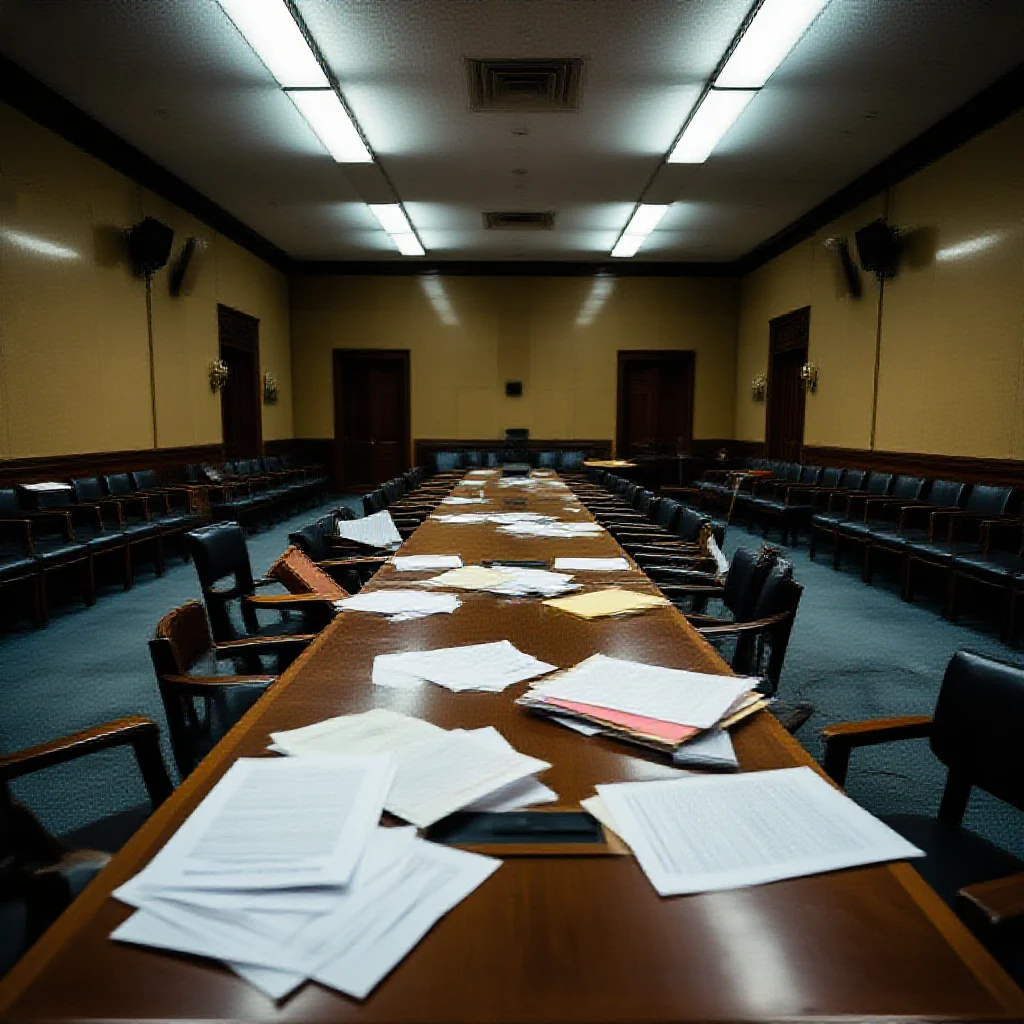
In March 2024, two MPs publicly condemned the conduct of Canada's House of
Beyond 'Junior High Behaviour': How Parliamentary Committee Dysfunction Undermines Climate Policy
Summary: In March 2024, two MPs publicly condemned the conduct of Canada's House of Commons environment committee as "laughable" and "junior high behaviour." This incident, occurring during a critical debate on oil and gas emissions, reveals more than mere political squabbling. It exposes a systemic dysfunction in parliamentary oversight mechanisms tasked with addressing the climate crisis. This analysis explores how procedural theatrics and partisan obstruction within committees create a governance bottleneck, delaying substantive policy action, eroding public trust, and ultimately impacting investor confidence and the economic transition. The critique by MPs Yvonne Jones and Laurel Collins serves as a case study in how institutional conduct directly influences policy efficacy and market signals.
The Incident: A Symptom, Not the Disease
On March 21, 2024, during a meeting of the House of Commons Standing Committee on Environment and Sustainable Development, a procedural debate devolved into explicit condemnation. The committee was engaged in discussions on a motion concerning a study on oil and gas emissions reductions. The conduct of the meeting prompted Liberal MP Yvonne Jones to state, "This is laughable, this is ridiculous, this is junior high behaviour." (Source 1: [Hansard, March 21, 2024]). NDP MP Laurel Collins echoed the sentiment, labeling the proceedings "junior high behaviour." (Source 1: [Hansard, March 21, 2024]).
The language used is analytically significant. Terms like "laughable" and "junior high" are not merely expressions of frustration; they are descriptors of a profound procedural breakdown. They indicate a departure from formal, evidence-based deliberation toward a state where process itself becomes an obstacle. This incident is not an isolated event but a visible symptom of a systemic condition. The core thesis is that committee conduct functions as a critical non-financial variable, directly impacting the throughput, quality, and economic implications of environmental and climate policy.
The Hidden Economic Logic of Parliamentary Theatre
The dysfunction witnessed in committee rooms operates as a non-tariff barrier to policy implementation. Deliberate delay and procedural obstruction create extended periods of regulatory uncertainty. For the specific study on oil and gas emissions reductions, each stalled meeting represents a delay in generating the analysis required to inform potential legislation or regulation.
This uncertainty transmits direct market signals. Investors in cleantech, renewable energy, and transitional industrial projects require predictable policy trajectories to de-risk capital allocation. Conversely, protracted committee debates on emissions frameworks can be perceived as a signal of attenuated political will, potentially preserving the valuation of incumbent assets for longer than market fundamentals might otherwise dictate. The cost of inaction, while complex to quantify precisely, accrues in two forms: the escalating physical risks of delayed climate mitigation and the forfeiture of first-mover economic advantages in the global transition to a low-carbon economy. Committee dysfunction directly influences the calculus of both.
Slow Analysis: Auditing the Institutional Supply Chain
A deep audit of parliamentary governance reveals that dysfunction in a central committee like Environment and Sustainable Development creates cascading bottlenecks. Legislation and policy related to agriculture, transport, natural resources, and finance often require input or a mandate from environmental studies. A jam in this initial stage slows the entire legislative "supply chain."
The long-term impact on governance structures is corrosive. Expert witnesses from academia, industry, and civil society may become reluctant to engage with processes perceived as performative rather than substantive. This reduces the quality of policy input. Furthermore, public cynicism toward political institutions is fed by visible displays of procedural failure, undermining the social license necessary for ambitious economic transition. A comparative analysis with other Westminster-style parliaments, such as the UK or Australia, would likely reveal correlations between committee norms—rules on filibustering, chair powers, cross-party working groups—and the speed and coherence of climate policy development.
Evidence and Verification: Anchoring the Critique
The factual record of the March 21 incident is a matter of public record, verified by the official Hansard transcript. This provides a concrete anchor point for a broader critique of institutional efficiency. The analysis extends beyond this single event by referencing established research on legislative productivity.
Organizations like the Samara Centre for Democracy have published studies on the effectiveness of parliamentary committees, noting challenges with partisanship and their impact on substantive work. The Institute for Research on Public Policy has examined policy throughput and regulatory delays. The timeline of the oil and gas emissions study itself, from initial motion to completion, serves as a quantifiable key performance indicator for committee functionality. Persistent delays or a diluted final report would serve as empirical evidence supporting the thesis that conduct affects output.
Conclusion: The Market's Verdict on Governance Quality
The conduct of parliamentary committees is increasingly scrutinized as a leading indicator of governance quality. For financial and industrial stakeholders, efficient, predictable, and evidence-based committee processes reduce regulatory risk. Dysfunction has the opposite effect, introducing a premium for uncertainty that can stifle investment in transitional sectors.
The neutral prediction, based on observable cause and effect, is that persistent committee dysfunction will correlate with specific market outcomes: a higher cost of capital for projects dependent on clear climate policy, increased volatility for sectors in regulatory limbo, and a potential reallocation of international investment to jurisdictions with more coherent and stable policy development pathways. The "junior high behaviour" critique, therefore, transcends political theater. It is a diagnostic of an institutional friction that carries measurable economic and environmental consequences. The efficiency of parliamentary oversight is not a matter of political decorum but a foundational component of climate policy efficacy and economic competitiveness.