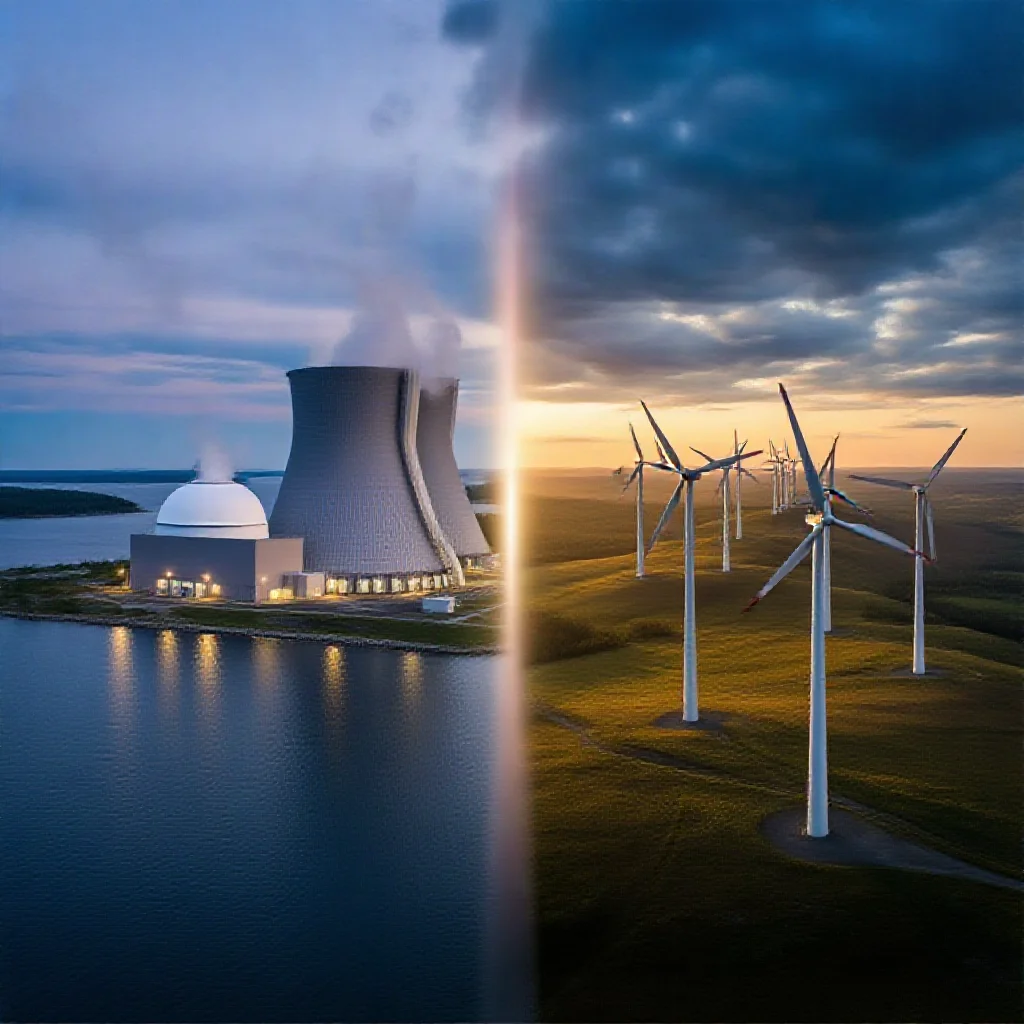
Canada's two largest provinces are charting starkly different courses to
Divergent Paths: How Ontario's Nuclear Bet and Quebec's Wind Surge Shape Canada's Energy Future
Canada’s two largest provinces are pursuing fundamentally different technological and economic strategies to address a common challenge: the need for massive new, decarbonized electricity generation. Ontario is committing to a centralized, capital-intensive expansion of nuclear power, while Quebec is accelerating a distributed, resource-based build-out of wind energy. These divergent paths offer a real-time case study in the complex trade-offs inherent in the global energy transition.
The Fork in the Road: Two Provinces, Two Core Logics
The strategic divergence is rooted in contrasting core logics. Ontario’s approach prioritizes capacity and certainty. The province’s Independent Electricity System Operator (IESO) forecasts a need to more than double its electricity generation capacity by 2050 to support population growth and industrial electrification (Source 1: IESO Report). In response, the provincial government has announced plans for 4,800 megawatts of new nuclear capacity using small modular reactors (SMRs) at the Bruce Power site (Source 2: Government Announcement). This model bets on firm, baseload generation to provide grid stability and predictable long-term costs, albeit with exceptionally high upfront capital expenditure (CAPEX).
Quebec’s strategy, conversely, is built on resource and scalability. The province’s 2023 Energy Transition Plan calls for adding 8,000 to 12,000 megawatts of new renewable generation capacity by 2035 (Source 3: Quebec 2023 Energy Transition Plan). A key component is a call for tenders for 1,500 megawatts of wind power, scheduled for launch in 2025 (Source 4: Government Announcement). This model leverages Quebec’s vast land area and existing hydroelectric reservoir storage—which can act as a massive battery—to integrate variable wind generation. The economic logic shifts from massive, singular capital deployments to managing the operational and grid integration costs of intermittent sources.
!Infographic map of Canada highlighting Ontario and Quebec
Deep Dive: Ontario's High-Stakes Nuclear Gamble
Ontario’s selection of the Bruce Power site for its SMR expansion is a strategic consolidation, not a greenfield venture. The move leverages the site’s existing nuclear expertise, established transmission connections, and a level of local social license cultivated over decades. The objective is to minimize developmental friction for a first-of-a-kind project.
The investment extends beyond megawatts. A primary long-term payoff is the potential development of a domestic SMR supply chain. Success in deploying SMRs at scale could position Ontario as a global hub for advanced nuclear technology, manufacturing, and exportable expertise. This represents a deliberate industrial policy to capture high-value jobs and technological leadership.
The risk audit for this path is significant. It hinges on the successful commercialization of SMR technology within projected timelines and budgets, a challenge where previous nuclear endeavors have historically struggled. Additional factors include long-term waste management liabilities and the opportunity cost of capital. The potential payoff is a scalable source of firm, decarbonized power that is largely weather-independent and occupies a small geographic footprint.
!Conceptual 3D rendering of a Small Modular Reactor complex
Deep Dive: Quebec's Wind-Powered Industrial Strategy
Quebec’s wind expansion is more than an energy procurement program; it is an integrated regional economic development strategy. Projects are frequently tied to benefits for host communities, such as in the Gaspésie region, and are viewed as foundational infrastructure for a future green hydrogen and industrial electrification ecosystem. The energy is intended to fuel both domestic demand and potential export markets.
The primary technical challenge is integration. While Quebec’s extensive hydroelectric reservoirs provide unparalleled flexibility to balance wind’s variability, adding 8,000-12,000 MW of new intermittent generation will require sophisticated grid management, potential supplemental fast-ramping resources, and significant transmission investments. The "hidden costs" of grid modernization and balancing services are a critical part of the total system cost equation.
The supply chain implications contrast sharply with Ontario’s ambitions. Quebec’s strategy largely relies on a globalized wind turbine supply chain. While there may be local assembly or component manufacturing, the province is not aiming to create a dominant export industry in turbine production. The economic value is instead captured in low-cost electricity for domestic industries and the sale of power, rather than in selling the generation technology itself.
!Wind turbine blades transported on a remote Quebec highway
The Unseen Battleground: Grid Architecture and Market Design
The chosen generation technologies will fundamentally shape each province’s future grid architecture. Ontario’s nuclear path reinforces a centralized grid model, dependent on large-scale plants feeding into high-voltage transmission corridors. This necessitates robust, predictable demand centers and reinforces the traditional utility-scale generation paradigm.
Quebec’s wind path, often involving projects in remote regions, pushes toward a more distributed and flexible grid. This model requires advanced forecasting, demand response capabilities, and potentially more decentralized grid control systems to manage bidirectional power flows and ensure reliability. The operational philosophies of the respective system operators, IESO and Hydro-Québec, will evolve in distinct directions.
From a market perspective, Ontario’s nuclear investment represents a long-term, fixed-cost liability that must be recovered, likely influencing rate structures and capacity market designs toward cost-of-service or contract-based models. Quebec’s wind additions, typically brought online via competitive tenders, introduce large volumes of near-zero marginal cost energy, which can suppress wholesale market prices but require other mechanisms to ensure system adequacy.
Neutral Market and Industry Predictions
The divergence between Ontario and Quebec will create two distinct test beds within a single national market. Ontario’s success will be measured by its ability to bring SMRs online on schedule and at projected cost, thereby validating a model for other jurisdictions lacking Quebec’s hydro resource. Failure or significant delay could lead to a capacity shortfall, reliance on natural gas generation, and increased electricity costs.
Quebec’s success will be measured by its ability to integrate vast quantities of wind power without compromising grid reliability or necessitating excessive curtailment. Its performance will offer critical data on the real-world limits of renewable penetration in a hydro-rich system, with implications for similar markets globally.
The long-term trend may see these paths converge through interconnection. Quebec’s flexible hydro and wind surplus could theoretically provide balancing services to Ontario’s nuclear-heavy grid, and Ontario’s firm capacity could offer reliability backing to Quebec. The extent of this synergy will depend on transmission expansion and the evolution of inter-provincial electricity trading frameworks. The ultimate outcome will be a detailed, real-world report card on two of the world’s leading decarbonization strategies.