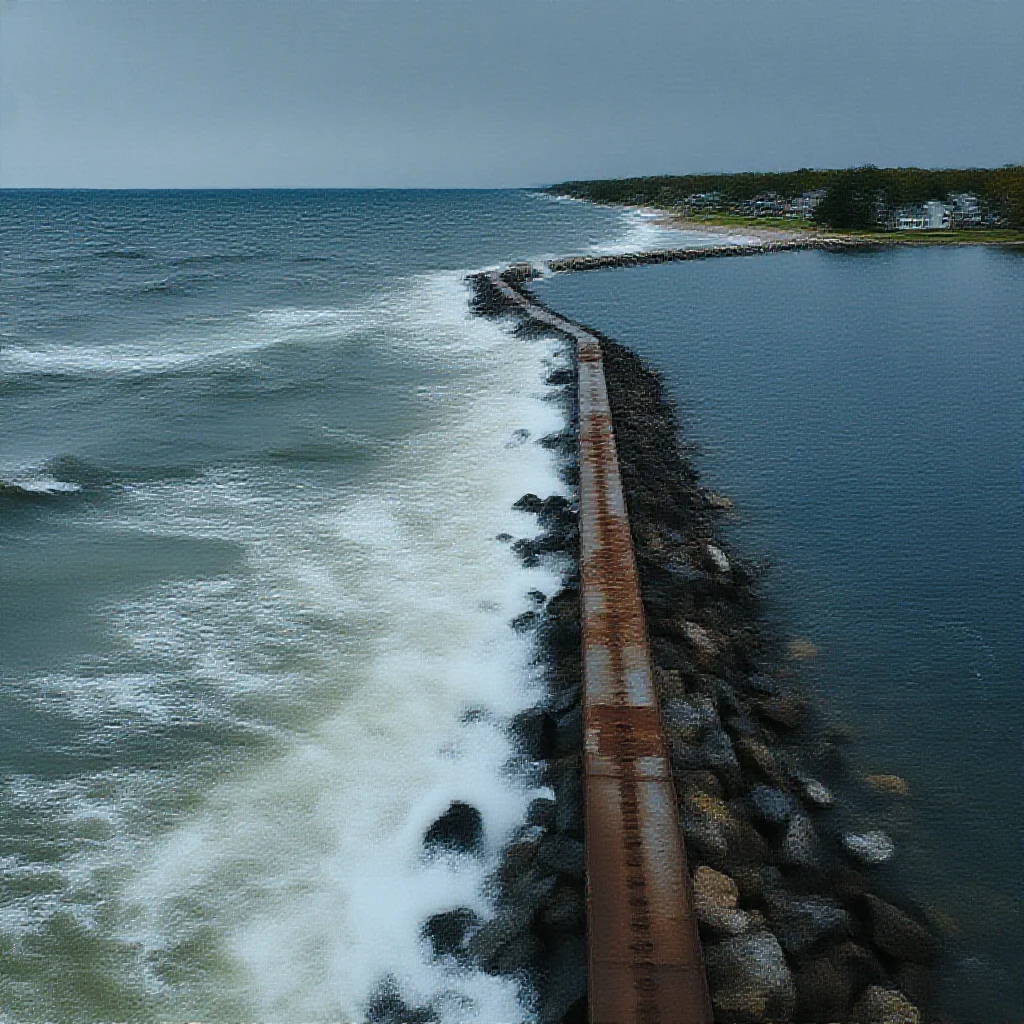
As climate change accelerates erosion along Lake Erie''s shoreline, a critical
The Cost of Holding Back the Tide: Who Pays for Lake Erie's Climate Adaptation?
Introduction: A Shoreline Under Siege
The municipal pier and parking lot in Port Burwell, Ontario, are being consumed. Accelerated erosion, driven by higher water levels and more frequent intense storms on Lake Erie, represents a direct threat to community infrastructure. The conflict is defined by the imperative to protect these assets against an overwhelming financial price tag. This scenario forces a central question of financial responsibility and fairness: should the costs be borne locally, or shared more broadly as a national climate adaptation priority?
The Scale of the Threat: More Than a Local Problem
The erosion threatening Port Burwell is not an isolated incident. A 2020 study by the Insurance Bureau of Canada established that 10% of Canada's coastline is at high risk of erosion (Source 1: Insurance Bureau of Canada, 2020). The localized need is substantial; in nearby Erieau, the estimated cost to repair and extend its existing 1.2-kilometre steel seawall is $20 million. This single project cost must be contextualized within a macro-economic forecast. A 2021 report by the Canadian Climate Institute estimated that climate change could cost Canada's economy $139 billion per year by 2050 (Source 2: Canadian Climate Institute, 2021). The logical deduction is that treating each shoreline erosion project as a discrete municipal issue ignores the systemic, climate-driven nature of the risk. The cause is national and global; the effects are local, but the financial response remains misaligned.
The Funding Gap: Why Current Mechanisms Are Failing
Federal funding mechanisms exist but are insufficient for the scale of the challenge. The federal Disaster Mitigation and Adaptation Fund (DMAF) has allocated $2 billion over ten years for large-scale infrastructure projects. This sum is dwarfed by the cumulative need represented by countless "Erieau-scale" projects required along the Great Lakes and other vulnerable coastlines nationwide. Municipal tax bases, particularly in smaller communities, cannot absorb costs in the tens of millions of dollars. This creates an adaptation deadlock: the need is proven, the engineering solutions are known, but the financial architecture for execution is absent. The perspective of organizations like the Federation of Canadian Municipalities underscores this funding crisis, highlighting that the scale of the challenge far exceeds locally available resources.
The Fairness Doctrine: Local Burden vs. National Priority
The debate over fairness exposes a flawed risk-assessment model in public infrastructure finance. Current models typically price adaptation infrastructure, like a seawall, based on its direct construction cost. This analysis does not account for the cascading economic and social costs of failure: lost property values, business disruption, community displacement, and the eventual cost of emergency response and relocation. The question of who bears the cost presents multiple potential endpoints. If municipalities bear the burden, critical projects may not proceed, transferring risk to property owners and insurers. If the cost is socialized nationally, it raises questions about the allocation of finite public funds. The logical analysis suggests that defining shoreline protection solely as local infrastructure is a categorization error if the destabilizing force is a national climate priority.
Beyond the Seawall: Rethinking the Financial Architecture for Adaptation
The required analysis extends beyond individual construction projects to the design of a new funding ecosystem. A systemic financial response would require mechanisms that account for shared, climate-driven risk. Potential models could include dedicated national adaptation funds with proportional cost-sharing formulas based on municipal fiscal capacity, the development of climate-resilient municipal bonds, or revised insurance frameworks that incentivize protective infrastructure. The future trend indicates that without such an architectural shift, the adaptation gap will widen. Communities with sufficient resources may fortify themselves, while others face gradual decline or catastrophic loss, leading to an inequitable distribution of climate impacts.
Conclusion: An Inevitable Reckoning
The erosion along Lake Erie’s shoreline is a physical manifestation of a financial and policy shortfall. Current mechanisms are inadequate, and the debate over fairness is a symptom of an unaligned risk model. The cause is well-understood; the effect is measurable land loss. The logical endpoint is that the financial responsibility for climate adaptation will be forced to evolve. Market and industry predictions suggest that pressure from municipalities, insurers facing escalating claims, and the quantified economic costs of inaction will necessitate a redefinition of shoreline defense from a local expense to a component of national infrastructure resilience. The alternative is a piecemeal and reactive approach, where the true cost is paid not in budgets, but in lost communities.