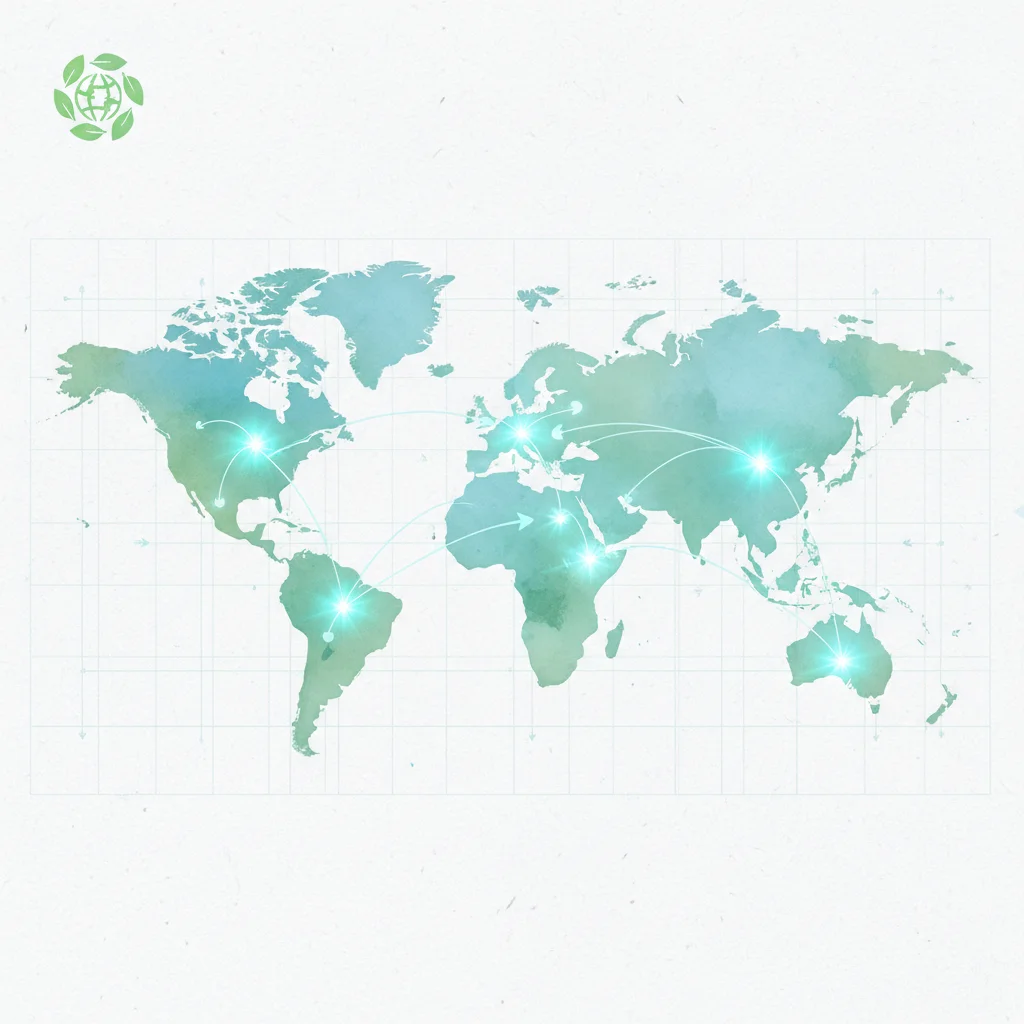
The year 2026 marks a fundamental shift in international business: globalization
International Business Trends 2026: Regional Globalization, Digital Transformation, and Sustainable Operations
Introduction: The End of One-Size-Fits-All Globalization
For decades, the prevailing logic of international business was simple: produce where labor is cheapest, sell where demand is highest, and treat the world as a single, frictionless market. That era has ended. By 2026, the hyper-globalization of the 1990s and 2000s has given way to a far more fragmented—yet arguably more resilient—architecture of interconnected regional clusters.
Three forces are driving this transition. First, digital transformation has fundamentally altered the cost equation of market entry, enabling both small and large firms to experiment across borders with unprecedented speed. Second, sustainability pressure has moved from a branding exercise to a binding operational constraint, reshaping supply chain decisions and access to capital. Third, emerging markets are no longer passive recipients of foreign investment—they are active innovation testbeds, creating products and business models that then flow back to developed economies.
This article provides a deep audit of these shifts, uncovering the hidden economic logic behind the regionalization of trade, the role of digital twins in reducing uncertainty, and the long-term impact on global supply chains. Drawing on insights from Layla Al-Mansoori, Senior Analyst at MENA Business Insight, we explore how businesses can navigate the new landscape.
[IMAGE: Infographic showing the transition from a flat global network to three interconnected regional hubs (Asia-Pacific, Americas, Europe-MENA), with arrows indicating reduced cross-cluster flows]
The Regionalization of Globalization: Clusters as the New Normal
In 2026, companies no longer view the world as a single market but as a set of densely connected regional clusters. The logic is straightforward: operating within a cluster—such as the Americas, Asia-Pacific, or Europe-MENA—offers resilience through proximity, shared regulatory frameworks, and reduced exposure to geopolitical disruptions.
Supply chains have been redesigned accordingly. Nearshoring is now standard practice across industries, from automotive manufacturing in Mexico serving North American markets to semiconductor assembly in Vietnam and Thailand for the Asia-Pacific region. Each cluster develops its own logistics hubs: Rotterdam and Jebel Ali for Europe-MENA, Singapore and Shanghai for Asia-Pacific, and Dallas and Panama for the Americas.
According to a 2025 McKinsey Global Institute analysis, companies that reconfigured their supply chains around regional clusters reduced average lead times by 20-30% compared to those maintaining long, single-source global lines. The trade-off is increased complexity: each cluster requires its own sourcing strategy, regulatory compliance team, and logistics network.
The MENA region is positioning itself as a strategic crossroad between Europe, Asia, and Africa. Layla Al-Mansoori of MENA Business Insight notes: "The UAE, Saudi Arabia, and Egypt are investing heavily in logistics infrastructure and free zones that allow companies to serve three continents from a single node. The key is that this is not just about transshipment—it's about building regional value chains, especially in renewable energy components and agri-tech, where local production is replacing imports."
The long-term impact is clear: reduced dependency on single-source markets—particularly China—but a new set of challenges. Companies must now manage cluster-specific strategies, each with its own currency risks, labor regulations, and consumer preferences. The flat world has been replaced by three-dimensional regional chessboards.
[IMAGE: Map of the world with three highlighted regional clusters (Americas, Asia-Pacific, Europe-MENA) and arrows indicating dense intra-cluster trade flows, with thinner cross-cluster arrows]
Digital Transformation: Lowering Costs of Market Entry Experimentation
One of the most profound shifts in international business is the dramatic reduction in the cost and risk of market entry, enabled by digital tools. In 2026, a company can test a product in multiple regions simultaneously without opening a single physical office, hiring local staff, or committing to long-term leases.
Digital twins—virtual replicas of physical products, supply chains, or even entire factories—allow firms to model market dynamics before making real-world investments. A small electronics manufacturer in Germany, for example, can create a digital twin of its supply chain to simulate disruptions in Southeast Asia, test alternative logistics routes, and evaluate the impact of tariff changes—all before shipping a single unit. The cost of running such simulations has fallen by more than 60% since 2022, thanks to cloud computing and AI-driven analytics.
AI-powered market simulations further reduce uncertainty. Platforms like those developed by BCG’s digital ventures unit now allow companies to input product specifications, pricing, and target demographics, then generate demand forecasts, competitor responses, and optimal entry strategies for dozens of countries within hours. "The era of big upfront bets is over," says a BCG report on digital commerce from early 2026. "Experimentation is no longer a luxury reserved for large multinationals; it is a core strategy for any firm looking to cross borders."
For SMEs, this shift is transformative. Virtual storefronts on cross-border e-commerce platforms such as Amazon Global, Alibaba.com, and regional players like Noon in the MENA region allow small businesses to list products in multiple markets with minimal investment. Data from McKinsey’s 2025 SME Digitization Survey indicates that nearly 40% of SMEs engaged in cross-border e-commerce used virtual product testing or market simulation tools before launching in a new region—up from just 12% in 2022.
The hidden economic logic is that digital tools have shifted from cost centers to revenue enablers. Instead of viewing technology as a necessary overhead, companies now treat it as a core driver of market-entry experimentation. The ability to fail fast, learn, and pivot is becoming a competitive advantage.
[IMAGE: Split screen: left side showing a physical product (e.g., a consumer electronics item), right side a digital twin with data overlays, market simulation charts, and demand forecast graphs]
Sustainability as an Operational Requirement: From Branding to Bottom Line
Sustainability in 2026 is no longer a marketing tagline or a reporting exercise. It has become a binding operational requirement that affects sourcing decisions, logistics routes, product design, and—perhaps most significantly—access to financing.
Green loans and sustainability-linked bonds now account for over a third of corporate debt issuance in major economies, according to the International Capital Market Association. Companies that fail to meet environmental, social, and governance (ESG) targets face higher interest rates, restricted credit lines, and in some cases exclusion from supply chains altogether. Walmart, for instance, announced in early 2026 that it would impose a 2% surcharge on suppliers that do not meet its carbon footprint reduction milestones. This is not a pilot program—it affects over 10,000 suppliers globally.
The operational implications are profound. Sourcing decisions now incorporate carbon accounting alongside cost and quality. Logistics routes are optimized not just for speed but for emissions intensity. A growing number of firms use AI-driven carbon calculators to compare shipping via rail, sea, or air across different regional clusters. The Port of Rotterdam has introduced a "green routing" system that discounts fees for vessels using alternative fuels or meeting efficiency thresholds.
Layla Al-Mansoori observes that in the MENA region, sustainability is reshaping investment patterns: "Saudi Arabia's NEOM and the UAE's Masdar City projects are not just about clean energy—they are about creating entire supply chains for green hydrogen and solar components that can serve Europe and Africa. Companies that want to participate in these ecosystems must meet strict sustainability criteria from day one."
A 2025 BCG study on sustainable operations found that firms that embedded sustainability into core operational processes—rather than treating it as a separate compliance function—achieved 15-20% lower total cost of ownership over a five-year horizon. The driver: energy efficiency, waste reduction, and lower regulatory penalties. Sustainability has moved from a cost of doing business to a source of operational competitive advantage.
[IMAGE: Graphic showing a supply chain map with carbon footprint overlays on different routes, plus a pie chart indicating the share of green loans in corporate financing]
Emerging Markets as Innovation Testbeds
The flow of innovation is no longer one-way—from developed to developing economies. In 2026, emerging markets are increasingly functioning as testbeds for products, business models, and technologies that then scale globally.
India, for example, has become the world's leading laboratory for low-cost medical devices, digital payment systems, and agricultural drones. Companies from Siemens Healthineers to local startups test products in India's price-sensitive, high-volume market before rolling them out in Southeast Asia and Africa. Similarly, Kenya's mobile money ecosystem (M-Pesa) has inspired a wave of fintech platforms across Latin America and South Asia.
The logic is simple: emerging markets offer high demand growth, lower regulatory barriers for pilot projects, and a willingness among consumers to try new digital services. A report from McKinsey's Global Institute in early 2026 noted that 55% of new product launches in consumer electronics and fintech were first tested in an emerging market—up from 35% in 2020.
For international businesses, this means treating emerging markets not as secondary sales outlets but as core R&D and innovation hubs. Companies that establish local innovation centers—such as Samsung's R&D labs in Vietnam and Brazil—gain access to talent, consumer insights, and manufacturing capabilities that can be leveraged globally.
[IMAGE: World map with hotspots over emerging market innovation hubs (India, Kenya, Vietnam, Brazil), connected by dotted lines to developed markets, indicating reverse innovation flows]
Cross-Border E-Commerce: Empowering SMEs with New Challenges
Cross-border e-commerce continues to grow at double-digit rates in 2026, driven by platforms that lower the barriers for small and medium-sized enterprises. According to data from eMarketer, cross-border online sales are expected to exceed $1.5 trillion in 2026, with SMEs accounting for nearly 45% of that volume.
The empowerment is real: a small artisan coffee roaster in Colombia can now sell directly to customers in Japan through an e-commerce marketplace without needing a local distributor. Platforms handle payment, logistics, and even customs clearance through integrated services like Amazon Global Logistics or Alibaba's Cainiao network.
But execution hurdles are significant. Tariff complexity, especially after recent trade policy changes in the US and EU, requires SMEs to navigate a maze of rules of origin and duty rates. Returns management remains a nightmare—returning a damaged product from a customer in Germany to a seller in Thailand can cost more than the product itself. Fraud and intellectual property risks also persist.
The key for SMEs is to use digital tools strategically. Companies like Pitney Bowes and DHL offer parcel-level compliance software that automates tariff classification and customs documentation. Virtual assistants powered by generative AI help small businesses answer customer inquiries in multiple languages. "The winners are those who treat cross-border e-commerce as a data-rich experiment, not just a sales channel," notes a BCG report on SME digital trade.
[IMAGE: Dashboard showing cross-border e-commerce metrics for an SME: sales by region, return rates, tariff costs, customer satisfaction scores]
Conclusion: Building Resilient Strategies for 2026
The trends outlined here are not passing fads. Regional globalization, digital transformation, sustainability as an operational requirement, emerging market innovation, and cross-border e-commerce for SMEs are reshaping the fabric of international business. Companies that treat these as independent phenomena will struggle. Those that see the interconnections—for example, using digital twins to test sustainable supply chain configurations in an emerging market cluster before scaling—will gain a durable edge.
Resilience in 2026 means building strategies that are adaptable, data-driven, and regionally aware. It means investing in digital experimentation tools, embedding sustainability into operations, and recognizing that emerging markets are sources of innovation, not just revenue. As Layla Al-Mansoori puts it: "The companies that succeed will be those that understand that 2026 is not about bigger globalization—it's about smarter, more connected localization at scale."
[IMAGE: Illustration of a globe with three distinct but interconnected clusters, each containing icons for digital twin, green leaf, and SME storefront, all connected by a circular data flow]