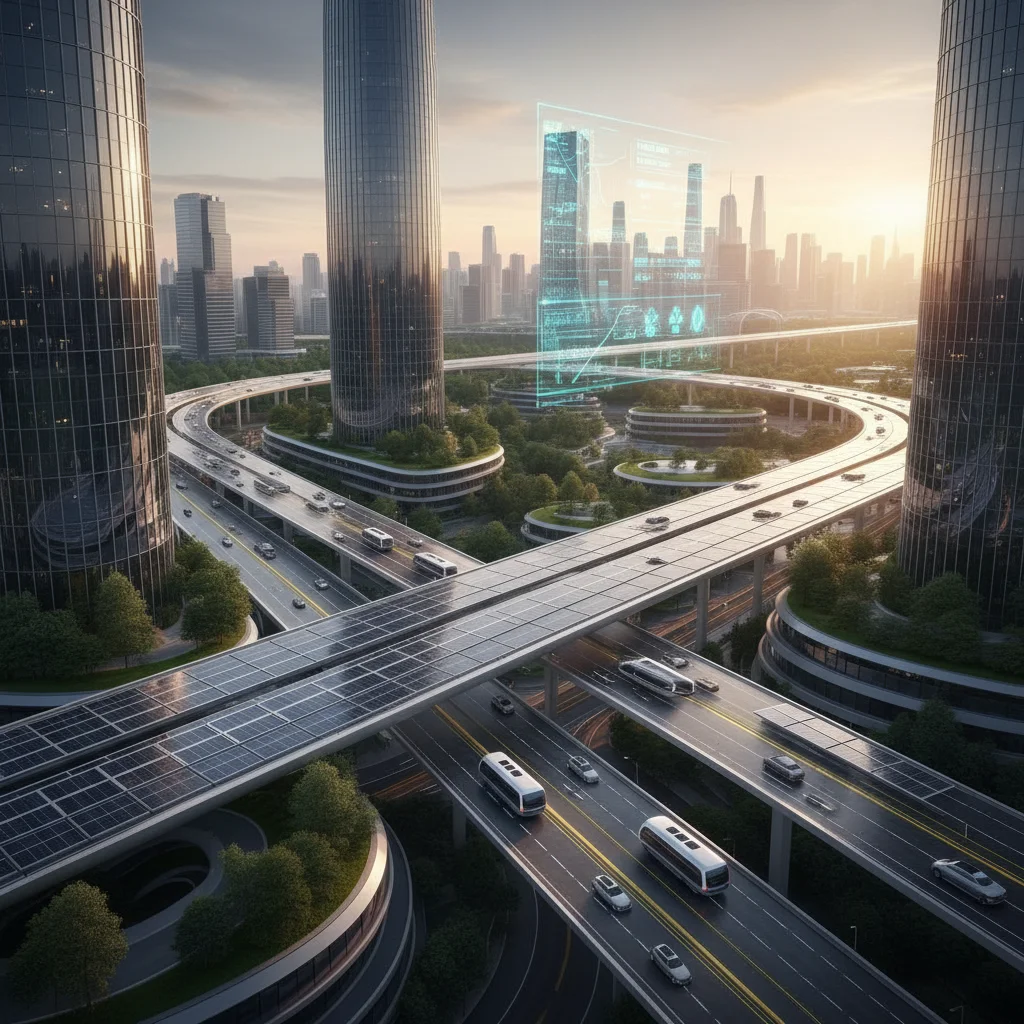
As the world hurtles toward 2025, infrastructure and transportation face
``markdownInfrastructure and Transportation in 2025: Decoding the Next Wave of Global Trends
As the world hurtles toward 2025, infrastructure and transportation face a convergence of pressures: climate resilience, digital disruption, fiscal constraints, and shifting geopolitical dynamics. This article unpacks the hidden economic logic behind four emerging trends—green adaptation, smart mobility platforms, modular construction, and new financing models—and examines their long-term impact on global supply chains, urban planning, and policy frameworks. Drawing on industry reports and expert projections, it offers a strategic roadmap for decision-makers navigating this complex landscape.
---
1. The Great Rebalancing: Why Infrastructure is No Longer Just Concrete and Steel
For decades, infrastructure investment was measured in lane-miles, megawatts, and cubic meters of concrete. By 2025, that calculus has fundamentally shifted. The core thesis driving global infrastructure strategy is no longer about capacity alone—it is about the ability to absorb shocks. Climate events, cyberattacks, and supply chain disruptions have rewritten the risk matrix.
Consider the Dutch "Room for the River" program, which transformed flood management from building higher dikes to giving rivers space to overflow safely. Contrast this with traditional US coastal defenses, many of which were designed for static sea levels now obsolete. The metric that matters has changed: the industry now evaluates projects on "resilience per dollar" rather than "cost per mile."
[IMAGE: Split image: left side shows a traditional highway under construction, right side shows a smart bridge with sensors and solar panels.]
The World Economic Forum’s Global Risks Report 2025 (projected) reinforces this: extreme weather events rank as the top short-term risk, while cyber insecurity sits among the top five long-term threats. Infrastructure that cannot withstand a Category 5 storm or a ransomware attack is already considered stranded capital. This rebalancing is forcing a reallocation of public funds—from purely expansionary projects to retrofitting and redundancy.
---
2. Digital Twins and the 'Soft Infrastructure' Revolution
While physical infrastructure grabs headlines, the silent revolution is happening in the digital layer. Digital twin technology—virtual replicas of physical assets that update in real time—has moved from pilot projects to operational scale. Entire transport networks now have living digital shadows that enable predictive maintenance, dynamic tolling, and traffic optimization.
The economic logic is compelling. McKinsey estimates that digital twins can reduce lifecycle costs of infrastructure by 20–30%. Beyond savings, they unlock new revenue streams through data monetization: real-time occupancy data for retail zones, congestion pricing algorithms, and insurance risk models.
[IMAGE: 3D digital twin interface showing a city's traffic flow with color-coded congestion hot spots.]
Singapore remains the benchmark. Its virtual island model, developed in partnership with national agencies, simulates land-use changes, transport flows, and environmental impacts simultaneously. By 2025, similar standards have been adopted by cities from Helsinki to Riyadh. The key insight: "soft infrastructure"—sensors, data platforms, AI analytics—is now a prerequisite for any major physical project seeking financing from climate-conscious lenders.
---
3. The Rise of Autonomous Corridors and Last-Mile Pods
Autonomous vehicles have been "five years away" for a decade. But by 2025, a clear bifurcation has emerged. Highway truck platooning—where multiple autonomous trucks follow a lead vehicle at close distances—is already commercially viable on dedicated corridors in Texas, Germany, and China. The fuel savings (up to 10% from reduced aerodynamic drag) and driver shortage mitigation are too compelling to ignore.
Urban autonomous shuttles, however, remain in regulatory limbo. The real bottleneck is not technology but liability distribution: if a shuttle hits a pedestrian, who pays—the manufacturer, the software developer, the fleet operator, or the city? Insurance frameworks are scrambling to catch up.
[IMAGE: Autonomous electric truck platoon on a dedicated lane, with a control center dashboard in the corner.]
Pilot programs reveal the hidden market dynamics. Texas passed "right-to-tow" laws allowing autonomous truck operators to recover costs from at-fault human drivers. Germany designated autonomous shuttle zones with modified traffic codes. Meanwhile, the insurance industry is pivoting to usage-based models, where premiums are calculated per mile driven under autonomous mode vs. manual. This shift unlocks a new asset class: data-rich insurance products that could reshape public-private partnerships in mobility.
---
4. Modular Construction: The Unseen Supply Chain Disruption
While most attention focuses on high-tech vehicles, a quieter upheaval is occurring in how infrastructure is built. Modular prefabrication—assembling bridge segments, tunnel rings, and station components in factories—has moved from niche to mainstream. The advantages are clear: on-site labor reduced by 40%, construction time cut by 30%, and carbon emissions lowered through controlled manufacturing processes.
Yet the supply chain implications are profound. Oversized modules require specialized transport—wide-load trucks, barge convoys, and rail flatcars—that create new corridor bottlenecks. Ports must upgrade cranes and storage yards to handle 50-ton prefabricated pieces. Inland assembly yards become critical nodes, often located far from traditional construction depots.
[IMAGE: A factory floor producing modular bridge segments, with a truck carrying a completed section to a construction site.]
The long-term impact is a geographical rebalancing of manufacturing hubs. Coastal zones, with easy port access, attract large prefabrication factories. Inland regions become assembly and finishing centers. This shifts shipping routes: instead of bulk raw materials (cement, steel rebar) moving to dispersed construction sites, finished modules move from a few mega-factories to regional hubs. Logistics planners must rethink everything from warehouse location to truck chassis design.
---
5. Green Fuel Hubs and the Hydrogen Infrastructure Gamble
The energy transition has created a new class of infrastructure: fuel hubs for alternative propulsion. Battery electric vehicles dominate passenger cars, but heavy trucking, shipping, and aviation require high-density energy carriers. Hydrogen has emerged as the leading candidate, but building the distribution network is a multi-trillion-dollar gamble.
By 2025, a patchwork of green fuel hubs is emerging. Rotterdam, the world’s largest port outside Asia, has committed to becoming a hydrogen import and distribution hub, with pipelines connecting to German industrial centers. Chile’s Atacama Desert hosts massive solar-powered electrolysis plants producing green ammonia for shipping. Yet the economics remain fragile: hydrogen storage and transport costs are still 3–5 times higher per unit of energy than natural gas.
[IMAGE: A futuristic hydrogen refueling station for heavy trucks, with electrolyzer tanks and a solar canopy in the background.]
The geopolitical dimension is unavoidable. Countries with abundant renewable energy or natural gas reserves (for blue hydrogen with carbon capture) become new energy exporters, potentially reshaping alliances. For policymakers, the challenge is avoiding stranded assets: hydrogen infrastructure built today could be obsolete if battery technology or synthetic fuels leapfrog it. Decision-makers are therefore adopting "phased scalability"—starting with small, flexible hubs that can expand or pivot based on market signals.
---
6. New Financing Models: Resilience Bonds and Outcome-Based PPPs
Traditional public-private partnerships (PPPs) are being reinvented to address the risk profile of 2025 infrastructure. Climate resilience has introduced "green bonds" and "resilience bonds" that tie interest rates to performance metrics—if a seawall prevents flooding, investors earn a premium; if not, they share the loss.
More radically, outcome-based PPPs are gaining traction. Instead of paying a contractor for building a road, governments pay for the outcome—reduced travel time, lower accident rates, or improved air quality. This aligns incentives but requires sophisticated monitoring systems (digital twins again) and trust in data sharing.
[IMAGE: Infographic showing a circular flow: investor capital → infrastructure project → performance metrics → returns tied to resilience outcomes.]
The World Bank’s 2025 Infrastructure Finance Report notes that blended finance—mixing concessional capital from development banks with private investment—is the fastest-growing segment. These structures are particularly suited to climate-adaptation projects, where the financial returns are long-term and hard to quantify. The hidden challenge is standardization: each project requires bespoke legal and financial engineering, raising transaction costs. Industry bodies are now pushing for "resilience metrics templates" to streamline deals.
---
Conclusion: From Building to Weaving
Infrastructure and transportation in 2025 are no longer about laying concrete or stringing steel—they are about weaving together physical assets, digital intelligence, and financial innovation into a system that can bend without breaking. The trends outlined—green adaptation, digital twins, autonomous corridors, modular construction, hydrogen hubs, and outcome-based finance—are not isolated. They reinforce each other: modular construction reduces the carbon footprint of digital-twin-enabled smart roads; green fuel hubs rely on resilient supply chains; new financing models make pilot projects bankable.
For decision-makers, the roadmap is clear: invest in data platforms before pouring concrete, design for flexibility over optimization, and align incentives across public and private sectors. The next wave of global infrastructure will not be judged by how big it is, but by how smart it is—and how well it survives the shocks that are sure to come.
``