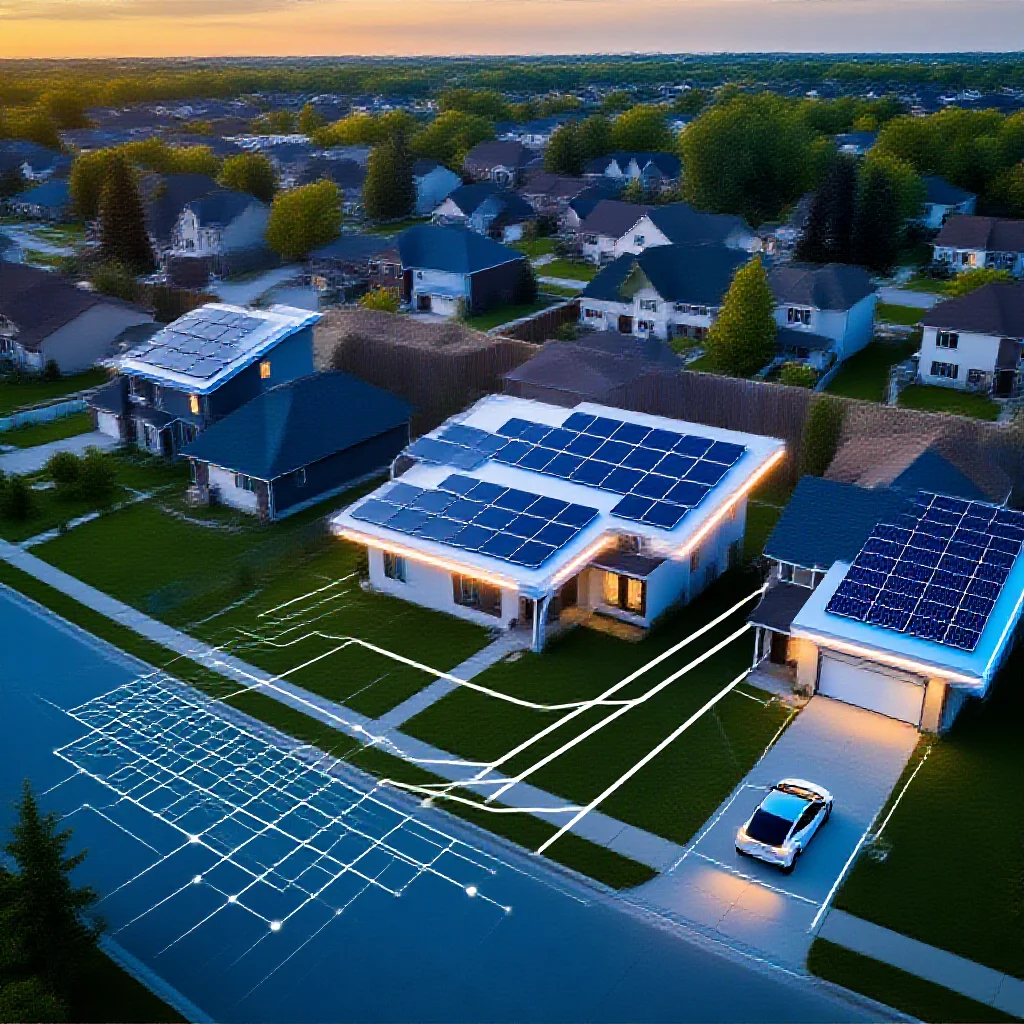
A new, federally-funded program offering free expert guidance on rooftop
Beyond the Panels: How a GTHA Solar Guidance Program Reveals Canada's Strategic Energy Shift
Introduction: The Grant as a Signal, Not Just a Subsidy
A new program now offers homeowners in the Greater Toronto and Hamilton Area free expert guidance on installing rooftop solar panels. This service is funded by a federal grant of $600,000, administered by the non-profit organization SolarShare (Source 1: [Primary Data]). The initiative's existence prompts a structural analysis beyond its immediate utility. The critical inquiry is not the service itself, but the origin of its funding and the selection of its administrator. The financial backing comes from Natural Resources Canada's Zero-Emission Vehicle Awareness Initiative (Source 1: [Primary Data]). This allocation reveals a tactical intervention designed to accelerate a systemic shift toward a decentralized, resilient, and consumer-driven energy grid. The program functions as a market catalyst, aiming to de-risk consumer adoption and stimulate local green economies.
Decoding the Funding: The Hidden Link Between EVs and Home Solar
The strategic significance of this program is illuminated by its funding source. The capital originates from a federal initiative explicitly focused on zero-emission vehicle awareness, not traditional energy infrastructure (Source 1: [Primary Data]). This linkage is not bureaucratic coincidence but reflects a coherent, if under-publicized, policy logic. The widespread adoption of electric vehicles represents a substantial increase in residential electricity demand. Rooftop solar generation directly offsets this new demand at its source. This convergence mitigates potential strain on the centralized grid during peak charging periods and enhances the environmental efficacy of electric vehicles by powering them with locally generated renewable energy. The policy approach tackles the integrated energy profile of a household—transportation and shelter—as a single system. Funding solar guidance through a vehicle initiative demonstrates an understanding that these technologies are interdependent components of a broader electrification strategy.
SolarShare's Role: The Non-Profit as a Trust Catalyst in a Fragmented Market
The selection of SolarShare, a non-profit renewable energy co-operative, as the program administrator is a deliberate structural choice. A government agency or for-profit entity could have executed similar functions. The deployment of a non-profit acts as a trust catalyst in a consumer market characterized by fragmentation, confusing sales tactics, and varying installer quality. Non-profit entities are perceived as providing neutral, educational guidance, reducing the perceived risk for homeowners navigating a complex purchase decision. SolarShare's model likely focuses on aggregating consumer interest and providing standardized, vetted information. This approach directly targets the "soft costs" of residential solar adoption—the non-hardware expenses related to customer acquisition, system design, permitting, and financing. In North American markets, these soft costs constitute a significant portion of the total system price. By providing free, expert guidance, the program aims to compress these market inefficiencies and lower the effective barrier to entry.
The Long-Term Play: Building a Distributed Grid for Resilience and Stability
The ultimate strategic objective extends beyond individual homeowner savings or even aggregated emissions reductions. Widespread adoption of rooftop solar photovoltaic systems transforms the electricity grid's architecture. It creates a distributed network of micro-generation assets. This distribution enhances grid resilience by reducing reliance on a small number of large, centralized power plants and long-distance transmission lines, which are vulnerable to extreme weather events and other disruptions. Furthermore, distributed generation can provide localized voltage support and reduce transmission losses. For utility planners, a predictable and managed growth of distributed energy resources allows for more efficient infrastructure investment and deferred capital expenditure on centralized generation and wires. The program, therefore, is a low-cost investment in gathering deployment data, understanding adoption patterns, and fostering a skilled installer base in Canada's most populous region. These are foundational elements for managing a future grid where energy production is increasingly consumer-owned and decentralized.
Conclusion: A Blueprint for Strategic Market Transformation
The GTHA solar guidance program is a blueprint for strategic market transformation. It utilizes a relatively modest federal investment to address multiple points of market failure simultaneously: consumer information asymmetry, high soft costs, and the strategic disconnect between transportation and building electrification. The program's design indicates a policy evolution from direct hardware subsidies to interventions that improve market function and build long-term capacity. The logical prediction is that similar programs will emerge in other urban centers, contingent upon the evaluation of key performance indicators from this initiative, such as reduction in customer acquisition costs for installers, increased installation rates, and improved consumer satisfaction metrics. Furthermore, utility regulatory frameworks will require continued adaptation to integrate and value the grid services provided by distributed resources. This program is a single node in a broader re-engineering of the energy system, positioning consumer-owned generation as a critical component of national infrastructure resilience and decarbonization.