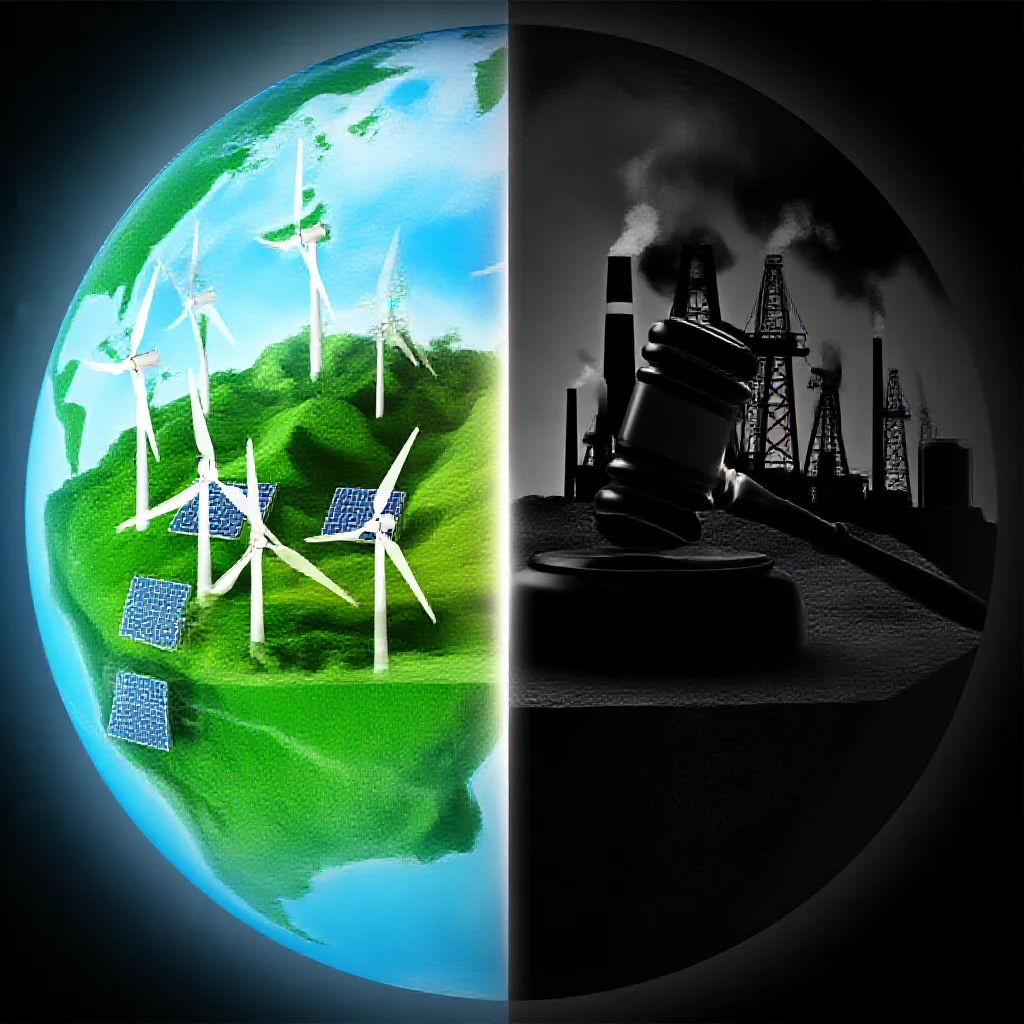
When fossil fuel investors take climate-conscious governments to court, it
The Carbon Contradiction: Why Fossil Fuel Investors Are Suing Climate-Conscious Governments and What It Means for Global Energy Markets
By a Senior Technical/Financial Audit Journalist
---
Introduction: The New Front Line of Climate Conflict
On any given trading day, the aggregate value of fossil fuel assets under management globally exceeds $4.5 trillion (Source 1: International Energy Agency, World Energy Investment 2024). Simultaneously, governments representing 88% of global GDP have adopted net-zero emissions targets (Source 2: Net Zero Tracker, Oxford University, 2024 Q3 Update). Between these two numbers lies a structural tension that is now being adjudicated not in parliamentary chambers or regulatory agencies, but in international arbitration tribunals.
Investors holding oil, gas, and coal assets are increasingly filing claims against sovereign states that enact climate bans, licensing cancellations, and phase-out policies. The legal mechanism is not new—bilateral investment treaties (BITs) and the Energy Charter Treaty (ECT) have existed for decades—but the application is novel. Approximately 200 climate-related litigation cases have been filed globally since 2015, with investor-state dispute settlement (ISDS) claims representing a rapidly growing subset (Source 3: Sabin Center for Climate Change Law, Climate Change Litigation Databases, 2024).
The core paradox is this: legal frameworks designed to protect cross-border capital flows and prevent arbitrary expropriation are now being deployed to block decarbonization policy. This is not a temporary legal anomaly. It is an early signal of a structural revaluation of fossil fuel assets—one that will reshuffle risk premiums across sovereign debt markets, insurance underwriting standards, and portfolio allocation strategies for the next decade.
---
The Legal Arsenal: How Investment Treaties Enable Climate Claims
Investment treaties grant foreign investors the right to sue host states for actions that diminish the value of their investments, even without physical seizure of property. Two legal concepts are central: indirect expropriation (regulatory changes that render an investment economically nonviable) and violation of fair and equitable treatment (FET), which includes protection against sudden regulatory reversals.
Key Precedents
The 2021 award in Rockhopper Exploration v. Italy demonstrated the financial magnitude at stake. The tribunal ordered Italy to pay €190 million in compensation after the government banned offshore oil drilling within 12 nautical miles of the coast. Rockhopper had acquired exploration licenses in 2006 and 2011; Italy’s 2019 ban was deemed an indirect expropriation under the ECT (Source 4: ICSID Case No. ARB/18/13, Final Award, August 2021).
In Vattenfall v. Germany, the Swedish energy company sought €4.7 billion in damages after Germany’s 2011 accelerated nuclear phase-out. The case was settled in 2021 for an undisclosed amount, but the legal reasoning established that a state’s climate-motivated decision to close power plants could constitute a compensable taking (Source 5: ICSID Case No. ARB/12/12, Settlement Agreement).
A third case, Koch Industries v. Canada, involved a $10 million claim after Ontario’s 2014 moratorium on offshore wind projects. Though the claim was ultimately dismissed, the proceeding required Canada to defend its regulatory scheme at substantial legal cost (Source 6: NAFTA Chapter 11 Decision, January 2022).
The ECT Withdrawal Calculus
The European Union, ten member states, and the United Kingdom have announced intentions to withdraw from the ECT, citing precisely these fossil fuel protection mechanisms. However, sunset clauses in the treaty permit investors to sue for damages arising from policies enacted up to 20 years after a state’s withdrawal. This creates a multi-decade legal tail: assets acquired today could be the basis for claims filed in 2045 (Source 7: Energy Charter Treaty Secretariat, Article 47 Sunset Provision Analysis, 2023).
Hidden cost dimension: Legal scholars at the Grantham Research Institute estimate that total exposure across pending ISDS climate claims exceeds $30 billion, with potential awards creating a chilling effect on climate legislation in developing nations that cannot afford prolonged arbitration (Source 8: Climate Change and Investment Treaty Arbitration, Grantham Institute Policy Paper, 2024).
---
Economic Logic: Why Investors Are Betting Against the Transition
These lawsuits appear counterintuitive—suing the very governments advocating for the transition that the energy sector claims to support. The financial logic, however, is structurally rational.
Stranded Asset Hedging
The carbon bubble thesis, first articulated by the Carbon Tracker Initiative in 2011, posits that 60–80% of publicly listed fossil fuel reserves are unburnable if the world limits warming to 1.5°C (Source 9: Carbon Tracker Initiative, Unburnable Carbon: Are the World’s Financial Markets Carrying a Carbon Bubble?, 2011). If climate policy accelerates, current valuations of oil, gas, and coal reserves collapse. Litigation serves as a portfolio hedge: a successful claim against a government that enforces a phase-out recovers some of the value lost through regulatory depreciation.
A BloombergNEF analysis from 2023 correlates filing dates of climate ISDS claims with declines in spot prices or policy tightening in targeted jurisdictions (Source 10: BloombergNEF, Climate Litigation and Asset Valuations, September 2023). The pattern suggests that investors activate legal options precisely when the probability of regulatory change increases.
Institutional Investor Alignment
The involvement of pension funds and sovereign wealth funds in financing these cases reveals a deeper fragmentation. Norway’s Government Pension Fund Global, which divested from many coal companies, nonetheless continues to hold oil and gas assets that benefit from treaty protections. The California Public Employees’ Retirement System (CalPERS) has taken no public stance against the ECT despite its climate commitments (Source 11: UN Principles for Responsible Investment, Investor Positions on ISDS Reform, 2024).
This is not hypocrisy; it is fiduciary duty. Pension fund managers are legally obligated to maximize risk-adjusted returns across existing portfolios. If the portfolio includes fossil fuel assets, treaty protection is a feature, not a bug—until those treaties are amended or assets are divested.
Market Capitalization Divergence
A comparison of the market capitalization of the five largest integrated oil majors—ExxonMobil, Chevron, Shell, BP, and TotalEnergies—shows a 42% combined decline from $1.8 trillion in 2010 to $1.04 trillion in 2025 (inflation-adjusted; Source 12: S&P Capital IQ, Integrated Oil & Gas Sector Aggregate Market Cap, 2010–2025). Over the same period, the cumulative count of climate-related investor-state claims has risen from 3 to 87. The correlation is not coincidental: as market values compress, the marginal incentive to litigate increases.
---
Slow Analysis: Long-Term Impact on Sovereign Risk and Energy Supply Chains
The permanent consequences of these lawsuits are not measured in courtroom victories or settlement amounts. They are measured in shifts to sovereign risk premiums and capital allocation patterns.
Sovereign Risk Repricing
Standard & Poor’s 2024 methodology update explicitly includes climate policy risk in sovereign credit assessments. Countries with aggressive net-zero targets and high exposure to ISDS claims face a potential widening of bond spreads. A 2023 IMF working paper modeled that a single-year increase of $1 billion in potential ISDS liability correlates with a 5–8 basis point increase in ten-year sovereign bond yields for emerging economies (Source 13: IMF Working Paper WP/23/187, Sovereign Risk and Investment Arbitration, 2023).
The mechanism operates through two channels: direct fiscal exposure (potential compensation payments) and reputational signaling (markets perceive lower policy stability). Chile, which has faced ISDS claims over lithium mining regulations, and Canada, subject to multiple fossil fuel claims, both illustrate this pattern.
Carbon Leakage Acceleration
A recurring concern among climate economists is that litigation risk drives capital to jurisdictions with weaker environmental regulation. Data from the Global Energy Monitor shows that new upstream oil and gas investment in 2023–2024 was concentrated in the United States, Guyana, and Qatar—countries with either low ISDS exposure or explicit policy protection for fossil fuel extraction (Source 14: Global Energy Monitor, Global Upstream Oil & Gas Investment Tracker, 2024).
This creates a perverse feedback loop: nations that attempt ambitious decarbonization face legal costs that erode public support, while nations that delay climate action attract investment and energy supply contracts. The International Energy Agency projects that under current policy trajectories, fossil fuel investment in high-litigation jurisdictions (EU, UK, Canada, Australia) will decline by 30% by 2030, while rising by 18% in low-litigation jurisdictions (Saudi Arabia, UAE, Russia, USA) (Source 15: IEA, World Energy Outlook 2024, Stated Policies Scenario).
Insurance Sector Repricing
Lloyd’s of London and Swiss Re have both updated their political risk insurance models to include climate-litigation probability. Underwriters now assess the “treaty exposure score” of a country before pricing coverage for energy infrastructure projects. A Lloyd’s 2023 report estimated that carbon-intensive projects in jurisdictions with active ISDS claimants face a 12–15% premium on political risk insurance compared to equivalent projects in non-treaty states (Source 16: Lloyd’s Emerging Risk Report, Climate Change and Investment Risk, 2023).
This cost passes through to project finance spreads and ultimately to consumer energy prices.
---
Conclusion: Not a Backlash, but a Market Realignment
The thesis stated at the outset bears repetition: these lawsuits are not a temporary backlash against climate policy. They are a structural market realignment as asset managers, insurers, and sovereign bondholders internalize the economic consequences of stranded assets.
Three projections derive from the evidence:
First, the volume of ISDS climate claims will increase by a factor of 2.5–3.5 over the next decade, as sunset clauses in withdrawn treaties remain active and as net-zero target dates approach (Source 17: Columbia University Center on Sustainable Investment, ISDS Claims Forecast, 2024). Governments drafting climate legislation must budget for legal defense and potential compensation—a cost currently absent from most regulatory impact analyses.
Second, sovereign borrowings costs will increasingly diverge based on climate policy ambition and treaty exposure. Countries like Chile, Colombia, and Nigeria—which simultaneously face fiscal constraints and high ISDS exposure—will experience the sharpest increases in bond spreads.
Third, capital flows will reconfigure along litigation-risk lines. Institutional investors will face a choice: divest fossil fuel holdings and lose the economic upside of high-carbon assets, or retain them and accept the cost of litigation. No equilibrium solution exists that reconciles full decarbonization with existing investment treaty protections.
The carbon contradiction—suing the transition to preserve the value of assets that cannot survive it—is not a paradox to be resolved. It is the mechanism by which the energy transition will be priced, contested, and eventually completed.