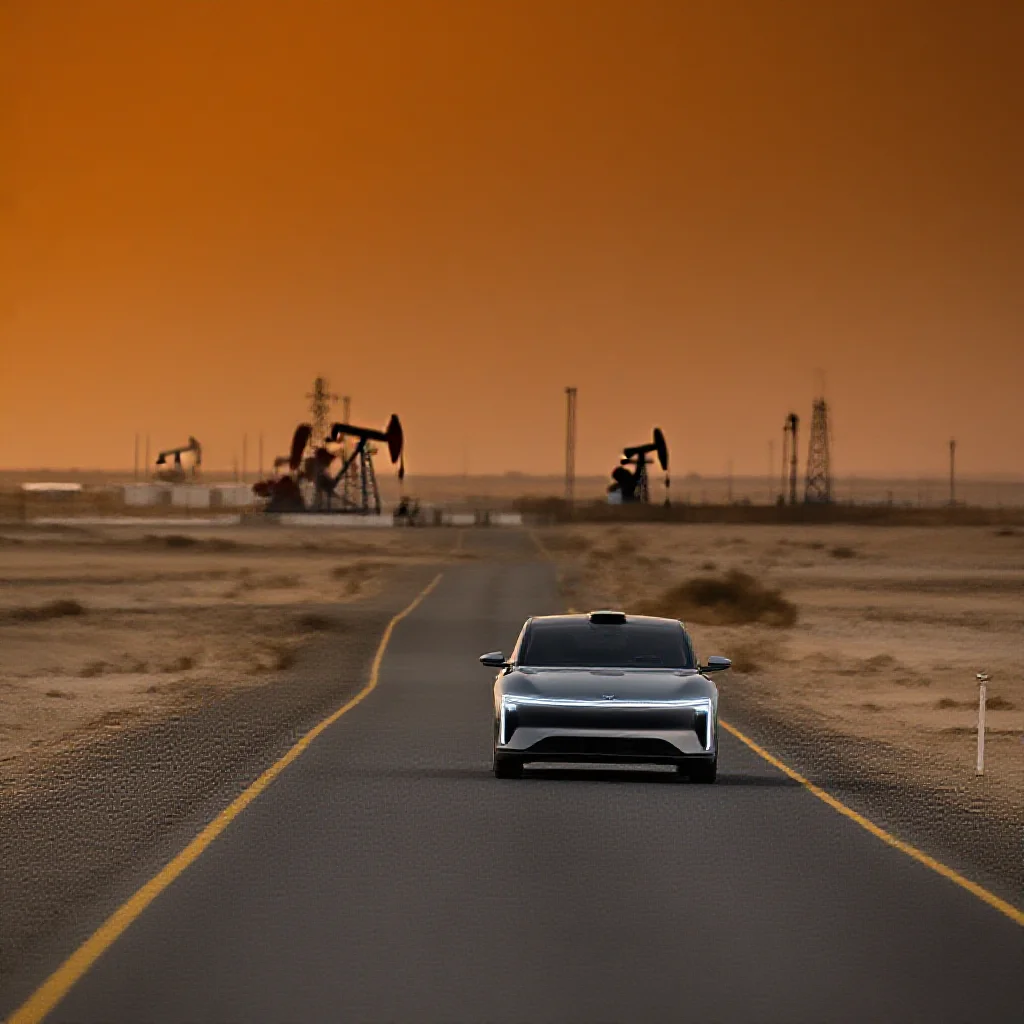
The rise of electric vehicles is not just a technological shift but a direct
EVs vs. Petro-States: How Electric Vehicles Are Undercutting Iran's Oil Exports and Accelerating the Global Energy Shift
A fundamental recalibration of global energy markets is underway, driven not solely by policy mandates but by the incremental, cumulative displacement of oil demand. Analysis indicates that the growth of the global electric vehicle fleet has already offset a volume equivalent to approximately 70% of Iran's pre-sanction oil export capacity. This displacement functions as a market-imposed constraint, distinct from geopolitical sanctions, with direct implications for vulnerable petro-state economies. Concurrently, recent global crises have acted as a potent accelerant for this transition, exposing systemic fragilities and compelling a strategic pivot toward energy sovereignty. The convergence of these trends suggests a restructuring of oil supply chains and producer economics is occurring faster than traditional demand models forecast.
The Silent Sanction: Decoding the 70% Figure
The assertion that electric vehicles have displaced the equivalent of 70% of Iran's oil exports requires precise economic contextualization. Prior to the reimposition of stringent international sanctions, Iran exported roughly 2.5 million barrels of crude oil and condensates per day. The global EV fleet, comprising over 30 million vehicles by the end of 2023, is estimated to have displaced approximately 1.8 million barrels of oil demand per day globally (Source 1: IEA Global EV Outlook 2024). This figure aligns closely with 70% of Iran's former export volume.
The economic logic extends beyond a simple volume comparison. This displacement represents a form of demand destruction that disproportionately impacts marginal producers. In a market where demand growth is curtailed, competition intensifies for the remaining market share. Producers with lower production costs and more stable geopolitical relationships are better positioned to retain buyers. Consequently, the oil displaced by EVs effectively shrinks the addressable market for higher-cost, geopolitically constrained producers like Iran, suppressing potential revenue and exacerbating fiscal pressures. The impact is not merely on lost sales but on the long-term valuation of reserves and infrastructure, elevating stranded asset risk.
Crisis as Catalyst: How Global Shocks Turbocharge the Transition
Recent geopolitical conflicts and associated energy price volatility have functioned as a profound accelerant for the energy transition, contrary to expectations of a fossil fuel resurgence. These crises have starkly illuminated the economic and security vulnerabilities inherent in dependency on concentrated hydrocarbon supply chains. This realization has catalyzed three simultaneous shifts: aggressive policy action, accelerated corporate strategy, and altered consumer behavior.
Policy frameworks such as the European Union's REPowerEU plan, which explicitly links energy security to accelerated electrification and renewable deployment, were direct responses to market disruption. Corporations, particularly those managing large fleets, have fast-tracked electrification timelines to hedge against future fuel price volatility and secure operational cost predictability. Data from BloombergNEF indicates EV sales growth remained robust through periods of economic uncertainty, suggesting a structural, not cyclical, shift in demand (Source 2: BloombergNEF Electric Vehicle Outlook 2023). Furthermore, the International Renewable Energy Agency (IRENA) reported record annual renewable capacity additions following the crisis, underscoring a broad-based investment pivot (Source 3: IRENA Renewable Capacity Statistics 2024).
The Tipping Point for Petrostates: Beyond Iran
Iran's economic exposure serves as a leading indicator for other petro-states with high fiscal breakeven prices and limited economic diversification. The primary risk is the erosion of long-term demand fundamentals. As EV adoption grows in key oil-importing regions like China, Europe, and North America, the competition among oil exporters will shift from a struggle for market share to a struggle for relevance. Certain crude streams, particularly those requiring complex, carbon-intensive refining or sourced from unstable regions, face early "de-monetization" as refiners optimize for a shrinking, more competitive market.
The long-term impact extends beyond wellhead economics to the entire oil logistics chain. Persistent demand destruction alters investment calculus for upstream projects, potentially stranding planned developments. It also reshapes midstream and downstream infrastructure, affecting the viability of specific tanker routes and refining configurations. Trade corridors that once flourished on flows from vulnerable producers may face underutilization. The strategic implication is a fundamental rewrite of energy security doctrines: for importers, security is increasingly defined by domestic electricity generation and mineral supply chains for batteries; for exporters, it hinges on the ability to monetize resources before peak demand is realized.
Conclusion: A Restructured Landscape
The displacement of Iranian oil exports by electric vehicles is a microcosm of a larger, systemic transition. The data indicates that demand-side technological adoption, when amplified by crisis-driven policy and investment, can reshape commodity markets with significant velocity. The foreseeable trend is a continued, non-linear acceleration of oil demand erosion in the light-duty transport sector. Market forces will increasingly differentiate between low-cost resilient producers and high-cost vulnerable ones, applying continuous financial pressure on the latter. The global energy system is not waiting for a single tipping point but is undergoing a parallel build-out of new electrified infrastructure and a managed attrition of incumbent hydrocarbon assets. The financial and geopolitical contours of this restructured landscape will be defined by the pace of this dual trajectory.