The global data center investment surge is creating an unprecedented strain
The Data Center Boom's Hidden Cost: How Power-Hungry Infrastructure Is Redefining Urban Resilience
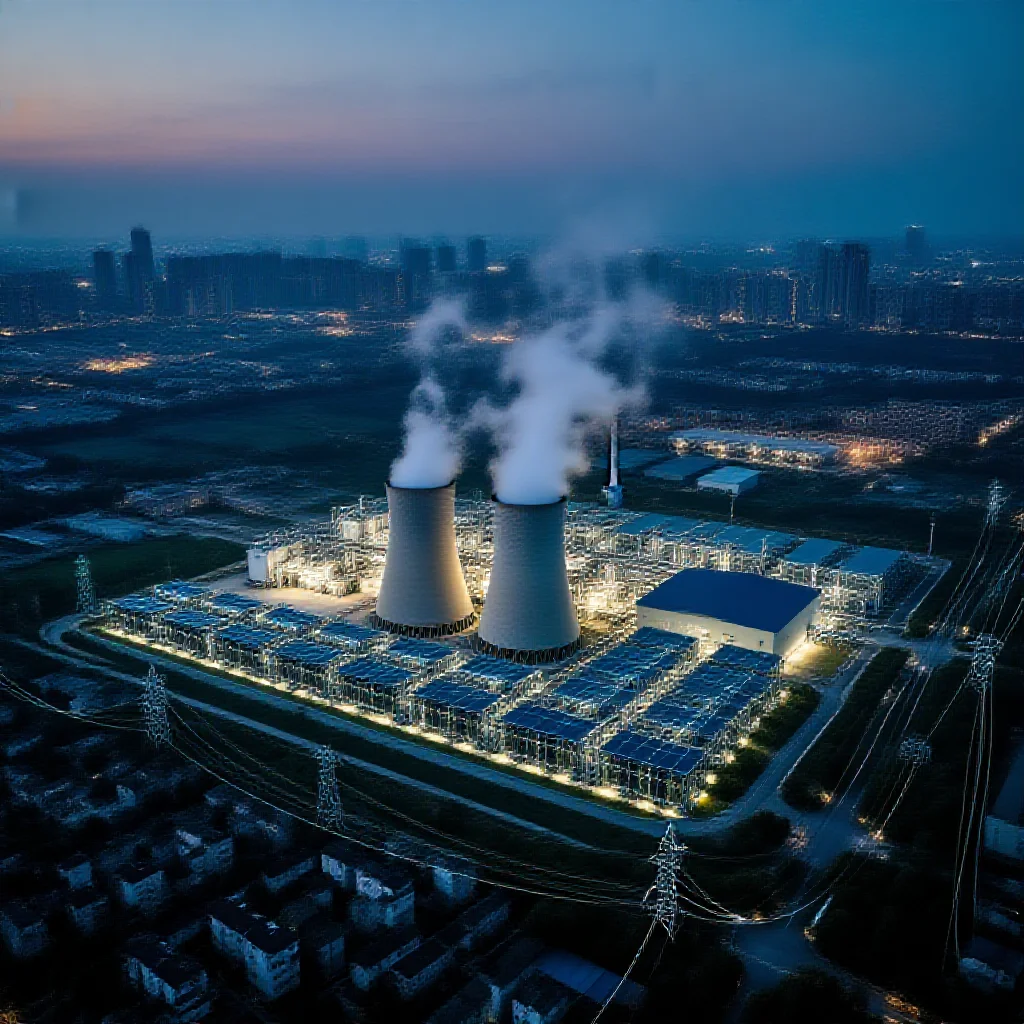
Image: A hyper-realistic depiction of data center infrastructure integrated into an urban landscape.
Introduction: The Infrastructure Paradox of the Digital Age
The global surge in data center construction represents a dual-edged sword for municipal economies. While these facilities are critical infrastructure for the digital economy, generating significant tax revenue and investment, they simultaneously function as unprecedented stressors on urban physical systems. The core conflict is defined by exponential digital growth—driven by artificial intelligence, cloud computing, and ubiquitous connectivity—colliding with finite municipal resources: electrical capacity, water supply, and land. Cities are becoming the new battleground where the terms of digital expansion are negotiated against tangible physical limits, forcing a fundamental recalibration of urban planning and utility management.
!A split-image graphic: one side showing server racks, the other showing aging power substations.
The Scale of the Strain: Quantifying the Demand Shock
The magnitude of the demand shock from modern data centers is quantifiable and substantial. In 2022, data centers in the United States consumed an estimated 4% of the nation's total electricity (Source 1: [Primary Data]). The Uptime Institute forecasts that global data center power consumption could exceed 1,000 terawatt-hours (TWh) by 2026 (Source 2: [Forecast Data]). To contextualize this load, a single large data center campus can request several gigawatts of power, a demand profile comparable to the output of a nuclear power plant. This scale represents a fundamental challenge for local utilities, whose capacity planning cycles, traditionally measured in decades, are being compressed.
The strain extends beyond the electrical grid. Cooling systems, which consume between 25% and 50% of a facility's electricity, also have a significant water footprint. A large data center can consume millions of gallons of water daily for evaporative cooling. This creates direct conflict in regions facing water stress, where municipal conservation goals are increasingly at odds with the operational requirements of digital infrastructure.
The Policy Response: From Passive Host to Active Regulator
Municipal and county governments are transitioning from passive hosts to active regulators in response to this infrastructure strain. This shift is marked by a move away from generic commercial or industrial zoning toward the creation of "critical infrastructure" zoning with specific performance requirements.
A leading example is Arlington County, Virginia, a major data center hub. The county now mandates that developers submit formal resilience plans. These documents must detail how the facility will manage its power and water use, including contingency plans for grid instability and strategies for mitigating environmental impact. This policy transforms the approval process from a simple land-use decision into a negotiated contract on operational resilience.
Conversely, the City of London, Ontario, implemented a different regulatory tool: a temporary moratorium, or "strategic pause," on new data center approvals. This action provides municipal planners with the time and agency to conduct comprehensive impact studies on local water and electrical systems before accepting further load. Both cases signal a pivotal shift where municipalities are leveraging policy to reclaim control over the pace and terms of digital infrastructure integration.
!A conceptual image of a city planner's desk with blueprints overlaid by digital network diagrams.
The Hidden Economic Logic: Redefining 'Location, Location, Location'
The site selection calculus for data center development has been fundamentally redefined. While proximity to fiber optic networks remains important, the primary factor is now access to reliable, high-capacity power infrastructure. This economic logic has long-term implications for the utility supply chain. The concentrated demand from data centers is accelerating capital investment in high-voltage transmission networks and incentivizing the development of new power generation. The nature of this generation—whether it locks in fossil fuel assets or drives power purchase agreements (PPAs) for new renewable projects—will significantly influence regional emissions trajectories.
This dynamic forces a municipal cost-benefit recalculation. The tax revenues from data centers must be weighed against the public and ratepayer cost of the necessary grid and water system upgrades. The question of whether these revenues are sufficient to offset the capital burden on public utilities is becoming a central component of fiscal planning in host communities.
Conclusion: The Redrawn Blueprint for Urban Resilience
The data center boom is acting as a stress test for urban resilience, exposing the interdependencies between digital and physical infrastructure systems. The policy innovations emerging in jurisdictions like Arlington County and London, Ontario, are likely to proliferate, establishing new standards for developer-municipal engagement. The future trend points toward more sophisticated regulatory frameworks that explicitly tie digital growth to sustainability outcomes, such as mandatory carbon-free energy matching or closed-loop water cooling systems.
Market predictions suggest that regions with pre-existing robust power infrastructure and clear, stable regulatory pathways will attract the majority of future investment. Conversely, areas with constrained grids or ambiguous policies may see development slow. The ultimate impact is a redefinition of urban resilience itself, expanding its scope to ensure that the foundation of the digital economy does not compromise the stability of the physical city it inhabits.