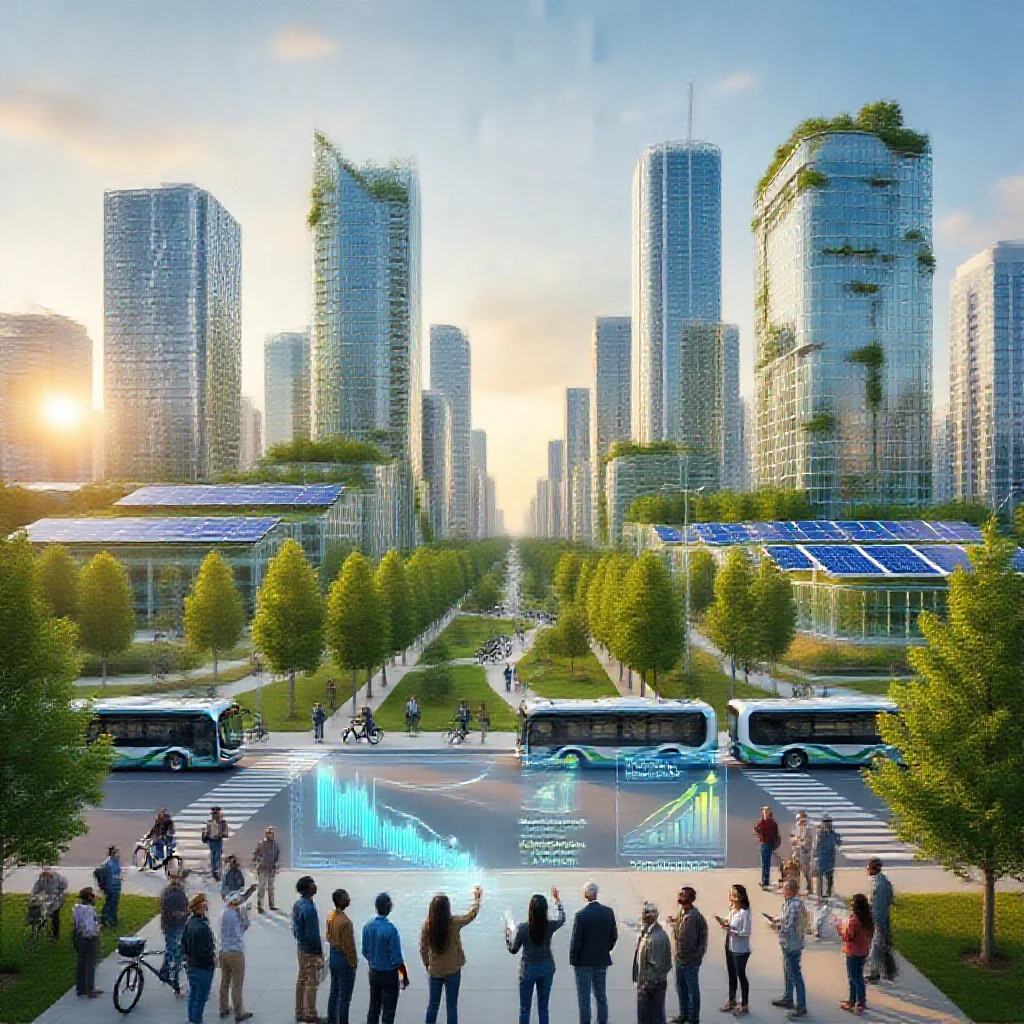
While national governments often stall, major cities are emerging as the
Beyond Carbon: How Cities Are Redefining Climate Leadership Through Economic Power and Equity
Opening Summary
While international climate negotiations frequently encounter geopolitical inertia, a distinct locus of implementation has emerged at the urban scale. Major global cities, operating through networks like C40, are executing climate policy through direct economic leverage and governance. This movement represents a structural shift from advocacy to operational sovereignty, where municipal action is reshaping global supply chains and redefining policy success to include social equity metrics. The aggregate economic weight of these cities, representing one-quarter of the global economy (Source 1: [C40 Cities network represents over 700 million citizens and one-quarter of the global economy]), provides the material basis for this transformation.The New Climate Vanguard: Cities as Sovereign Economic Actors
The limitations of top-down international agreements have created a vacuum filled by metropolitan pragmatism. The C40 network, comprising nearly 100 mayors, functions not as a traditional lobbying entity but as a coalition of executing authorities (Source 1: [C40 Cities is a network of nearly 100 mayors of the world's leading cities]). This distinction is critical. These cities have transitioned from policy advocates to market shapers, utilizing tools inherent to municipal governance: procurement contracts, building codes, zoning ordinances, and strategic public investment. The deployment of these instruments transforms abstract emissions targets into binding market demand. The network’s formal goal for all member cities to achieve carbon neutrality by 2050 (Source 1: [The C40 Cities network has a goal for all member cities to be carbon neutral by 2050]) is pursued through this granular, economic intervention.The Los Angeles Blueprint: A Demand-Side Revolution in Energy and Transport
The climate strategy of Los Angeles provides a clear case study in supply-chain forcing mechanisms. Its commitment to 100% renewable energy by 2035 (Source 1: [Los Angeles has a goal to reach 100% renewable energy by 2035]) functions as a guaranteed, long-term procurement mandate for the city’s municipal utility. This creates a predictable market for renewable technology providers, accelerating innovation and cost reduction beyond the city’s borders. Concurrently, its targets for electric vehicle (EV) adoption and modal shift—80% of new vehicles sold to be electric by 2028 and 25% of trips by walking, biking, or transit by 2035 (Source 1: [Los Angeles has a goal for 80% of all vehicles sold to be electric by 2028], [Los Angeles has a goal for 25% of trips to be taken by walking, biking, or transit by 2035])—leverage municipal fleet electrification and infrastructure investment to send unambiguous demand signals to the automotive and mobility sectors. These are not pleas for change but specifications for market response.The Hidden Axis: Measuring Thriving, Not Just Reducing Carbon
The most significant evolution in urban climate strategy is the explicit integration of well-being metrics. C40’s ‘Thriving Cities Initiative’ formalizes this shift, requiring the measurement of equity and health outcomes alongside carbon emissions (Source 1: [The C40 Cities network has a 'Thriving Cities Initiative' to measure well-being and equity alongside emissions]). This integration addresses a core political economy challenge: climate action’s durability depends on broad public support, which is sustained by tangible co-benefits. The analytical framework thus expands from a singular metric—tons of CO2 avoided—to a multi-dimensional dashboard including air quality improvements, green space access, job creation in new industries, and reductions in health inequality. This reframes the value proposition of climate investment from cost to net societal gain.The Ripple Effect: How Urban Action Reshapes Global Systems
The aggregate demand generated by coordinated city action creates de facto global standards. When multiple major cities mandate electric bus fleets, sustainable construction materials, or renewable energy procurement, they collectively create markets of sufficient scale to justify industrial retooling. This effect cascades through underlying supply chains for energy, transportation, and materials. Analysis of this movement requires two timelines: the fast analysis of immediate policy announcements and procurement wins, and the slow, deep audit of long-term urban economic transformation and behavioral change. The emerging pattern indicates that systemic global change is increasingly driven by the aggregated local actions of economically powerful urban centers.Neutral Market and Industry Predictions
The trajectory of urban climate leadership suggests several convergent outcomes. First, industrial sectors serving urban infrastructure—construction, energy, transportation—will face increasing pressure to align product offerings with the procurement specifications of leading global cities. Second, the ‘Thriving Cities’ metrics framework is likely to influence global ESG (Environmental, Social, and Governance) reporting standards, prioritizing social outcomes alongside environmental ones. Third, the economic efficiency gains demonstrated by early-adopting cities, particularly in renewable energy and electric transport, will create a competitive pressure for other municipalities to follow, irrespective of national policy positions. The primary driver for this expansion will be economic logic, not regulatory compulsion.C40 Cities
urban climate action
city climate leadership
carbon neutral cities
Thriving Cities Initiative
Los Angeles climate goals
urban economic power
climate equity