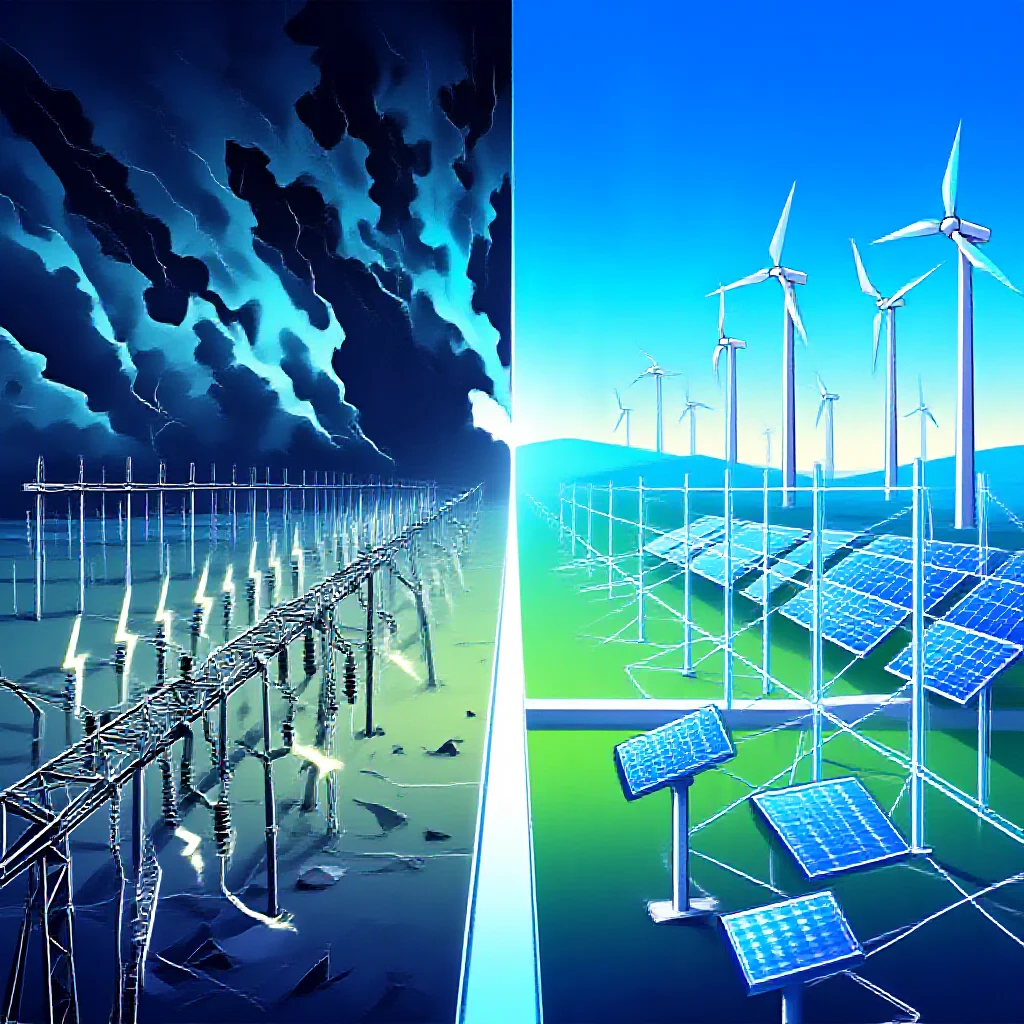
A global energy shock has exposed critical vulnerabilities in Canada''s
Canada's Energy Crossroads: Planning for Resilience in a Volatile Global Market
A global energy shock has functioned as a high-intensity stress test for national energy infrastructures, revealing critical vulnerabilities in Canada's system. The immediate crisis of price volatility and supply chain disruption has illuminated a deeper, systemic shortfall: a chronic deficiency in long-term, integrated energy planning. Analysis from key institutions frames this not as a transient supply issue but as a fundamental failure of strategic foresight and system architecture, with significant implications for economic stability and decarbonization commitments.
The Shock and the Shortfall: How Volatility Exposed Canada's Planning Gap
The recent period of global energy market instability has shifted from a temporary disruption to a persistent condition, exposing the fragility of systems designed for a more predictable era. This volatility acts as a diagnostic tool, highlighting where planning horizons have been too short and system integration too weak. The Canadian Climate Institute identifies this planning gap as a central barrier to a successful transition. The core problem is a misalignment between reactive market mechanisms and the strategic, decades-long planning required to rebuild a foundational piece of national economic infrastructure. The issue transcends simple capacity additions; it concerns the design principles of the system itself—its flexibility, interconnectivity, and resilience to both geopolitical and climatological shocks.
The Scale of the Switch: Decoding the Numbers Behind Net-Zero
The required transformation is quantified in the Canadian Climate Institute's May 2022 report, The Big Switch. The analysis projects that Canada's electricity system must expand by two to three times its current size by 2050 (Source 1: Canadian Climate Institute, "The Big Switch" report, May 2022). Concurrently, electricity's share of total final energy demand must rise from approximately 17% in 2020 to over 50% by mid-century to align with net-zero emissions targets (Source 1: Canadian Climate Institute, "The Big Switch" report, May 2022).
This numerical shift represents a fundamental re-platforming of the national energy economy. It is not an incremental expansion but a structural overhaul where electricity becomes the primary energy carrier, displacing large volumes of direct fossil fuel combustion in transportation, industry, and heating. The economic logic dictates a reallocation of capital on a multi-decade scale, impacting labor markets, industrial supply chains, and regional development strategies. The capital intensity and lead times for generation, transmission, and distribution assets necessitate planning frameworks that extend far beyond typical business or political cycles.
The Global Mismatch: Why Current Investment Trends Are a Dead End
Canada's planning challenge exists within a contradictory global investment landscape. In 2021, the International Energy Agency (IEA) warned that global investment in oil and gas is misaligned with pathways to net-zero emissions by 2050 (Source 2: International Energy Agency (IEA) report, 2021). This misalignment creates a dual risk: stranded asset potential for continued fossil fuel investment and insufficient capital flow to the required clean energy infrastructure.
The IEA further stipulates that global investment in clean energy must triple by 2030 to set a course for net-zero by 2050 (Source 2: International Energy Agency (IEA) report, 2021). This global capital reallocation represents a significant external variable for Canada. Strategic national planning must therefore account for and navigate competitive international capital markets for clean technology and financing. A failure to create a coherent, investable plan risks ceding economic opportunity and importing dependency on foreign-manufactured energy transition technologies.
Beyond Megawatts: The Unseen Entry Point of System Resilience
The primary engineering challenge is scaling generation and grid capacity. However, the core strategic challenge is designing for system resilience. A resilient energy system must maintain reliability and affordability through two primary vectors of shock: physical (increasing frequency and severity of extreme weather events) and economic (volatility in global fuel prices and supply chains).
A system dominated by diversified, non-imported electricity generation coupled with robust transmission interties and demand-side management technologies is inherently more resilient to both vectors. This transforms energy from a commodity cost into a predictable input for industrial competitiveness and household stability. The planning imperative shifts from procuring the cheapest marginal megawatt-hour to architecting a system that minimizes systemic risk to the broader economy. This requires new regulatory models, market designs, and inter-provincial coordination frameworks that prioritize long-term system value over short-term localized cost minimization.
Neutral Market and Industry Predictions
Based on the identified data and structural trends, several predictions can be logically deduced. First, regulatory and policy frameworks will increasingly mandate long-term integrated resource planning that explicitly values resilience and decarbonization, forcing utilities and system operators to adopt longer planning horizons. Second, capital will continue to flow towards assets perceived as "future-proof," increasing the risk premium and cost of capital for projects lacking a clear net-zero alignment, potentially leading to stranded investments in certain fossil fuel infrastructure. Third, competitive advantage will accrue to regions that successfully streamline permitting and approval processes for critical clean electricity and transmission projects, attracting electro-intensive industries seeking stable, clean power. Finally, the innovation focus will intensify on technologies that provide grid flexibility and storage, as these will be the critical enablers for managing a system dominated by variable renewable resources while maintaining reliability.
The convergence of global market volatility and stringent decarbonization targets has rendered Canada's traditional energy planning models obsolete. The path forward is defined by a strategic pivot from reactive market adjustments to the proactive, system-wide engineering of a resilient, electrified energy foundation. The economic cost of inaction is measured in future vulnerability to external shocks and forfeited competitiveness in a decarbonizing global economy.