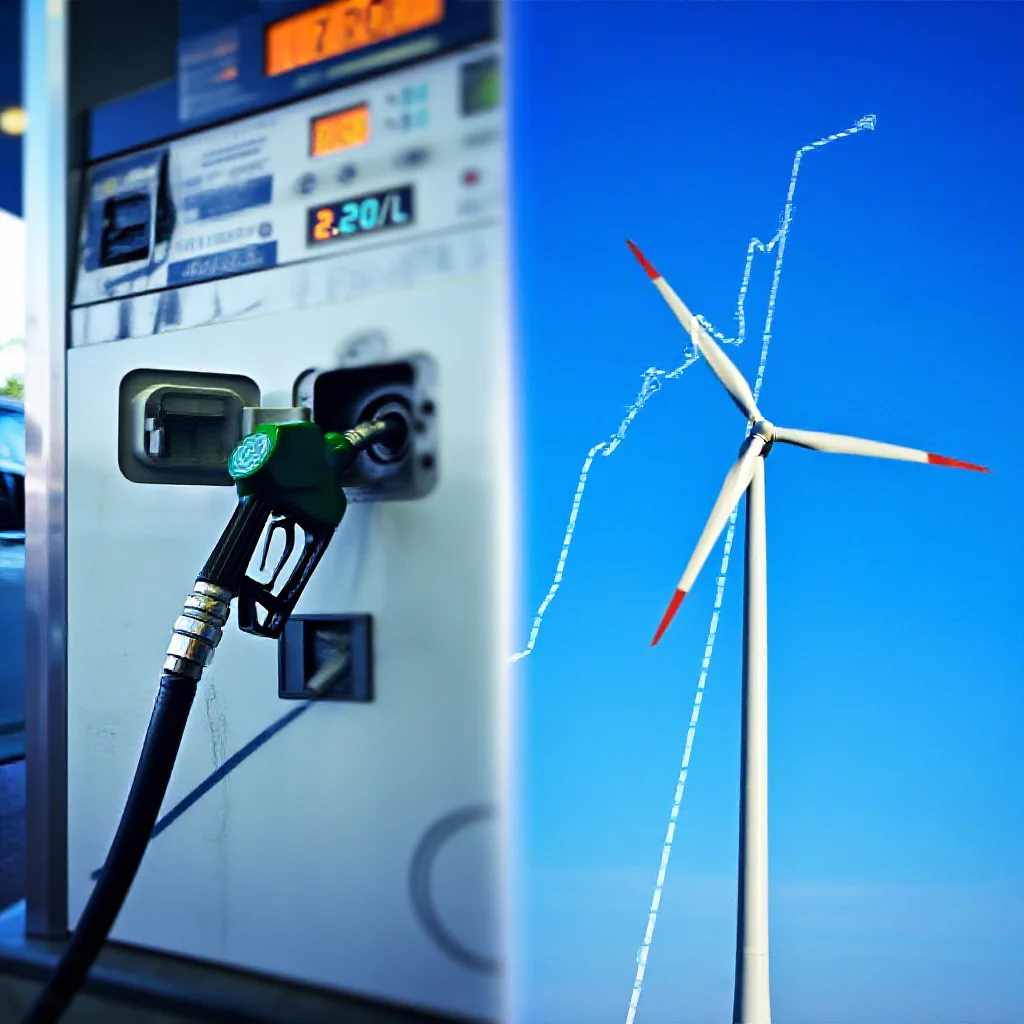
Canada''s rising gasoline prices, exacerbated by the April 2024 carbon tax
Beyond the Pump: The Hidden Economic Logic and Political Tension of Canada's Carbon Tax
Gasoline prices in Canada have risen significantly, with costs in markets like Vancouver reaching C$2.20 per litre in April 2024 (Source 1: [Primary Data]). A federal carbon tax increase to C$80 per tonne, effective April 1, 2024, added 17.6 cents per litre to the price of gasoline (Source 2: [Primary Data]). This has ignited a debate that transcends simple cost-of-living concerns, centering on the core economic logic of the policy and its measurable impacts.
The Price Signal: Decoding the Economic Intent Behind the Pain at the Pump
The federal carbon tax is designed not merely as a revenue mechanism but as a core economic instrument: a price signal. Its intent is to make carbon-intensive activities more expensive, thereby making alternatives more attractive. The 17.6-cent-per-litre addition functions as this signal, embedding the environmental cost of emissions into the market price.
This policy-driven increase, however, operates within a broader context of global oil market volatility and refining margins. The total price rise observed at the pump is a composite of these market forces, existing provincial and federal excise taxes, and the carbon charge. The fundamental policy trade-off is the creation of immediate, visible costs to incentivize long-term, invisible shifts in technology, infrastructure, and consumer behavior. The economic hypothesis is that consistent, predictable increases in the carbon price will alter investment and consumption decisions over time.
The Net Cost Conundrum: A Clash of Data and Household Economics
A central point of contention lies in the policy's net financial impact on households. The federal government states most households receive rebates that exceed the cost (Source 3: [Primary Data]). This conclusion is derived from aggregate modeling of average energy consumption and the distribution of Climate Action Incentive payments.
This claim conflicts with analysis from the Parliamentary Budget Officer (PBO), which reported the carbon tax had a negative net economic impact for most households in the 2023-24 fiscal year, even after accounting for rebates (Source 4: [Primary Data]). The methodological divide often centers on distributional effects and the scope of analysis. The PBO's assessment includes broader economic impacts, such as the tax's effect on wages and investment income, which the government's calculation may not fully capture.
Organizations like the Canadian Taxpayers Federation present a more direct cost estimate, arguing the tax costs a family of four up to C$2,943 annually, even after rebates (Source 5: [Primary Data]). Scrutiny of such estimates involves examining assumptions about household energy consumption patterns and the fungibility of rebate money. A further behavioral economics challenge exists: the upfront price increases at the pump are psychologically salient, while rebates, delivered quarterly, may not be perceived as direct compensation, potentially undermining the price signal's intended effectiveness.
Beyond the Rebate Debate: Assessing the Policy's Core Effectiveness
The debate over household net cost often overshadows the critical, performance-based question: Is the tax, at its current level and design, actually reducing emissions? This is the policy's stated primary objective. Evidence from independent analysts like Canada's Ecofiscal Commission suggests carbon pricing is among the most cost-effective tools for reducing emissions.
The analysis requires distinguishing between the "Consumption Signal" and the "Investment Signal." A price of C$80 per tonne may be sufficient to marginally influence daily consumption choices, such as combining errands or using public transit. The more significant question is whether this price is high enough to drive the capital investment required for long-term emissions reduction—investment in clean technology, industrial retrofits, and new infrastructure. Critics, such as Franco Terrazzano of the Canadian Taxpayers Federation, argue, "The carbon tax is making life more expensive for Canadians and it's not reducing emissions at all" (Source 6: [Primary Data]). Proponents, like the policy group Clean Prosperity, counter that "The carbon tax is a critical tool for Canada to reduce its greenhouse gas emissions" (Source 7: [Primary Data]).
The tension lies in the policy's dual function as a behavioral lever and a revenue mechanism for redistribution. Its effectiveness in driving deep decarbonization depends on whether the price trajectory is sufficient to alter major investment decisions and whether complementary policies are in place to enable low-carbon alternatives.
Neutral Market and Policy Trajectory Analysis
The future trajectory of this policy is defined by its legislated schedule. The carbon price is set to rise to C$170 per tonne by 2030, guaranteeing that its component of fuel prices will continue to increase predictably. This will maintain pressure on consumption patterns and incrementally improve the business case for low-carbon investments.
Market predictions indicate that global oil price volatility will remain the dominant driver of short-term price fluctuations at the pump, often overshadowing the carbon tax increment. However, the political volatility surrounding the policy is likely to intensify with each scheduled increase, focusing debate on the rebate mechanism's adequacy and the visibility of emission reductions.
The ultimate measure of the policy’s success or failure will be empirical, resting on long-term emissions data and the rate of adoption of clean technologies across the economy. The current debate, while focused on immediate costs, is a proxy for a deeper conflict between short-term economic adaptation and long-term environmental and industrial restructuring.