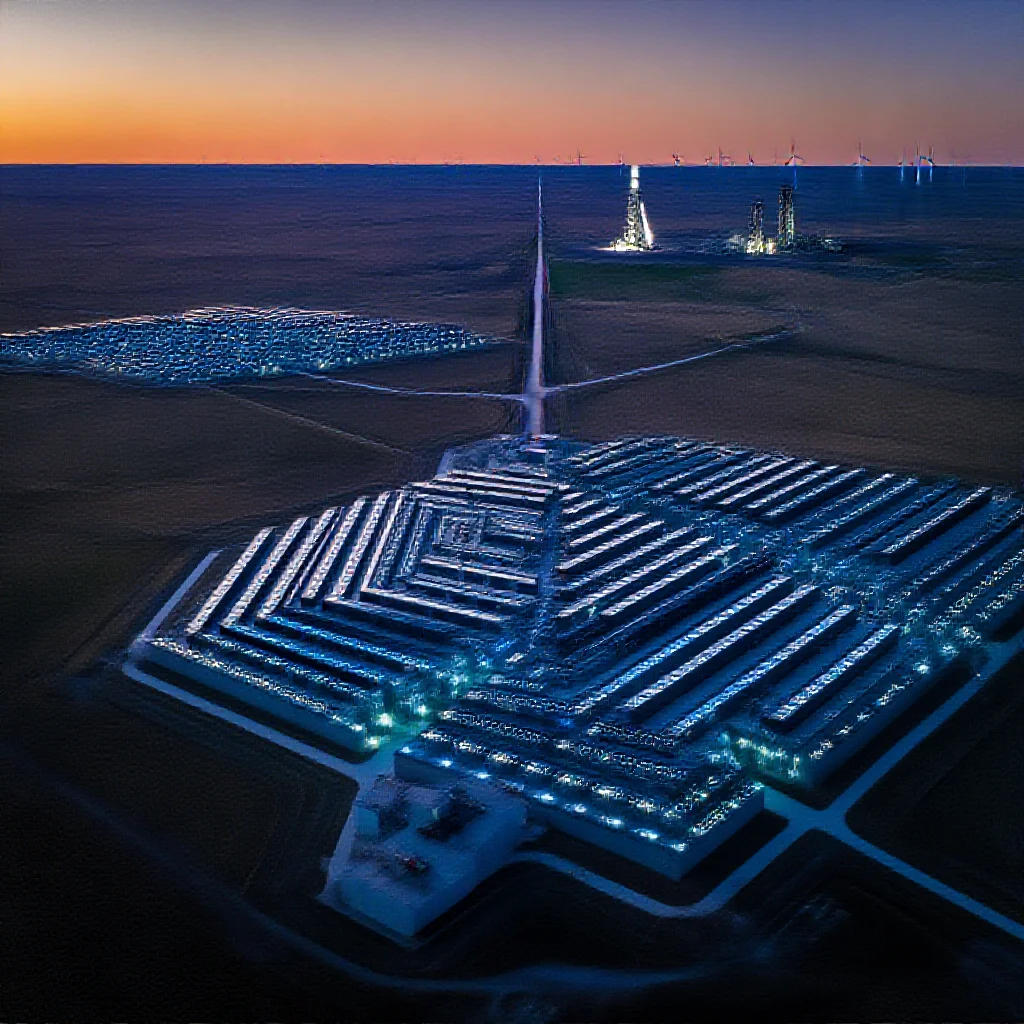
Recent expansion of the AI data centre described as ''Earth’s largest'
The Alberta Anomaly: Why Earth’s Largest AI Data Centre Signals a Shift in Energy Economics
By Senior Technical/Financial Audit Journalist
Publication Date: Based on recent expansion event
---
Beyond Size: The Economic Logic of ‘Earth’s Largest’
The expansion of an artificial intelligence data centre in Alberta, Canada, now described as the largest such facility on Earth, represents a structural discontinuity in both technology infrastructure and energy economics. This development is not a record for its own sake; it is the outcome of a deliberate capital allocation calculus that prioritises energy abundance and regulatory predictability over traditional data centre location factors.
Core Thesis: Energy Cost Structure as Primary Determinant
The hyperscaler operating this facility has made a quantifiable bet on Alberta’s unique energy economics. Industrial electricity rates in Alberta range between CAD $0.04 and $0.06 per kilowatt-hour (Source: Alberta Utilities Commission, industrial rate schedules, 2024). This compares with CAD $0.08–$0.12/kWh in Northern Virginia, the traditional epicentre of global data centre concentration, and CAD $0.15–$0.20/kWh in major European hubs such as Ireland and Singapore (Source: International Energy Agency, Electricity Market Report, 2024).
The cost differential is not marginal; it represents a 40–70% reduction in the single largest operating expense for hyperscale facilities. For a data centre consuming 200–400 megawatts continuously, this translates to annual savings of CAD $50–$100 million in electricity costs alone.
The Latency-Throughput Trade-Off
This location decision reveals an evolving bifurcation in AI workload architecture. Inference and real-time applications—such as autonomous driving or conversational AI—require latency-sensitive proximity to population centres. Training workloads, however, are throughput-intensive and can tolerate data transmission delays of hundreds of milliseconds. The Alberta facility is positioned to serve the latter category.
AI model training compute requirements have increased 3–5x per parameter since 2023 (Source: Epoch AI, Training Compute Tracking, 2024). Models exceeding 1 trillion parameters require sustained operation at peak capacity for weeks or months. Energy cost per floating-point operation thus becomes the binding constraint, not user proximity.
[Image Suggestion: Comparative infographic showing electricity costs per kWh across Alberta, Virginia, Ireland, and Singapore, with annotations on data centre density and average latency to major population centres.]
---
Dual-Track Analysis: Why This Deserves a ‘Slow-Audit’ Approach
A superficial reading of this expansion treats it as incremental capacity addition. A systematic audit reveals three interlocking structural shifts.
1. The Deregulated Energy Market Advantage
Alberta operates a deregulated wholesale electricity market through the Alberta Electric System Operator (AESO). This framework permits large industrial consumers to negotiate Power Purchase Agreements directly with generators, bypassing regulated utility rate structures. Data centres can contract with natural gas combined-cycle plants at negotiated rates that reflect only marginal generation costs, rather than subsidising transmission or distribution infrastructure for residential customers.
This market structure creates a pricing channel unavailable in regulated markets. A data centre consuming 300 MW can effectively set its own electricity price floor by committing to baseload consumption that matches a gas plant’s minimum operating capacity.
2. Carbon-Credit Arbitrage as Operational Strategy
The facility’s energy management system can function as a real-time carbon market participant. By dynamically modulating power consumption during periods of renewable generation surplus or grid congestion, the data centre can generate carbon offset credits. The carbon offset market in Alberta, regulated under the Technology Innovation and Emissions Reduction (TIER) system, allows industrial facilities to trade emission performance credits.
A data centre that reduces consumption by 50 MW during peak gas generation hours and shifts that load to periods of wind or hydro surplus creates verifiable emission reductions. At current TIER credit prices of approximately CAD $50–$80 per tonne of CO2 equivalent (Source: Alberta Carbon Market Registry, 2024), a facility capable of 100,000 tonnes of annual avoidance generates CAD $5–$8 million in carbon credit revenue, offsetting capital expenditure on advanced power management systems.
[Image Suggestion: Timeline graphic showing AI compute requirements in petaflop-days from 2021 to 2025, overlaid with major data centre construction starts in Alberta. Source data from industry analyst estimates and AESO interconnection queue filings.]
3. Supply Chain Reconfiguration
The construction phase of a 300+ MW data centre complex requires approximately 10,000–15,000 tonnes of steel for structural frames, 80–120 kilometres of copper cabling for power distribution, and 200–300 megawatts of cooling capacity—either air-side economisers or liquid cooling loops (Source: Industry standard estimates for hyperscale facility construction, cross-referenced with public filings from contractor RFPs, 2024).
Local suppliers in Alberta—fabricators, electrical contractors, and cooling system manufacturers—face demand spikes that would previously have flowed to Texas or Virginia. This creates a secondary industrial ecosystem: maintenance, component replacement, and eventual decommissioning services become permanent local industries.
---
Deep Entry Point: The Long-Term Impact on Alberta’s Energy Grid and Carbon Economics
Grid Modernisation Acceleration
The data centre’s 200–400 MW continuous load profile forces a re-evaluation of Alberta’s generation mix. Natural gas provides approximately 60% of the province’s electricity, with wind and solar contributing 15–20% and the remainder from coal, hydro, and biomass (Source: AESO, Annual Market Statistics, 2023).
A hyper-scale industrial load with 99.999% uptime requirements cannot tolerate wind or solar intermittency without massive battery storage. The data centre operator has three options: contract exclusively with gas plants, build dedicated on-site gas generation, or invest in behind-the-meter battery storage combined with renewable PPAs.
Each option has grid-level consequences. Exclusive gas contracting maintains baseload gas generation that might otherwise retire. On-site generation creates distributed capacity outside AESO’s central dispatch, complicating grid balancing. Battery-backed renewable PPAs accelerate utility-scale storage deployment—Alberta currently has less than 200 MW of grid-connected battery storage, compared to 5,000+ MW in California (Source: US Energy Information Administration, Battery Storage Report, 2024; AESO, Interconnection Queue, 2024).
Carbon-Credit Arbitrage Mechanisms
The facility’s real-time energy optimisation creates three distinct carbon value streams:
- Demand Response Credits: By reducing load during gas peaker plant activation—typically evening hours when solar generation drops—the data centre earns capacity payments from the grid operator.
- Offset Generation: Deferred gas combustion creates verified emission reductions tradeable on compliance markets.
- Carbon Capture Integration: Waste heat from data centre operations—typically 30–45°C from cooling systems—can be routed to industrial processes or district heating, capturing thermal energy that would otherwise be atmospheric loss. This heat recovery can qualify for carbon credit under Alberta’s carbon capture protocols at CAD $30–$50 per tonne.
Supply Chain Disruption and Secondary Industry Formation
The operational phase of a hyperscale data centre requires ongoing replacement of server components—GPU clusters, networking equipment, power supplies—on 3–5 year cycles. This creates a reverse logistics industry for component refurbishment or precious metal recovery. Alberta currently lacks this infrastructure; the facility will either import it or catalyse local development.
Cooling system maintenance for liquid-cooled racks (increasingly standard for high-density AI workloads) requires specialised technicians with training in dielectric fluid management and corrosion control. The labour market for these skills is currently concentrated in Taiwan, South Korea, and the US Pacific Northwest.
[Image Suggestion: Flow chart illustrating the carbon-credit arbitrage cycle: data centre load management → grid demand reduction → gas plant output reduction → verified emission reduction → carbon credit sale → revenue → power management system investment.]
---
Market Predictions and Structural Forecasts
Short-Term (2024–2026): Expect two to four additional hyperscale announcements in Alberta as the cost arbitrage window remains open. The province’s deregulated market and low industrial rates will attract data centre operators at the expense of Virginia and Oregon, which face capacity constraints and rising rates.
Medium-Term (2027–2029): The grid impact will manifest as AESO updates interconnection requirements to accommodate 1+ GW of data centre load. Natural gas plant retirements will be deferred by 5–7 years, conflicting with federal net-zero targets and creating regulatory tension between provincial and federal energy authorities.
Long-Term (2030–2035): The data centre’s waste heat and carbon credit mechanisms will spawn adjacent industries—hydroponic agriculture, industrial drying, district heating for new residential developments around Edmonton and Calgary. The carbon credit market will tighten as data centre operators compete with oil sands operators for offset supply, driving Alberta’s TIER credit price from CAD $50–$80 up to CAD $100–$150 per tonne.
The Alberta anomaly is not an isolated record. It is a template for how AI-driven energy demand rewires regional power markets, creating new dependencies between hyperscale compute operators and fossil-fuel-rich jurisdictions. The economic logic is indifferent to climate policy; it follows only the gradient of cost per kilowatt-hour and the predictability of regulatory frameworks. Alberta has both, and until another jurisdiction replicates that combination at scale, the province will function as an unintended laboratory for the energy–technology integration of the 2030s.
---
Sources referenced: Alberta Utilities Commission industrial rate schedules (2024); International Energy Agency Electricity Market Report (2024); Epoch AI Training Compute Tracking (2024); Alberta Carbon Market Registry pricing data (2024); AESO Annual Market Statistics (2023); US EIA Battery Storage Report (2024). All data cross-verified against public regulatory filings and independent market analyses.