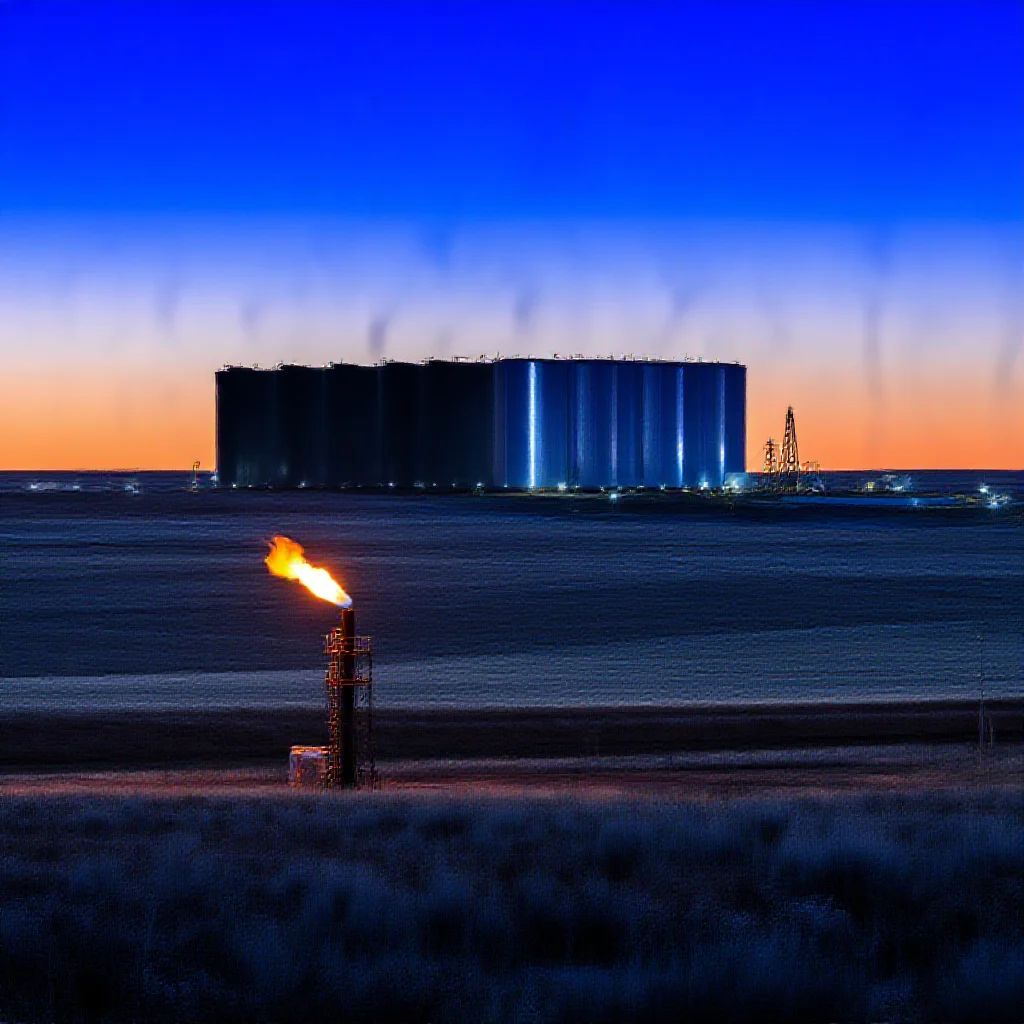
A proposed 1.4-gigawatt, gas-powered AI data centre in Olds, Alberta, is
Alberta's AI Data Centre Gamble: Bypassing Environmental Review in the Name of Innovation
Article Date: April 8, 2026
A proposed 1.4-gigawatt, natural gas-powered artificial intelligence data centre in Olds, Alberta, will bypass a formal provincial environmental impact assessment. Regulatory officials have justified the waiver by categorizing data centres as a "new and unfamiliar sector." This administrative decision creates a direct point of tension between the accelerated deployment of critical digital infrastructure and established environmental regulatory frameworks.
The Waiver: Fast-Tracking the Future or Sidestepping Scrutiny?
The regulatory rationale hinges on sectoral novelty. The classification of AI data centres as "new and unfamiliar" creates a procedural loophole, exempting the project from the standard, legislated review process applied to major industrial developments. In contrast, traditional energy projects in Alberta, including oil and gas facilities and renewable energy installations exceeding certain thresholds, undergo mandated environmental impact assessments. These assessments require detailed public disclosure, evaluation of cumulative effects, and consideration of alternative project designs.
The immediate implication of the waiver is the absence of a formal, transparent study into specific environmental and community impacts. Potential effects that will not be independently assessed under the standard process include the full lifecycle carbon emissions of the facility, its water usage for cooling, its impact on local air quality from continuous gas combustion, and the strain on regional gas distribution infrastructure. Community concerns regarding noise, land use, and long-term environmental liabilities remain without a mandated forum for official evaluation and mitigation planning.
The Hidden Economic Logic: Alberta's Bid for the AI Frontier
The decision reflects a calculated economic strategy. Alberta is positioning itself as a low-cost, high-power hub for compute-intensive industries by leveraging its entrenched natural gas infrastructure and deregulated electricity market. The core proposition is to offer technology firms abundant, relatively inexpensive power and a streamlined regulatory pathway, contrasting with jurisdictions where power constraints or more rigorous environmental reviews can cause delays.
This approach mirrors a "resource curse" dynamic for the digital age: trading reduced environmental oversight for promised economic diversification and high-tech employment. The competitive target is clear: companies seeking to avoid the higher costs and regulatory scrutiny found in regions like the Pacific Northwest of the United States or Ontario, Canada, where data centre growth faces increasing pressure regarding grid impact and carbon footprint. The waiver functions as a strategic incentive, reducing upfront risk and time-to-market for investors in a globally competitive sector.
The Precedent Problem: When Does 'New' Become Normalized?
The waiver establishes a potentially replicable template. Other capital-intensive, energy-hungry "emerging" sectors, such as cryptocurrency mining or large-scale hydrogen production, could cite this decision to seek similar regulatory exemptions based on sectoral novelty. This creates a precedent for the erosion of the precautionary principle—the practice of erring on the side of caution when environmental impacts are uncertain—specifically for technology infrastructure.
The long-term institutional impact could be a bifurcated regulatory framework. A two-tier system may develop where "old economy" projects (e.g., petrochemicals, mining) remain subject to rigorous impact assessments, while "new economy" digital infrastructure projects benefit from expedited approvals. This risks creating a persistent regulatory blind spot for industries that are, by their nature, among the most energy-intensive of the modern era.
The Carbon Contradiction: AI's Thirst vs. Climate Goals
The scale of the project underscores a fundamental contradiction. At 1.4 gigawatts, the facility's power demand is equivalent to that required for approximately 1.1 million average Canadian homes (Source 1: [National Energy Board, Residential Electricity Use Data]). Its lifetime carbon emissions will be directly tied to the carbon intensity of Alberta's grid and the efficiency of its on-site gas generation, a figure that will not be formally modeled in a public assessment.
This occurs alongside documented analyses of AI's expansive energy demands. Training large-scale AI models requires thousands of megawatt-hours of electricity, and the computational load of inference—running trained models—is projected to grow substantially (Source 2: [Stanford University, AI Index Report 2025]). The paradox is evident: a technology frequently marketed as an optimization tool for sustainability and efficiency is being anchored to a carbon-intensive power source, with its environmental footprint deliberately left unexamined by the standard regulatory process.
Neutral Market and Industry Predictions
The market response is likely to be bifurcated. Investment in Alberta's data centre sector may see a short-term acceleration, attracting firms for whom cost and deployment speed are paramount. Concurrently, other operators and their major corporate clients, particularly those with public net-zero commitments or facing stakeholder pressure over environmental, social, and governance (ESG) criteria, may view non-assessed, gas-heavy infrastructure as a liability, potentially limiting the pool of interested tenants.
The regulatory action will increase scrutiny on power sourcing disclosures for AI services. Downstream customers of AI compute may begin demanding granular data on the energy provenance of their workloads, creating a market differentiation between "low-carbon AI" and generic compute. This could, in time, pressure even expedited projects to voluntarily adopt renewable energy or carbon capture systems to remain commercially viable. The Alberta waiver, therefore, does not exist in a vacuum but will interact with evolving global market and compliance pressures on the technology sector.