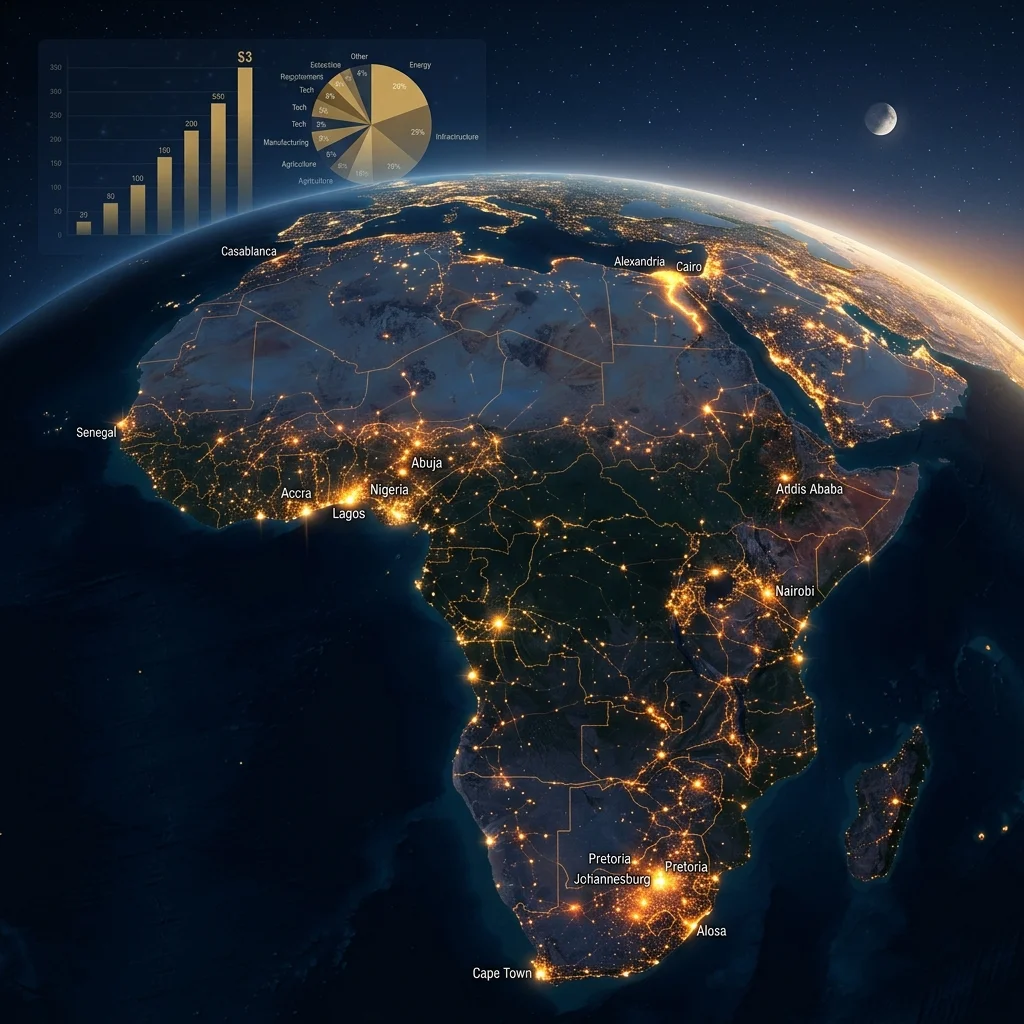
Africa is witnessing an unprecedented wave of infrastructure and investment
Decoding Africa's $3 Trillion Project Pipeline: Insights from the ABIQ Platform
By Senior Technical/Financial Audit Journalist
---
Introduction: The $3 Trillion Opportunity – A New Investment Horizon
Africa currently hosts 3,000+ active investment projects with a combined value exceeding $3 trillion, as tracked by the ABIQ business intelligence platform across all 54 African nations (Source 1: ABIQ Platform Data). This project pipeline represents one of the largest coordinated capital deployment zones in the global emerging markets landscape.
The underlying economic logic connecting this project density to fundamental demographic and macroeconomic forces is clear. Africa's population is projected to grow from 1.340 billion in 2020 to 1.617 billion by 2030—a 25% increase over ten years (Source 2: UN Population Projections). Concurrently, the International Monetary Fund predicts GDP acceleration from 3.5% in 2024 to 4.3% by 2029 (Source 3: IMF Regional Economic Outlook). Project concentration correlates directly with these demographic tailwinds and expected consumption growth.
ABIQ functions as the only validated data platform covering all 54 African countries, extending its tracking to the Middle East (UAE and Saudi Arabia) for a combined near-$7 trillion project universe (Source 1). The platform provides access to over 15,000 companies active in project origination, financing, and execution across both regions (Source 1).
---
West Africa’s Dominance: Beyond Oil and Minerals
West Africa leads all sub-regions with projects valued at more than $1 trillion—exceeding North Africa's $930 billion and East Africa's $750 billion (Source 1: ABIQ Sub-Regional Breakdown). Nigeria anchors this dominance with $330 billion in active projects, while emerging hubs in Ghana and Côte d'Ivoire contribute substantially to the regional total (Source 1).
Key structural shift: West Africa's project composition is undergoing a measurable transition away from extractive industries toward long-term urbanization infrastructure. While the region historically attracted investment centered on oil and mineral extraction, the current pipeline reveals building construction and transport infrastructure gaining proportional share. This shift signals a strategic pivot: developers and governments are positioning for sustained urban population growth rather than cyclical commodity price movements.
Nigeria alone holds 330 active projects (Source 1). Transport sector investments—encompassing roads, railways, and airports—account for a significant portion of the continent-wide $580 billion transport project pool (Source 1). Regional connectivity initiatives (trans-West African highways, rail corridors linking Lagos to Abidjan) represent a deliberate strategy to create integrated economic zones capable of supporting population clusters projected to exceed 500 million by 2030 (Source 2).
---
Egypt: The Country-Level Powerhouse – 450 Projects, $640 Billion
Egypt operates in a distinct category within Africa's project landscape: 450+ active projects worth $640 billion (Source 1: ABIQ Country Data). This dwarfs South Africa's $402 billion and Nigeria's $330 billion, positioning Egypt as the single largest national project market on the continent (Source 1).
Concentration drivers: Egypt's project density reflects two simultaneous dynamics. First, state-led megaprojects—including the New Administrative Capital, Suez Canal zone expansion, and massive housing initiatives—account for a disproportionate share of value. Second, Egypt occupies a strategic geographic bridge between Africa, the Middle East, and Europe, attracting cross-regional capital flows.
ABIQ's tracking across both Africa and the Middle East (UAE, Saudi Arabia) reveals that Egypt benefits uniquely from this dual-region visibility (Source 1). Investment from Gulf sovereign wealth funds and European development finance institutions converges on Egyptian infrastructure at rates unmatched by other African markets. The implication for investors: Egypt functions less as a pure African play and more as a gateway economy where regional risk diversification strategies converge.
---
Sectoral Giants: Building Construction ($840B) and Energy ($630B)
Building construction dominates Africa's project pipeline with more than 850 active projects valued at approximately $840 billion (Source 1: ABIQ Sector Data). This sector's scale reflects both commercial real estate development and government-led housing programs responding to population growth.
Sector analysis:
| Sector | Active Projects | Total Value |
|--------|----------------|-------------|
| Building Construction | 850+ | $840 billion |
| Energy | Data tracked | $630 billion |
| Transport (Roads, Airports, Railways) | Data tracked | $580 billion |
(Source 1: ABIQ Sectoral Breakdown)
The energy sector's $630 billion pipeline underscores Africa's dual challenge: addressing current electricity access deficits (approximately 600 million people without reliable power) while building capacity for industrial expansion. Renewable energy projects—particularly solar and wind in North Africa and hydropower in East Africa—represent a growing share, though oil and gas infrastructure (LNG terminals, pipeline networks) still commands significant capital allocation.
Transport infrastructure at $580 billion reveals the continent's connectivity deficit and the scale required to integrate fragmented national markets. Road projects dominate value terms, but railway and airport investments are accelerating, particularly in East Africa (Kenya's Standard Gauge Railway extensions, Ethiopia's new airport corridors).
---
The Demographic-Investment Feedback Loop
Africa's population trajectory from 1.34 billion (2020) to 1.62 billion (2030) creates a compound demand cycle that directly influences project viability (Source 2: UN Population Division). Each percentage point of population growth generates proportional demand for housing (building construction), energy (power generation), and mobility (transport infrastructure).
Analytical framework: The correlation between population density and project concentration is not coincidental. West Africa's $1 trillion+ pipeline corresponds to the region projected to absorb the largest absolute population increase. Egypt's $640 billion portfolio aligns with North Africa's 100 million+ population base and its position as a transcontinental logistics hub.
The economic logic operates as follows: Demographic pressure → government infrastructure spending → private sector investment in housing/commercial real estate → employment growth → increased consumption → further infrastructure demand. ABIQ's project tracking validates this cycle empirically: markets with the highest population growth projections (Nigeria, DRC, Ethiopia, Tanzania) show corresponding project pipeline acceleration (Source 1).
---
Platform Intelligence: ABIQ’s Role in Supply Chain and Investment Decisions
ABIQ's coverage of 15,000+ companies across 54 African countries, UAE, and Saudi Arabia positions the platform as a comprehensive intelligence source for stakeholders navigating this $7 trillion total market (Source 1: ABIQ Company Database).
Data validation methodology: Unlike aggregated or estimated datasets, ABIQ maintains validated project records—distinguishing between announced, under-construction, and completed phases. This granularity enables:
- Supply chain strategists: Identifying project procurement timelines to position materials, equipment, and logistics capacity
- Risk assessors: Monitoring project progression rates across countries and sectors to calibrate exposure
- Investment analysts: Cross-referencing project values with GDP growth forecasts (IMF: 3.5%→4.3%) to calculate market entry timing
The platform's dual-region focus (Africa + Middle East) reveals capital flow patterns invisible to single-region databases. Egyptian megaprojects funded via UAE sovereign wealth funds, Saudi infrastructure contracts awarded to African construction firms, and Gulf solar investments in North African energy projects—all represent cross-regional dynamics captured by ABIQ's integrated tracking (Source 1).
---
Market Predictions: 2025–2030 Outlook
Based on current project pipeline data and demographic trajectories, several forward indicators emerge:
1. West Africa will maintain pipeline leadership through 2030. The $1 trillion+ base, combined with Nigeria's population projection exceeding 400 million by 2050, creates sustained demand for building construction and transport infrastructure. Shift from extractive to urban development projects will accelerate.
2. Egypt's state-led model will face sustainability pressure. With $640 billion in active projects, Egypt's reliance on government-directed investment raises questions about private sector absorption capacity. Investors should monitor project completion rates versus new announcements.
3. Energy sector will exceed $1 trillion by 2027. Current $630 billion base plus announced renewables targets (African Union: 300 GW by 2030) and LNG export infrastructure investments will drive sector expansion.
4. Transport infrastructure financing will shift toward public-private partnerships. The $580 billion transport pipeline exceeds government financing capacity, compelling PPP frameworks across road, rail, and airport projects.
5. East Africa will challenge West Africa's project share. Population growth rates (Ethiopia, Tanzania, Uganda) combined with Chinese and Gulf investment flows will push East Africa's $750 billion pipeline toward parity with West Africa within five years.
(Source 1: ABIQ Trend Analysis; Source 3: IMF Growth Projections)
---
Conclusion: Data-Driven Strategy in Africa’s Project Economy
The $3 trillion African project pipeline, validated by ABIQ's platform across 54 countries, represents a structural economic shift rather than a cyclical uptick. Population growth (1.34B→1.62B by 2030) and GDP acceleration (3.5%→4.3% by 2029) provide the fundamental underpinning for sustained capital deployment.
For market participants, the distinction between headline numbers and actionable intelligence lies in data validation. Platforms like ABIQ that track project progression across sectors, countries, and phases offer supply chain planners, risk managers, and investment committees the granularity required for capital allocation decisions.
The project pipeline's sectoral composition—building construction ($840B), energy ($630B), transport ($580B)—reflects a continent simultaneously addressing basic infrastructure deficits while positioning for demographic expansion. West Africa's $1 trillion dominance, Egypt's $640 billion concentration, and the 15,000-company ecosystem tracked by ABIQ collectively define Africa's project economy as a distinct asset class demanding specialized intelligence for effective navigation.
---
Data sources: ABIQ platform project database (current active projects), UN Population Division (2020 baseline and 2030 projections), IMF Regional Economic Outlook (2024-2029 growth forecasts). All project values in USD.