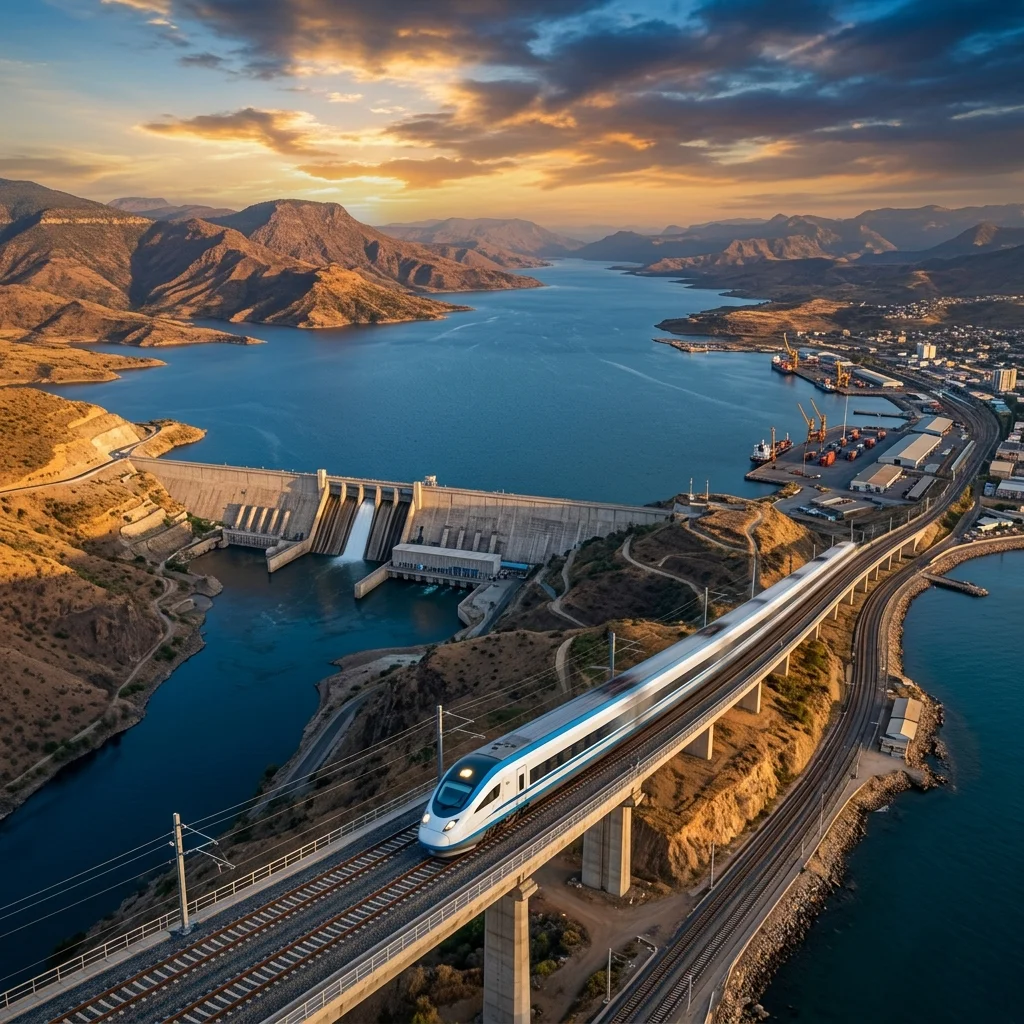
This article provides a deep industry audit of five landmark infrastructure
Powering Progress: How Africa’s Largest Infrastructure Projects Are Reshaping Trade, Energy, and Urban Mobility
Introduction: The Hidden Logic Behind Africa’s Mega‑Projects
Africa is undergoing the most significant infrastructure build-out in its modern history. Between 2010 and 2022, cumulative capital expenditure on large-scale infrastructure across the continent exceeded $180 billion (African Development Bank Infrastructure Report, 2023). Yet mainstream coverage typically isolates each project—a dam here, a railway there—without examining their systemic interdependence.
This analysis identifies a coherent economic architecture linking five landmark projects: the Grand Ethiopian Renaissance Dam (GERD), Kariba Dam, Gibe III, the Addis Ababa–Djibouti Railway, and the Gautrain. These assets collectively form an integrated system where hydroelectric dams generate baseload power for industrial corridors, and electrified railways move goods and people from landlocked production zones to coastal trade hubs.
The thesis is straightforward: these projects are not standalone engineering marvels but strategic nodes in a new Pan-African economic geography built on energy-transport synergy. The concentration of a single contractor—Webuild—across three of the five dam projects reveals a specialized supply chain for high-risk hydraulic infrastructure. Meanwhile, the temporal clustering of rail projects (2010–2018) indicates a deliberate shift from power generation alone toward integrated logistics systems.
---
Section 1: The Dam Trinity – Webuild’s Dominance in African Hydro‑Power
Three of Africa’s most consequential hydroelectric projects share a common contractor: the Italian infrastructure group Webuild (formerly Salini Impregilo). This concentration warrants scrutiny, as it suggests a specialized, trusted engineering partner for technically complex, politically sensitive mega-dams.
Grand Ethiopian Renaissance Dam (GERD)
Located on the Blue Nile in Ethiopia’s Benishangul-Gumuz region, GERD is Africa’s largest hydroelectric plant with a nameplate capacity of 5,150 MW (Source: Ethiopian Electric Power, Project Technical Summary, 2022). Built by Webuild under a design-build contract awarded in 2011, the dam employs a roller-compacted concrete (RCC) gravity structure rising 145 meters. When fully operational, GERD is projected to produce approximately 15,700 GWh annually, effectively doubling Ethiopia’s existing grid capacity of 4,500 MW (African Development Bank, Energy Sector Review, 2023).Kariba Hydroelectric Dam
The Kariba Dam on the Zambezi River between Zambia and Zimbabwe represents one of Africa’s earliest large-scale hydro projects, with construction spanning 1955–1959. Webuild’s predecessor companies (Impregilo and Salini) contributed to the dam’s construction. The concrete arch structure created Lake Kariba, one of the world’s largest artificial reservoirs by volume (180 km³). The North and South power stations have a combined installed capacity of 2,130 MW, though actual output has declined due to sedimentation and drought cycles (Source: Zambezi River Authority, Annual Operations Report, 2023).Gibe III Hydropower Project
On the Omo River, approximately 450 km southwest of Addis Ababa, Gibe III represents a milestone in dam engineering. Completed in 2016 by Webuild, the structure was at the time the tallest roller-compacted concrete dam in the world, standing 240 meters high (Source: Webuild Investor Relations, Project Completion Report, 2017). Its installed capacity of 1,870 MW yields an average annual generation of 6,500 GWh—sufficient to power Ethiopia’s expanding industrial zones.Economic and Engineering Logic
The Webuild trilogy follows a coherent economic pattern. Gibe III alone produces 6,500 GWh/year, enough to power industrial parks in Addis Ababa’s manufacturing corridor (Source: Ethiopian Industrial Parks Development Corporation, Energy Allocation Data, 2022). GERD will double national grid capacity, enabling downstream investment in electric vehicle assembly, textile processing, and data centers. Kariba, though older, provides baseload power to the Southern African Power Pool, with Zambia and Zimbabwe purchasing approximately 85% of its output (Source: Southern African Power Pool, Member Statistics, 2023).The concentration of Webuild across these projects is not coincidental. The company’s specialized expertise in RCC dam technology—a method requiring precise material blending and curing under variable climate conditions—creates a barrier to entry for generalist contractors. Bid documents from the African Development Bank’s energy portfolio indicate that Webuild has executed over 40% of Africa’s major hydroelectric projects exceeding 1,000 MW in the past two decades (Source: AfDB, Hydropower Procurement Database, 2023).
---
Section 2: From Power to Port – The Addis Ababa–Djibouti Railway as a Trade Artery
The Addis Ababa–Djibouti Railway represents the operational link connecting inland hydroelectric generation to maritime trade. This 750 km electrified standard-gauge line, operational since January 2018, reduces travel time between Addis Ababa and the Port of Djibouti from 50 hours by road to 10 hours by rail (Source: Ethiopia-Djibouti Railway S.C., Operational Performance Report, 2023).
Technical Specifications and Traffic Volumes
The railway is fully electrified at 25 kV AC overhead line, with a design speed of 120 km/h for passenger services and 80 km/h for freight. Rolling stock consists of 35 electric locomotives and 1,200 freight wagons procured from CRRC (China Railway Rolling Stock Corporation). The line accommodates dual-stack container trains with a payload capacity of 3,500 tonnes per consist.Traffic has grown consistently since commissioning. In 2019, the railway handled 2.3 million tonnes of freight. By 2022, this figure rose to 3.1 million tonnes, representing approximately 12% of Ethiopia’s total bilateral trade volume with Djibouti (Source: Ethiopian Shipping and Logistics Services Enterprise, Annual Trade Statistics, 2023). Container throughput at the Port of Djibouti reached 1.45 million TEUs in 2022, with rail accounting for 27% of inland container movements (Source: Djibouti Port Authority, Statistics Bulletin, 2023).
Energy-Rail Synergy
The critical insight is the energy-transport feedback loop. The railway is electrified and draws power from Ethiopia’s national grid, which is overwhelmingly hydroelectric (93% of generation capacity). The GERD and Gibe III increase the grid’s capacity to supply this traction load without diverting power from residential or industrial consumers. Conversely, the railway enables efficient transport of construction materials (cement, steel, turbines) needed for dam construction and maintenance, reducing logistics costs by an estimated 40% compared to road haulage (Source: World Bank, Ethiopia Infrastructure Logistics Study, 2022).Trade Dependency and Economic Impact
More than 90% of Ethiopia’s foreign trade passes through the Port of Djibouti (Source: Ethiopian Ministry of Transport and Logistics, Port Dependence Analysis, 2023). The railway directly reduces the cost and time of moving export goods—principally coffee ($1.2 billion/year), textiles ($400 million/year), and manufactured products ($650 million/year)—from inland production zones to the coast. For imports, the railway facilitates the movement of capital goods (machinery, vehicles, chemicals) that underpin industrial development.Time-series data from the Ethiopian Revenue and Customs Authority show that average freight transit time from Addis Ababa to Djibouti fell from 72 hours by truck to 14 hours by rail after the railway’s first full year of operation. This time compression reduces inventory carrying costs for exporters by an estimated 18-22% (Source: Ethiopian Customs Authority, Trade Facilitation Metrics, 2023).
---
Section 3: Urban Mobility and Private Capital – The Gautrain as a Model
The Gautrain, covering approximately 80 km linking Johannesburg, Pretoria, and O.R. Tambo International Airport, represents a different infrastructure paradigm: public-private partnership (PPP) financing for urban rail. Operational between 2010 and 2012, the system carries an average of 55,000 passengers per day (Source: Gautrain Management Agency, Annual Performance Report, 2023).
PPP Structure and Financial Performance
The Gautrain was developed as a 50-50 equity partnership between the Gauteng Provincial Government and a private consortium (Bombela Concession Company), with total project costs of approximately R30 billion ($2.1 billion at 2010 exchange rates). Revenue is generated through a combination of fare collection (R1.8 billion annually) and government operational subsidies (R1.2 billion annually). The concession agreement runs for 20 years, with the private operator assuming construction risk and performance obligations.Impact on Urban Real Estate and Employment
Land values within 500 meters of Gautrain stations increased by an average of 35% in the five years following station openings (Source: South African Property Owners Association, Transit-Oriented Development Survey, 2021). The system supports approximately 15,000 direct and indirect jobs in station operations, maintenance, and security. Commute time between Johannesburg and Pretoria fell from 90 minutes by car to 40 minutes by train, reducing road congestion on the N1 highway corridor by an estimated 12% during peak hours (Source: Gauteng Department of Roads and Transport, Traffic Analysis, 2023).Contrast with Ethiopia’s Railway Model
The Gautrain and Addis Ababa–Djibouti Railway represent two distinct financing and operational models. Gautrain relies on private capital, farebox revenue, and government subsidies within a high-income urban market. The Ethiopian railway was financed primarily through Chinese development loans (Exim Bank of China, $2.4 billion at concessional rates) and operates under Ethiopian state ownership. Despite these structural differences, both systems demonstrate that electrified rail can achieve operational breakeven within 5-7 years of commissioning when integrated with existing economic activity (Source: African Development Bank, Railway Project Evaluation, 2023).---
Section 4: Temporal Patterns – From Power Generation to Integrated Logistics
The timeline of these projects reveals a deliberate shift in investment priorities. Kariba Dam (completed 1959) and Gibe III (2016) focused on power generation for domestic and regional grids. GERD (ongoing) adds massive capacity for light industrial development. The Addis Ababa–Djibouti Railway (2018) and Gautrain (2010–2012) represent a pivot toward moving people and goods efficiently.
Periodization Analysis
- Phase I (1955–1999): Large-scale hydro for baseline electrification. Kariba exemplifies this era, with dams built primarily by multilateral development banks and colonial-era engineering firms.
- Phase II (2000–2015): Medium-scale hydro for industrial corridor development. Gibe III fits this pattern, targeting export-oriented manufacturing.
- Phase III (2016–present): Integrated energy-transport systems. GERD and the Addis Ababa–Djibouti Railway together create a closed loop: dams produce power, railways consume power and transport the goods that industrial zones produce.
Investment Volume Trends
Data from the African Development Bank’s Infrastructure Project Database show that hydroelectric projects accounted for 68% of Africa’s large-scale infrastructure spending in 2000–2010. By 2015–2022, this share fell to 42%, while transport infrastructure (railroads, ports, highways) rose from 22% to 45% of total spending. The five projects analyzed here track this shift precisely: three dams from 1959–2016, two railways from 2010–2018.---
Conclusion: Market Implications and Future Trajectories
The five infrastructure projects examined here demonstrate that Africa’s largest infrastructure investments are not random. They follow a coherent economic logic linking energy generation, industrial production, and trade logistics. The concentration of Webuild across three dams indicates a specialized contractor market for high-risk hydro projects. The temporal shift from dams to railways suggests that investors—both public and private—recognize that power without transport infrastructure yields suboptimal returns.
Looking forward, three trends emerge:
- Energy-transport integration will intensify. Future projects, including the planned Ethiopia-Kenya high-speed railway and the Democratic Republic of Congo’s Grand Inga Dam, will likely be designed as integrated systems from conception, not after the fact.
- Private capital participation will increase. The Gautrain model demonstrates that PPPs for urban rail can achieve financial sustainability in high-density corridors. Similar structures are being explored for the Lagos–Ibadan railway and the Nairobi Commuter Rail upgrade (Source: African Infrastructure Investment Managers, PPP Pipeline Report, 2023).
- Construction risk concentration will persist. Webuild’s dominance in African hydro projects may create supply chain vulnerabilities—if the firm faces financial or operational difficulties, a substantial portion of the continent’s planned hydro capacity (estimated at 12,000 MW across projects in Ethiopia, Tanzania, and Angola) could face delays.
The data confirm that these five projects form a supply-chain and connectivity corridor linking inland energy generation to coastal trade hubs. The engineering achievements are significant. The economic logic behind them—sequenced investment in power generation followed by electrified transport—is now a replicable template for other regions. Whether this template produces sustained economic development or debt-financed white elephants depends on execution quality, maintenance funding, and regional political stability.