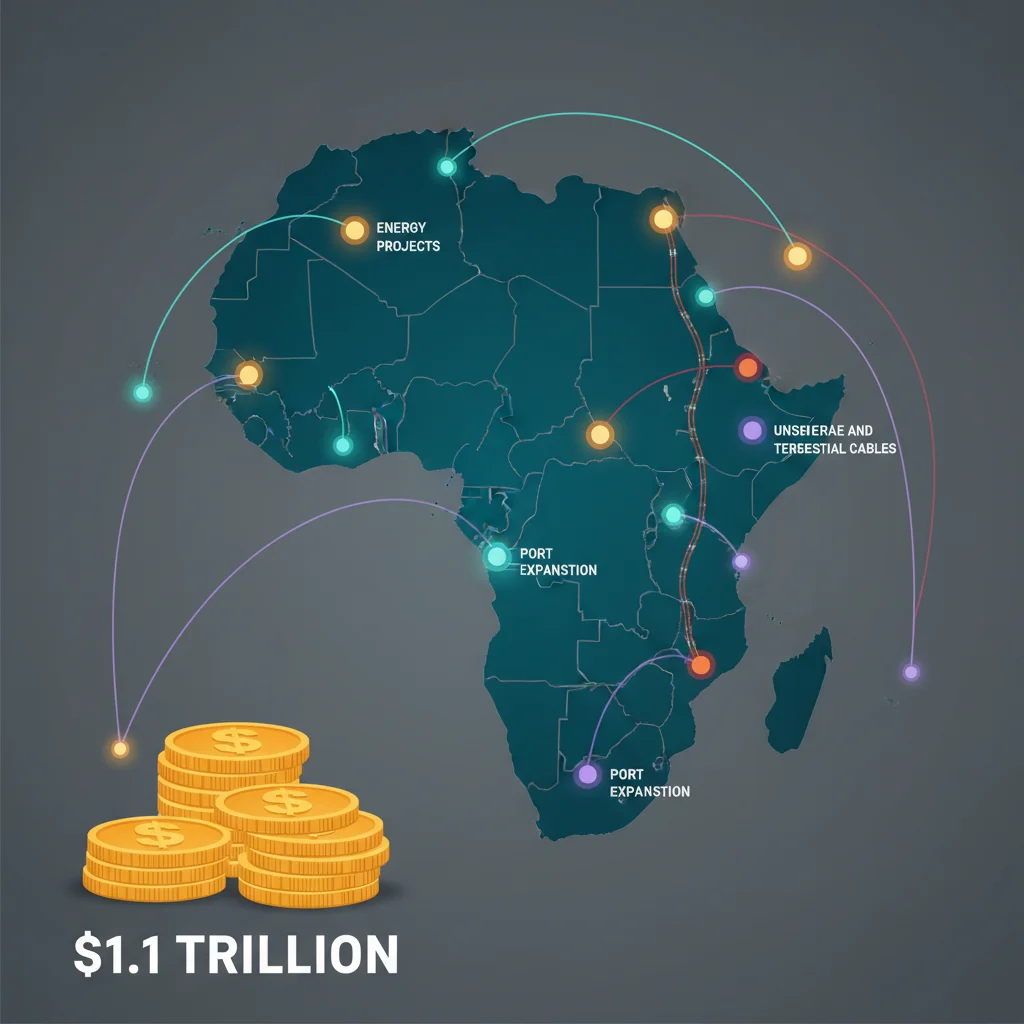
The State of Africa's Infrastructure Report 2025 reveals a continent with
Africa's Infrastructure Paradox: $1.1 Trillion in Domestic Capital Yet Lagging Buildout – Insights from 2025 Report
Introduction: The $1.1 Trillion Question
Africa holds over $1.1 trillion in domestic capital—pooled from pension funds, insurance companies, public development banks, and sovereign wealth funds. Yet the continent's infrastructure deficits remain among the most acute in the world. In 2024, Africa added only 6.5 GW of utility-scale power capacity. Compare that to India’s 18 GW of renewable additions and the United States’ 48.6 GW, and the gap becomes stark. The continent that is home to 18% of the global population accounts for less than 3% of global electricity generation.
This is the core paradox of Africa’s infrastructure story: abundant domestic savings are not translating into transformative buildout. The State of Africa’s Infrastructure Report 2025, published by the Africa Finance Corporation (AFC), reveals a continent sitting on a mountain of capital that remains largely parked in treasury bills, foreign bonds, and short-term instruments. Meanwhile, power outages cost sub-Saharan Africa an estimated 2–5% of GDP annually, and port congestion at major hubs like Mombasa and Durban adds weeks to global supply chains.
Why does this disconnect persist? The report points to fragmented regulatory environments, a lack of bankable project pipelines, and a persistent risk perception that deters domestic institutional investors from long-term infrastructure commitments. But the opportunities are equally clear: if Africa could mobilise even a fraction of its domestic capital into energy, transport, and digital infrastructure, the returns—both financial and developmental—would be transformative.
[IMAGE: Bar chart comparing energy additions (GW) across Africa, India, and the US in 2024]
Energy: Doubling the Buildout Urgently
Africa’s energy transformation is both an urgent necessity and a massive investment opportunity, the report states. To meet basic development goals, the continent must double or triple its annual energy buildout. Currently, over 600 million Africans lack access to electricity, and those who have it face unreliable supply and high costs.
The report identifies cross-border interconnectors and regional power markets as top priorities. Projects like the Zambia–Tanzania–Kenya interconnector and the Nigeria–Niger–Benin–Burkina Faso line could unlock economies of scale, allowing countries with abundant hydro or solar resources to export power to deficit regions. Yet only about 5% of electricity generated in Africa is currently traded across borders, compared to 15% in Southeast Asia and 70% in Europe.
Domestic capital can be channelled into these grid integration projects. Pension funds, with their long-duration liabilities, are natural investors in transmission infrastructure that offers stable, inflation-linked returns. But policy and regulatory harmonisation remain significant barriers. The report calls for standardised power purchase agreements, independent system operators, and regional regulatory bodies that can de-risk cross-border investments.
“Africa’s energy transformation is both an urgent necessity and a massive investment opportunity,” the AFC report quotes. “The capital exists; what is missing is the enabling environment to deploy it at scale.”
[IMAGE: Map of existing and planned cross-border electricity interconnectors in Africa]
Ports and Railways: Third Wave of Privatisation and Corridor Economics
Africa is entering a third wave of port privatisation, with new investment partners shifting from state-operated models to private-led frameworks that attract both domestic and foreign capital. The first wave, in the 1990s and early 2000s, saw major international terminal operators take over container handling in countries like South Africa, Nigeria, and Kenya. The second wave focused on smaller terminals and niche operations. Now, the third wave is characterised by greenfield projects, vertically integrated logistics hubs, and a growing role for domestic institutional investors.
The report highlights ports such as Lekki Deep Sea Port in Nigeria, Tema in Ghana, and the upcoming Bagamoyo port in Tanzania as examples of how private capital—including from African sovereign wealth funds—can transform trade infrastructure. Port privatisation in Africa has been shown to reduce vessel turnaround times by 30–50% and increase throughput by double-digit percentages.
Railway investment is also accelerating, notably along the Lobito Corridor, which connects the Democratic Republic of Congo’s mineral-rich Katanga province to Angola’s Atlantic coast. The corridor, backed by a consortium including the AFC, Trafigura, and Mota-Engil, aims to unlock billions of dollars in copper and cobalt exports. To guide investors, the AFC has launched a digital railway infrastructure map available at map.africafc.org, providing data on existing and planned rail lines, freight volumes, and investment opportunities.
Road infrastructure presents a more complex picture. While major corridors like the Trans-African Highway network are improving, secondary and rural roads show sharp disparities in quality and density. Private participation remains limited outside mining and agricultural corridors, representing a gap that domestic capital can fill through toll road concessions and public-private partnerships.
[IMAGE: Aerial view of the Lobito Corridor railway or a modernised port terminal]
Industrial Transformation: Steel, Fertilisers, and Oil Refining
The report identifies steel as “Africa’s industrial imperative.” The continent currently imports over 20 million tonnes of steel annually, worth roughly $20 billion, while holding vast reserves of iron ore and coking coal in countries like South Africa, Mauritania, and Liberia. Domestic capital can fund integrated steel mills that reduce import dependency, create jobs, and drive construction and manufacturing sectors.
Countries like Nigeria and Egypt have already begun investing in local steel production, but most projects remain in early stages or undercapitalised. The AFC report argues that by pooling pension fund and sovereign wealth capital, large-scale steel projects could achieve bankability. For every $1 billion invested in steel production, an estimated 10,000 direct and indirect jobs could be created, with significant downstream multiplier effects for the construction and automotive industries.
Fertilisers are called “the next frontier.” Africa imports roughly 80% of its fertiliser needs, yet the continent holds substantial natural gas reserves that can be converted into ammonia and urea. Building local production capacity would not only reduce import bills—estimated at $30 billion annually—but also boost agricultural yields and food security. The report cites the Dangote Fertiliser plant in Nigeria, which uses domestic gas to produce 3 million tonnes of urea per year, as a model that could be replicated across the continent.
Oil refining is another area where domestic capital can drive transformation. Despite being a major crude oil exporter, Africa imports over 50% of its refined petroleum products. The Dangote Refinery and the upcoming Uganda–Tanzania crude pipeline represent efforts to close this gap, but many other planned refineries face financing hurdles. The AFC report suggests that domestic capital, structured through special-purpose vehicles with multilateral guarantees, can help de-risk these projects and reduce Africa’s exposure to volatile global fuel markets.
[IMAGE: Photo of a steel mill or fertiliser plant with African workers, or a map of existing and planned refineries]
Digital Infrastructure: From Connectivity Gaps to Leapfrogging
The report highlights digital infrastructure as one of the most dynamic and investable sectors in Africa today. Data centre investment in the region grew by over 40% in 2024, driven by cloud adoption, mobile money expansion, and the rise of AI applications. Yet the continent still accounts for less than 2% of global data centre capacity, with most facilities concentrated in South Africa, Nigeria, and Kenya.
To meet demand, an estimated $50 billion in data centre investment is needed by 2030. Fibre optic backbone networks also require expansion: while coastal cities are well-served, inland regions remain underserved. The AFC report notes that domestic capital can play a pivotal role in financing fibre-to-the-home projects, submarine cable landings, and edge data centres that bring computing power closer to users.
The leapfrogging potential is real. Mobile money already accounts for over 70% of global transaction value, and digital identity systems are enabling financial inclusion for millions. But connectivity gaps persist; internet penetration remains below 40% in most sub-Saharan countries. The report argues that bridging this gap requires not just infrastructure investment but also policy reforms that lower spectrum costs, encourage infrastructure sharing, and reduce the cost of devices.
“Digital infrastructure in Africa is not just about connecting people,” the report states. “It is about enabling an entire ecosystem of e-commerce, education, healthcare, and financial services. The returns on investment are both commercial and social.”
[IMAGE: Infographic showing data centre growth and fibre connectivity map of Africa]
Financing the Future: Mobilising Domestic Capital
The central question remains: how can Africa mobilise its $1.1 trillion in domestic capital for infrastructure? The report outlines several key recommendations.
First, creating a pipeline of bankable projects is essential. Many African infrastructure projects fail to attract investment because they lack feasibility studies, environmental approvals, or creditworthy off-take agreements. The AFC proposes a “project preparation facility” that uses blended finance from development finance institutions and donors to bring projects to a bankable stage.
Second, new investment frameworks are needed. Pension funds in countries like Namibia, Botswana, and South Africa have already begun allocating to infrastructure, but regulatory caps and liquidity requirements constrain them elsewhere. The report calls for regulatory reforms that allow more flexible asset allocation, as well as the creation of infrastructure bonds with credit enhancements.
Third, cross-border integration is critical. Regional power pools, customs unions, and corridor institutions can create larger, more liquid markets that attract larger investors. The African Continental Free Trade Area (AfCFTA) provides the policy backbone, but implementation on infrastructure harmonisation remains slow.
Fourth, public-private partnerships (PPPs) must be structured to share risk appropriately. Many African PPPs have failed because governments retained too much risk or because contracts were not enforceable. The report advocates for standardised PPP frameworks, independent dispute resolution mechanisms, and greater transparency in procurement.
[IMAGE: Flowchart showing how domestic capital moves from pension funds, sovereign wealth funds, and banks into infrastructure projects]
Conclusion: A Roadmap for the Continent
Africa’s infrastructure paradox is not a mystery—it is a challenge of coordination, regulation, and risk perception. The $1.1 trillion in domestic capital is real, but it will not flow into energy, ports, railways, industrial plants, or data centres without deliberate action from governments, regulators, and financial intermediaries.
The State of Africa’s Infrastructure Report 2025 provides a clear roadmap: double the annual energy buildout to 15 GW or more; push forward the third wave of port privatisation and railway corridor development; invest in integrated steel, fertiliser, and refining capacity; and bridge digital connectivity gaps through targeted data centre and fibre backbone investments.
The opportunities are abundant, but they require a shift in mindset. Domestic capital must be seen not as a passive store of value but as an active engine of transformation. With the right frameworks, risk mitigants, and political will, Africa can turn its infrastructure deficit into a growth story that benefits its 1.5 billion people and the global economy. The question is no longer whether the capital exists—it is whether Africa’s leaders can deploy it.
[IMAGE: Stylized map of Africa with glowing nodes representing infrastructure projects, connected by lines, with '$1.1 trillion' in corner, modern clean design]