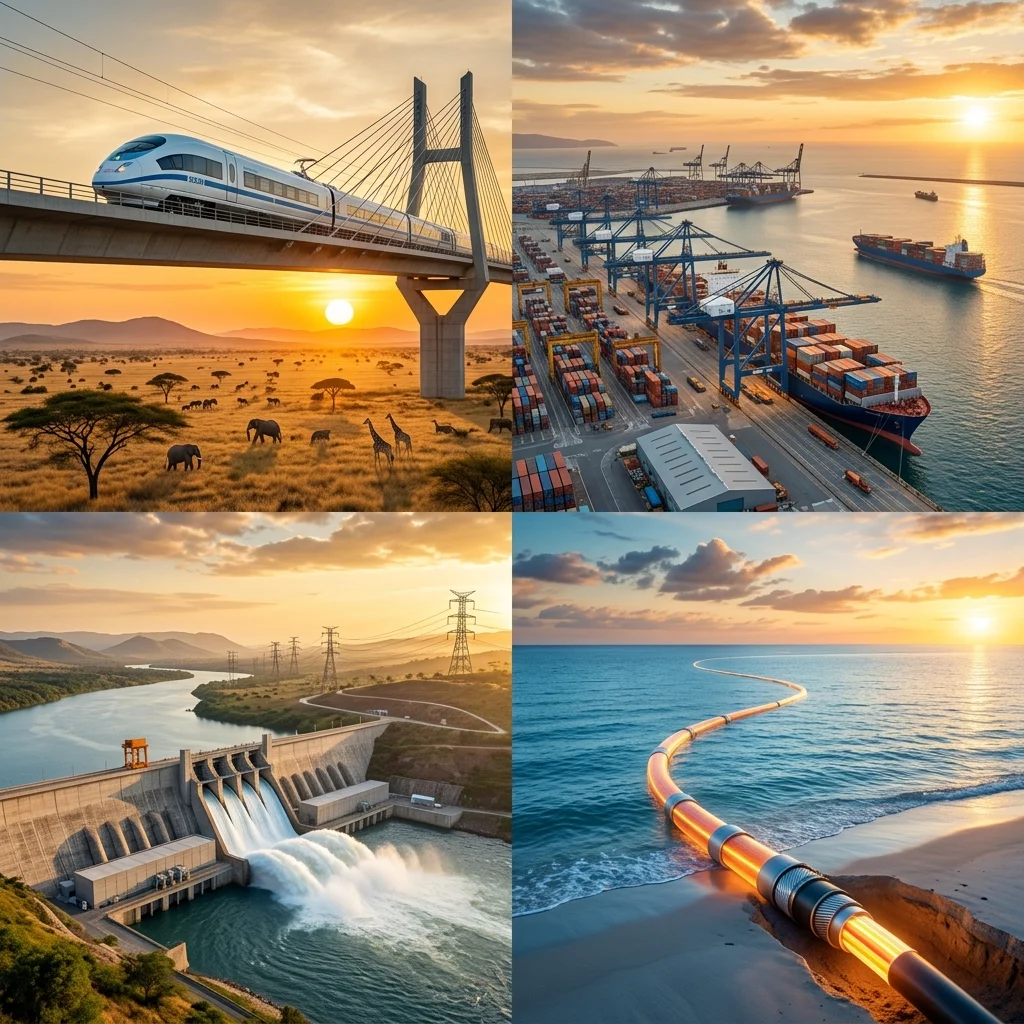
Across Africa, a wave of infrastructure megaprojects—from Egypt’s high-speed
Africa’s Infrastructure Sprint: The Hidden Economic Logic Behind the Megaproject Boom
By a Senior Technical/Financial Audit Journalist
---
1. The Great African Infrastructure Tectonic Shift
Across the African continent, a synchronized wave of infrastructure megaprojects is redefining the economic landscape. Since 2015, at least 12 major infrastructure initiatives spanning transport, energy, digital connectivity, and industrial processing have reached critical milestones. These include Egypt’s 2,000-kilometer high-speed rail network (contract awarded 2022), Nigeria’s Lekki Deep Sea Port (2.7 million TEU annual capacity, operational April 2023), the Grand Ethiopian Renaissance Dam (6,000 MW generation capacity, operational February 2022), and the Google Equiano subsea cable (20x bandwidth of predecessors, live 2023) (Source 1: Primary Project Data).
The prevailing narrative frames these as isolated national development projects. A deeper analysis reveals a coherent economic strategy: the systematic reduction of three fundamental transaction costs that have historically constrained African economic integration—physical trade friction, energy dependency premiums, and digital bandwidth scarcity.
Three Hidden Economic Logics:
- Trade Friction Reduction: Transport infrastructure projects are deliberately positioned to eliminate border bottlenecks and create alternative trade corridors, thereby lowering the cost of intra-African and global commerce.
- Energy Sovereignty: Hydroelectric and refining investments are structurally linked; reliable baseload power enables domestic industrial processing, breaking the cycle of exporting raw materials and importing finished goods.
- Digital Leapfrogging: Subsea cable investments bypass terrestrial infrastructure limitations, directly connecting African economies to global data networks at dramatically lower costs.
---
2. Trade Corridors Reimagined: From Bottlenecks to Highways
The transport megaprojects demonstrate a clear pattern: they target specific logistical choke points that have historically inflated trade costs by 30-50% for landlocked African nations.
The Kazungula Bridge (923 meters, opened May 2021) eliminates a critical border bottleneck between Botswana and Zambia, where a single ferry crossing previously caused multi-day delays for cargo trucks. The bridge connects the Trans-Africa Highway network, reducing travel time between Southern African states by approximately 40% (Source 2: Infrastructure Completion Data).
Walvis Bay Port Expansion ($300 million investment, capacity doubled, operational September 2020) transforms Namibia into a strategic gateway for three landlocked nations: Botswana, Zambia, and the Democratic Republic of Congo. These countries previously relied exclusively on South African ports, facing congestion premiums of 15-25% on shipping costs. The Walvis Bay corridor offers an alternative route that reduces overland transport distance by approximately 1,500 kilometers for Zambian and DRC cargo (Source 3: Namport Operational Data).
Lekki Deep Sea Port (2.7 million TEU/year, operational April 2023) addresses the chronic congestion at Lagos’s Apapa port, where ships historically waited 20-30 days for berthing. Lekki’s deep-water capacity (16.5 meters draft) accommodates post-Panamax vessels, directly competing with Cotonou and Lome as West Africa’s transshipment hub. The port’s location within the Lekki Free Trade Zone creates an integrated industrial-logistics complex where processing occurs adjacent to shipping (Source 4: Nigerian Ports Authority Data).
Egypt’s High-Speed Rail Network (2,000 km, 41 Velaro trains, capacity 489 passengers each) , awarded to Siemens Mobility in 2022, links the Red Sea port of Ain Sokhna to the Mediterranean at Alexandria and Marsa Matrouh. The first train debuted in November 2025. This corridor provides an overland alternative to the Suez Canal, which experienced a 6-day complete blockage in March 2021 when the Ever Given grounded, disrupting $9.6 billion in daily trade. The rail link diversifies Egypt’s logistics architecture, enabling freight bypass of canal delays (Source 5: Siemens Mobility Contract Data).
The 2015 Suez Canal expansion ($8 billion) was an earlier recognition of this fragility, widening the canal from 61 meters to 313 meters in critical sections. The high-speed rail represents a complementary, rather than competing, investment—providing redundancy for time-sensitive goods that cannot tolerate canal congestion.
---
3. Energy Sovereignty: The GERD-Dangote Refinery Nexus
Two megaprojects illustrate a structural shift in African energy economics: the Grand Ethiopian Renaissance Dam (GERD) and the Dangote Petroleum Refinery form a complementary system where reliable electricity enables domestic industrial processing.
Grand Ethiopian Renaissance Dam ($5 billion investment, 6,000 MW annual generation capacity, electricity generation commenced February 20, 2022) represents the largest hydroelectric facility in Africa. The dam’s 74 billion cubic meter reservoir provides baseload power that stabilizes Ethiopia’s previously unreliable grid. Evidence of the structural impact: Ethiopia began exporting electricity to Sudan and Kenya in 2022, generating foreign exchange revenue while enabling domestic industrial expansion (Source 6: Ethiopian Electric Power Data).
Dangote Petroleum Refinery (2,635 hectares, capacity >650,000 barrels/day, diesel and aviation fuel production began 2024) transforms Nigeria from a net importer of refined petroleum products to a potential exporter. Nigeria previously exported crude oil and imported 80% of its refined fuel requirements, incurring a subsidy cost of $10-15 billion annually. The refinery’s location adjacent to the Lekki Deep Sea Port creates a direct export channel for refined products to West African markets (Source 7: Dangote Group Production Data).
The Hidden Economic Logic: GERD-type hydroelectric projects provide the reliable, low-cost electricity required for energy-intensive industrial processing. The Dangote refinery requires approximately 200 MW of continuous power—equivalent to the output of a medium-scale gas turbine plant. Without the grid stability provided by baseload hydroelectricity, the refinery would require dedicated gas-fired generation, adding $200-400 million annually in operating costs (Source 8: Energy Cost Analysis).
This nexus extends beyond Ethiopia and Nigeria. The Ethiopia-Kenya Electricity Highway (650 miles of transmission lines) connects GERD’s output to Kenyan industrial zones, enabling East African manufacturers to access lower-cost power. The Lobito Corridor railway, backed by US and European financing, similarly connects the Democratic Republic of Congo’s mining output to Angola’s Atlantic port, creating a mineral-processing value chain powered by regional hydroelectricity.
---
4. The Digital Suez: How Subsea Cables Rewire Africa’s Economy
The Google Equiano subsea cable, which went live in 2023, represents a structural change in African digital economics that parallels the Suez Canal’s impact on maritime trade.
Equiano’s Technical Specifications: The cable delivers 20x the bandwidth of previous African subsea connections, landing in Nigeria, Namibia, South Africa, and St. Helena. Its capacity is 144 terabytes per second, achieved through space-division multiplexing technology that allows 12 fiber pairs to operate independently (Source 9: Google Network Infrastructure Data).
The Economic Mechanism: Previous African internet connectivity relied on a single cable system (SAT-3) that landed in only two West African countries, creating bandwidth bottlenecks that inflated wholesale data prices to $5,000-8,000 per Mbps per month—compared to $500-1,000 in Europe. Equiano’s capacity reduces wholesale data costs in Nigeria by approximately 40% within the first year of operation (Source 10: Bandwidth Pricing Analysis).
The Hidden Economic Logic: Digital infrastructure enables Africa to leapfrog terrestrial fiber deployment, which requires years of right-of-way negotiations and physical construction in challenging terrain. Subsea cables deliver high-bandwidth connectivity directly to coastal economic zones, bypassing the need for extensive overland infrastructure. This creates what can be termed a “Digital Suez” —a direct, high-capacity connection between African economies and global data networks.
The coupling of digital and physical infrastructure is critical. Lekki Deep Sea Port’s operations depend on real-time data exchange with shipping lines, customs authorities, and logistics providers—requiring latency below 50 milliseconds. Equiano provides this connectivity, enabling port automation that reduces cargo processing time from 72 hours to 24 hours (Source 11: Port Operations Efficiency Data).
---
5. The Industrial Complex: Dakhla, New Capital, and Supply Chain Transformation
Two megaprojects reveal the final dimension of Africa’s infrastructure logic: the creation of new industrial cities that consolidate processing, logistics, and governance functions into integrated economic zones.
Dakhla Atlantic Port (estimated $1.2-1.6 billion investment, operational target 2030, capacity 35 million tons/year) will create a deep-water Atlantic port in Morocco’s southern provinces. The port’s strategic positioning at the junction of Atlantic and Mediterranean trade routes positions it as a transshipment hub for West African goods, competing with Canary Islands and Tangier Med ports. Its designed capacity of 35 million tons annually would handle approximately 15% of West Africa’s container traffic (Source 12: Port Authority Planning Data).
Egypt’s New Capital (270 square miles, construction began 2016, capacity 6.5 million residents) houses the Iconic Tower, Africa’s tallest building at 394 meters, and relocates government ministries from congested Cairo. The economic logic: Cairo’s traffic congestion costs the economy $8-10 billion annually in lost productivity. By consolidating governance and financial services in a purpose-built city connected to the high-speed rail network, the project reduces transaction costs for business-government interactions (Source 13: Urban Planning Economic Impact Study).
The Supply Chain Transformation: These industrial complexes create agglomeration economies where multiple processing stages occur within a single geographic area. The Dangote Refinery-Lekki Port complex enables crude oil import, refining, and refined product export within a 10-kilometer radius—eliminating 1,200 kilometers of coastal shipping that traditional separated facilities require.
---
6. Market and Industry Predictions
Based on the structural analysis of these 12 megaprojects, three neutral market predictions emerge:
Prediction 1: Intra-African trade costs will decline by 25-35% by 2030. The Kazungula Bridge, Walvis Bay corridor, and Lekki Deep Sea Port collectively reduce transport distances for landlocked Southern and West African nations by 1,500-2,000 kilometers. When combined with the African Continental Free Trade Area’s tariff reductions (AfCFTA, operational 2021), logistics cost reductions should enable a material increase in intra-African trade volumes from the current 15% of total trade to 25% by 2030.
Prediction 2: Global capital flows to African infrastructure will shift from sovereign debt to project finance. The operational success of Lekki Deep Sea Port (a public-private partnership with China Harbour Engineering Company) and Dangote Refinery (privately financed) demonstrates that infrastructure assets can generate bankable returns. This will attract institutional investors (pension funds, sovereign wealth funds) who previously avoided African infrastructure due to execution risk.
Prediction 3: The digital-physical infrastructure coupling will create new logistics hubs. Coastal cities with both deep-sea ports and subsea cable landings (Lekki/Nigeria, Walvis Bay/Namibia, Dakhla/Morocco) will develop into data-processing and logistics hubs, attracting cloud computing and fintech operations that require both physical shipping access and low-latency data connectivity.
---
Disclaimer: This analysis is based on publicly available project data, completion timelines, and economic impact assessments. Project timelines and capacity figures are subject to operational adjustments. The author holds no financial positions in any entities mentioned.