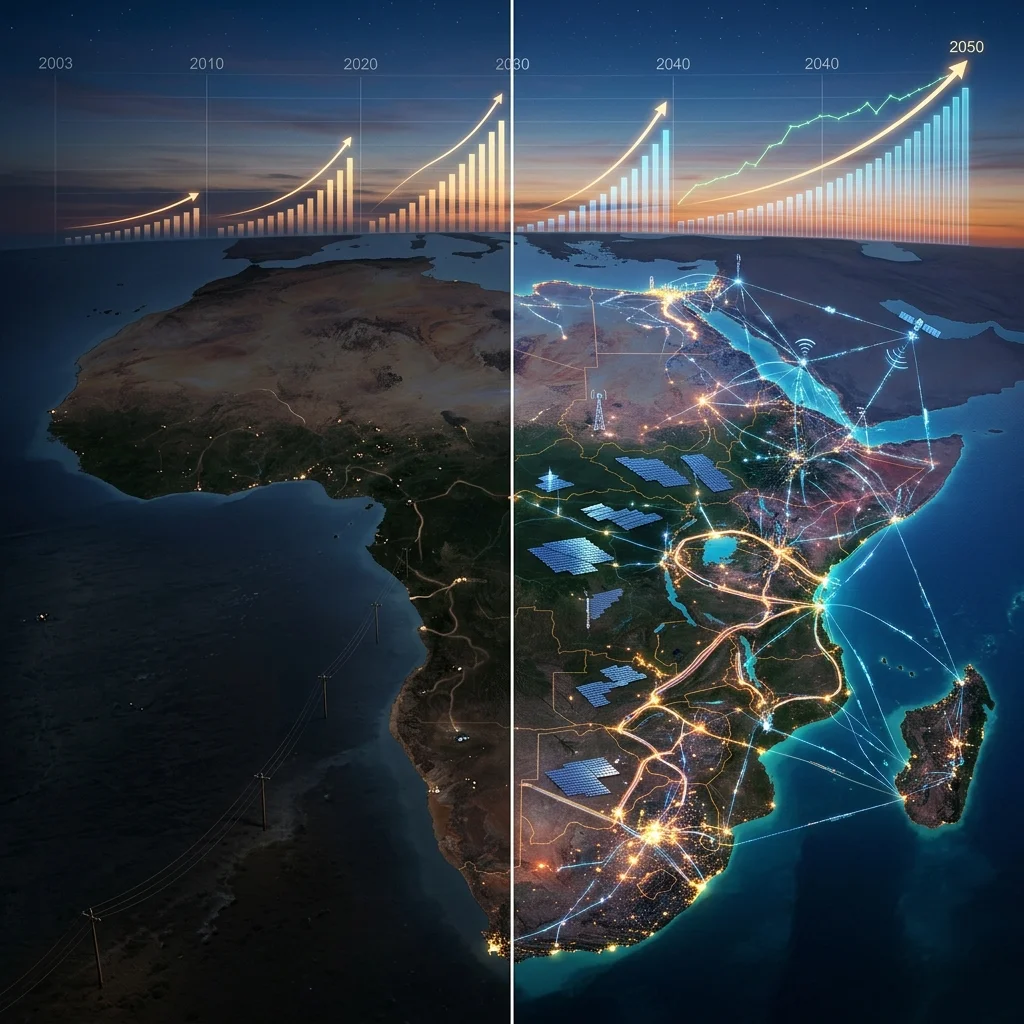
Africa’s infrastructure gap remains one of the biggest barriers to economic
Africa’s Infrastructure Leap: From Fragmented Systems to a Trillion-Dollar Economy by 2050
Introduction: The Infrastructure Paradox
Africa stands at a crossroads where surging economic potential collides with chronic infrastructure deficits. The continent faces an annual financing gap of $130–170 billion—a figure that dwarfs current investment flows and underscores the scale of the challenge. Yet the dominant funding model remains government-led, constrained by narrow fiscal space and competing priorities such as health, education, and debt servicing. This creates a fundamental paradox: a region with some of the world’s fastest-growing economies and youngest populations remains trapped by fragmented systems, weak cross-border coordination, and ageing hard infrastructure.
The implications extend beyond inconvenience. Poor road networks add 30–50% to transport costs in landlocked countries. Unreliable electricity forces businesses to rely on expensive diesel generators, eroding competitiveness. Digital connectivity gaps exclude hundreds of millions from the global economy. The ISS African Futures scenarios provide a stark analytical framework: under the Current Path, incremental improvements barely dent the deficit; under the Large Infrastructure and Leapfrogging scenario, coordinated, ambitious investment could unlock a near-trillion-dollar expansion by 2050. The choice between these futures is not just technical—it is existential for Africa’s developmental aspirations.
[IMAGE: Map of Africa with infrastructure bottlenecks highlighted (e.g., missing road corridors, low electrification zones).]
---
Two Decades of Progress: AIDI Score Analysis
The Africa Infrastructure Development Index (AIDI), published by the African Development Bank, offers a composite measure covering four pillars: transport, electricity, ICT, and water/sanitation. Between 2003 and 2025, Sub-Saharan Africa improved its AIDI score by approximately 50%—a remarkable gain from a very low base. North Africa, starting from a higher baseline (driven by countries like Egypt, Morocco, and Tunisia), saw only a 12% increase over the same period. This divergence tells a nuanced story: rapid catch-up is possible in lagging regions, but absolute gaps remain vast.
Breaking down the components reveals uneven progress. Transport infrastructure—roads and railways—has seen moderate expansion, but quality and maintenance remain poor. The ICT pillar has experienced the fastest growth, driven by mobile penetration and fibre-optic cable landings, though rural access lags. Energy and water components have improved slowly, constrained by large upfront capital requirements and long project timelines. The AIDI data underscores that while Africa is not standing still, the pace and distribution of infrastructure development remain insufficient to meet the demands of industrialisation and urbanisation.
Critically, the AIDI improvement masks significant intra-regional disparities. East Africa has made strong strides in ICT and energy, while Central Africa remains the most underserved. Southern Africa benefits from South Africa’s relatively developed grid and transport corridors, but other countries in the region struggle. The lesson for policymakers: aggregate gains do not automatically translate into inclusive development. Targeted interventions in the weakest pillars—especially electricity—are essential to avoid deepening inequality even as averages rise.
[IMAGE: Bar chart comparing AIDI improvements by region (2003 vs 2025) with annotations.]
---
Electricity Access: The 600 Million Challenge
In 2024, only 58% of Africans had access to electricity—a figure that starkly illustrates the continent’s energy poverty. Just six countries (Egypt, Mauritius, Seychelles, Morocco, Algeria, Tunisia) have achieved universal access. The rest of the continent is grappling with a gap that affects 600 million people, according to International Energy Agency estimates. This "electricity trap" is not merely a statistic; it is a direct brake on industrialisation, healthcare delivery (vaccine cold chains, hospital equipment), education (lighting for evening study, digital learning), and the digital economy.
Under the Current Path scenario modelled by ISS African Futures, the situation improves only marginally by 2050. An estimated 543 million people—21% of the projected population—would remain without electricity. That is barely better than today’s 42% unserved share in absolute terms, and worse in relative terms given population growth. The implication is sobering: business-as-usual will leave a fifth of Africa in the dark for another generation.
The bottleneck is not just generation capacity but also transmission and distribution networks. Many countries have added generation (especially renewables like solar and hydropower), but weak grids mean power is lost or cannot reach remote areas. Off-grid solutions—mini-grids and solar home systems—offer a pathway, but scale-up faces regulatory hurdles, financing constraints, and maintenance challenges. Achieving universal electricity access by 2050 would require tripling annual investment in the power sector to over $100 billion, according to the African Development Bank. Without a decisive shift in policy and capital mobilisation, the electricity trap will persist.
[IMAGE: Nighttime satellite image of Africa showing stark contrast in light emissions between northern/coastal regions and the interior.]
---
The Current Path vs. The Leapfrogging Scenario
The ISS African Futures modelling provides a quantitative comparison of two trajectories. Under the Current Path, Africa’s infrastructure development continues at its present pace—incremental, fragmented, and constrained by low government investment and limited private sector participation. GDP growth remains moderate, poverty reduction slow, and the continent’s share of global trade stagnates.
By contrast, the Large Infrastructure and Leapfrogging scenario envisions a coordinated, ambitious push: integrated transport corridors, continental energy pools, universal digital connectivity, and accelerated adoption of leapfrog technologies such as mobile money, drone logistics, and smart grids. The projected outcomes are striking:
- GDP per capita rises by approximately $510 (in constant 2015 dollars) by 2050 compared to the current path.
- Trade volume increases by $478 billion.
- The total economy is nearly $1 trillion larger.
- Extreme poverty (living below $1.90/day) falls to 299 million—63 million fewer people than under the Current Path.
These gains are not automatic. They hinge on overcoming what the African Development Bank calls the "financing paradox": governments are the primary funders of infrastructure but have limited fiscal space, while private capital remains cautious due to perceived risks, currency volatility, and weak regulatory frameworks. The leapfrogging scenario requires a dual-track approach: traditional hard infrastructure (roads, ports, power plants) paired with digital leapfrogging (mobile broadband, fintech, satellite connectivity). The latter offers lower per-capita costs and faster deployment, but cannot substitute for foundational assets like electricity and transport.
[IMAGE: Side-by-side comparison infographic showing Current Path indicators vs. Leapfrogging scenario indicators for 2050.]
---
Regional Integration: The Missing Link
One of the most critical yet underappreciated dimensions of Africa’s infrastructure challenge is regional integration. The continent has 54 countries with widely varying standards, regulations, and grid specifications. A road corridor from Lagos to Abidjan may cross multiple customs posts, weigh stations, and checkpoints, adding days to transit times. A power pool connecting hydro-rich Ethiopia and Kenya with energy-deficient neighbours faces transmission losses and tariff disagreements. The African Continental Free Trade Area (AfCFTA) creates a policy framework for integration, but infrastructure must follow.
The East African Community (EAC) and the Southern African Development Community (SADC) have made progress on cross-border transport corridors and energy trade, but implementation is slow. The Programme for Infrastructure Development in Africa (PIDA) prioritises 69 projects worth $150 billion, yet many remain stalled due to funding gaps and political coordination challenges. Under the leapfrogging scenario, harmonised standards, joint project planning, and regional infrastructure bonds could unlock substantial efficiencies. For example, the West African Power Pool could reduce electricity costs by up to 30% through trade and shared reserves, while the Trans-African Highway network could cut logistics costs that currently account for 40–70% of product prices in landlocked countries.
---
Private Capital Mobilisation and the Hidden Logistics Cost
Mobilising private capital is essential to bridge the financing gap, but historical returns on Africa infrastructure have been modest due to risks including currency devaluation, regulatory unpredictability, and off-taker creditworthiness. Blended finance instruments—combining concessional capital from development finance institutions with commercial investment—have emerged as a promising approach. The Africa50 infrastructure fund, for instance, has successfully co-financed projects in energy and transport. Infrastructure debt funds, green bonds, and public-private partnerships (PPPs) need stronger enabling environments, including independent regulators, transparent procurement processes, and currency hedging mechanisms.
A hidden cost that the Current Path perpetuates is logistics inefficiency driven by road dominance. Over 80% of Africa’s freight moves by road, despite railways being 4–6 times more energy-efficient per ton-km. Road maintenance costs are high, congestion in urban corridors erodes productivity, and carbon emissions are significant. Shifting freight to rail and inland waterways requires massive upfront investment but offers long-term savings. The leapfrogging scenario envisions multi-modal transport corridors, including upgraded railways (such as the standard-gauge lines in Kenya and Ethiopia), dry ports, and riverine navigation on the Congo and Niger rivers. Combined with digital logistics platforms for cargo tracking and customs automation, these investments could reduce transport costs by 20–30%, directly improving trade competitiveness.
---
Conclusion: A Roadmap for Policymakers and Investors
Africa’s infrastructure gap is not an insurmountable barrier—it is an investment opportunity that, if seized, can transform the continent’s economic trajectory. The evidence from AIDI scores, ISS scenarios, and regional case studies points to a clear path: dual-track investment blending traditional hard infrastructure with digital leapfrogging, regional integration to eliminate fragmentation, and innovative financing to de-risk private capital.
Policymakers must prioritise bankable project preparation, regulatory harmonisation, and fiscal space reforms. Investors should look beyond headline risks to the demographic dividend, urbanisation trends, and resource-driven demand. The 600 million people without electricity are not just a statistic—they are a market waiting to be connected. The fragmented transport networks are not just a cost—they are a bottleneck waiting to be unblocked. The Leapfrogging scenario shows that with coordination and ambition, Africa can move from fragmented systems to a trillion-dollar economy by 2050. The question is not whether it is possible, but whether the continent—and its partners—will choose the path that leads there.
[IMAGE: Infographic summary of recommended dual-track approach: hard infrastructure (roads, rail, power) on one side, digital leapfrogging (broadband, fintech, smart grids) on the other, with arrows showing synergy towards 2050 GDP and poverty reduction targets.]