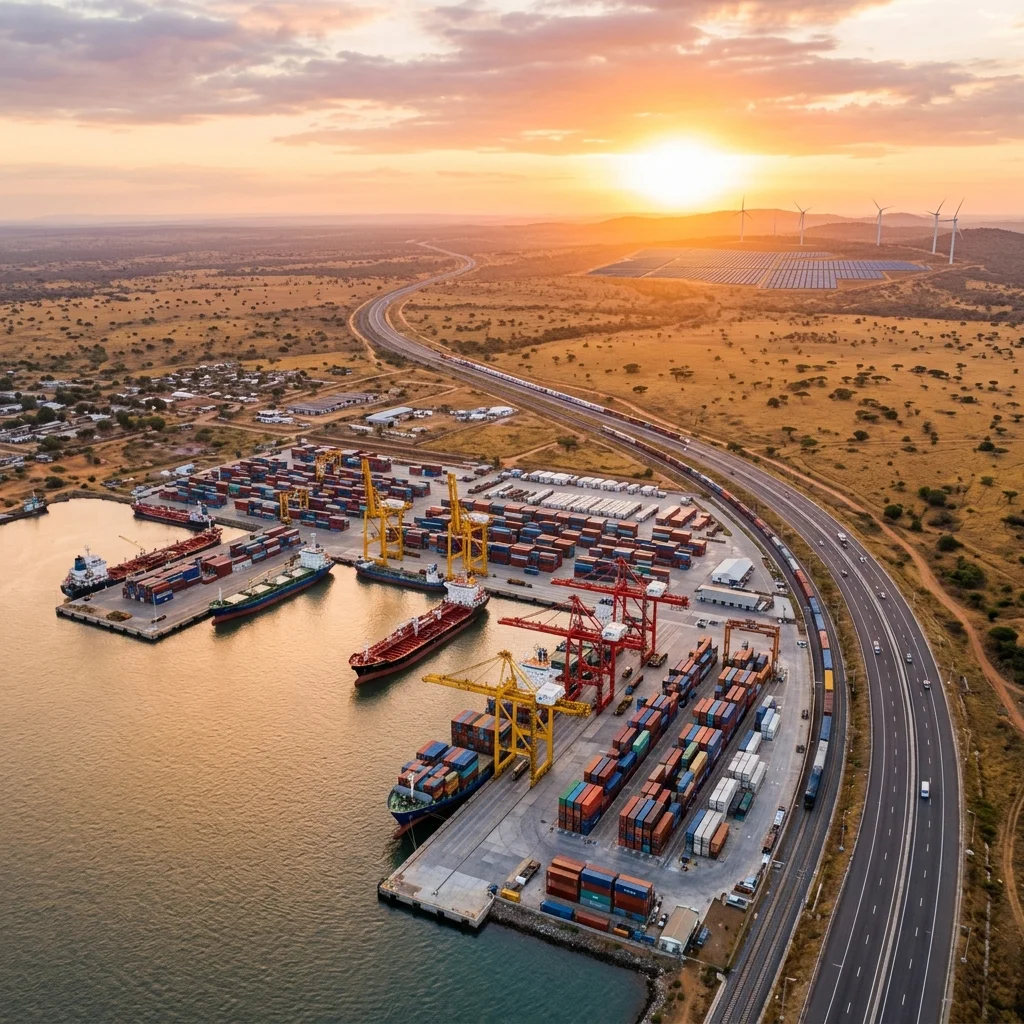
The African Continental Free Trade Area (AfCFTA) promises to unlock intra-African
The $400 Billion Missing Link: Infrastructure Investment Opportunities Under the African Continental Free Trade Area
The Hidden Economic Logic: Trade Without Roads Is Just a Promise
The African Continental Free Trade Area (AfCFTA) represents the world's largest free trade zone by number of participating countries, encompassing 54 nations with a combined GDP of $3.4 trillion. Yet the agreement's tariff elimination provisions—covering 90% of goods—will remain largely theoretical without a corresponding transformation in physical connectivity. Implementation of the AfCFTA will require an additional 2 million trucks, 150,000 rail wagons, over 150 maritime vessels, and 250 aircraft (Source 1: ECA primary data). The physical networks to support these assets are currently absent or severely degraded across most trade corridors.
Current intra-African trade accounts for approximately 15% of total continental trade, compared to 58% in Asia and 68% in Europe (Source 2: African Development Bank comparative trade data). This disparity is not primarily a function of tariff barriers, which the AfCFTA addresses, but of logistical fragmentation. Transport costs in Africa are 50-100% higher than in other developing regions, with border delays averaging 4-6 days (Source 3: ECA transport logistics database).
The core insight is structural: infrastructure investment under AfCFTA is not a cost center requiring subsidy but the single largest enabler of the tariff-free trade gains the agreement promises. Without it, tariff reductions produce marginal benefits constrained by physical bottlenecks. With it, the multiplier effects cascade through manufacturing, agriculture, and services sectors that depend on predictable supply chains.
The $70–90 Billion Annual Funding Gap: Who Pays and What For?
Africa's annual infrastructure needs are estimated between $130 billion and $170 billion. Current average annual investment stands at approximately $80 billion, leaving a funding gap of $70–90 billion annually (Source 1: Mike Salawou, ECA Director of Technology, Climate Change and Natural Resources Management). This gap is not uniformly distributed across sectors.
The water sector accounts for approximately 50% of the infrastructure funding deficit, driven by urban population growth and climate-induced water stress. Energy accounts for 21%, reflecting the continent's chronic power generation deficits. Transport accounts for 16%, with cross-border corridors receiving disproportionate underinvestment relative to urban road networks (Source 4: ECA sectoral breakdown analysis).
The African Development Bank has committed approximately $45 billion to cross-border infrastructure projects, representing the largest multilateral allocation to this segment (Source 5: AfDB project portfolio data). However, public financing sources—multilateral development banks, bilateral aid, and national budgets—collectively cover less than 50% of the annual requirement. Private capital participation remains constrained by regulatory risk, currency volatility, and project bankability issues.
The funding gap's composition reveals a structural mismatch: the sectors with highest returns to AfCFTA trade facilitation (transport and energy) receive proportionally less public financing than water, which has stronger political constituencies but weaker direct trade impacts. This misallocation represents the primary strategic entry point for investors seeking projects with demonstrable trade-enabling returns.
Transport: The $400 Billion Opportunity in Rolling Stock and Routes
Transport infrastructure investment opportunities under the AfCFTA exceed $400 billion, concentrated in rolling stock acquisition, port modernization, and corridor development (Source 1: Robert Lisinge, ECA Acting Director of Technology, Climate Change and Natural Resources Management). This figure encompasses the vehicles, vessels, and aircraft required to service expanded intra-African trade volumes.
The breakdown of the $400 billion opportunity reveals distinct investment categories with varying risk-return profiles. Truck fleet expansion (estimated at $80–100 billion) represents the most accessible entry point, with relatively short asset lives (5–7 years) and predictable demand from landlocked countries' import dependencies. Rail rolling stock ($50–70 billion) requires longer horizons but benefits from existing corridor concessions in East and Southern Africa. Maritime vessels ($60–80 billion) and aircraft ($40–60 billion) require specialized operational expertise but offer Pan-African market coverage (Source 6: ECA transport demand modeling).
The operational ecosystem supporting these assets—maintenance hubs, fueling stations, digital tracking systems, and customs terminals—represents an additional $100–150 billion in complementary investment. This "software" layer of transport infrastructure is frequently overlooked in public-sector planning but generates higher returns than physical assets due to lower capital requirements and recurring revenue models.
Border crossing modernization alone could reduce transit times by 30-50% on major corridors (Source 7: AfDB trade facilitation studies). The one-stop border post model, implemented at 20+ crossings under AfDB financing, has demonstrated 40% reductions in clearance times and 25% reductions in transport costs. Scaling this model across the 100+ major border crossings on the Trans-African Highway network represents a $5–8 billion investment opportunity with measurable trade volume impacts.
Energy: The 80% Generation Gap by 2035 and the 3% Climate Premium
Energy demand in Africa is projected to rise by 3% by 2030. More significantly, an additional 80% of electricity generation capacity will be required by 2035 compared to 2020 levels (Source 1: ECA energy sector projections). This gap is not merely a domestic consumption issue but a binding constraint on trade-enabling infrastructure: logistics hubs, cold chains, port equipment, and digital customs systems all require reliable power.
Current installed generation capacity in sub-Saharan Africa (excluding South Africa) stands at approximately 80 GW, roughly equivalent to Spain's capacity for a population 20 times larger (Source 8: International Energy Agency Africa Energy Outlook). The generation deficit is concentrated in baseload capacity, with intermittent renewable sources accounting for less than 10% of total generation despite high solar and wind potential.
Integrating climate resilience into existing infrastructure systems costs an estimated 3% of total investment (Source 1: Elizabeth Maruma Mrema, UNEP Deputy Executive Director). This premium insures against cascading trade disruptions: port flooding from sea-level rise, road washouts from extreme precipitation events, and power outages from drought-affected hydroelectric systems. In West Africa, the 2022 port closures in Abidjan and Tema—caused by coastal flooding—resulted in estimated trade losses of $300 million per week (Source 9: UNEP climate impact assessment).
The climate resilience premium is not a voluntary add-on but a structural requirement for asset valuation. Infrastructure projects without resilience specifications face shorter economic lifespans and higher maintenance costs, reducing their bankability for long-term investors. For institutional investors requiring 20-30 year asset horizons, the 3% upfront cost translates to negative net present value in scenarios without climate adaptation.
Deep Entry: The Invisible Logistics Web—Digital Infrastructure as the Fourth Utility
Beyond physical assets, the AfCFTA requires interoperable digital infrastructure spanning customs systems, real-time cargo tracking, and cross-border payment settlement. This "smart corridor" concept—integrating Internet of Things sensors for cargo monitoring, blockchain for trade documentation, and automated customs clearance—represents a capital-light investment opportunity with high scalability.
Current customs digitization levels vary dramatically across African states, from 90% digital clearance in Rwanda to less than 15% in several Central African nations (Source 10: ECA digital trade readiness assessment). The absence of interoperable single-window customs platforms forces physical document processing at borders, negating the time savings from tariff elimination. Investment in digital customs infrastructure—costing $10–30 million per country for comprehensive deployment—generates trade facilitation returns of 15-25:1 through reduced clearance times and lower compliance costs (Source 11: World Bank trade facilitation cost-benefit analysis).
Cross-border payment systems represent the second digital infrastructure priority. The Pan-African Payment and Settlement System (PAPSS), developed by Afreximbank, currently processes transactions in 50+ currencies across 16 central banks. Scaling PAPSS to full continental coverage requires additional $50–80 million in system development and integration costs, with projected transaction volumes exceeding $5 billion annually by 2027 (Source 12: Afreximbank payment system projections).
Digital infrastructure investments exhibit three characteristics attractive to institutional investors: (1) government counterparties with sovereign credit ratings, (2) recurring revenue from transaction fees, and (3) scalability without proportional physical footprint expansion.
Market Predictions and Strategic Entry Points
Three investment themes emerge from the infrastructure gap analysis:
First, climate-resilient transport corridor assets—ports, railways, and border crossings—will command premium valuations as trade volumes increase. Projects incorporating climate adaptation specifications (raised port elevations, drought-resistant road materials, redundant power supply) will achieve lower financing costs and longer asset lifecycles than conventional alternatives. The 3% climate premium will become standard underwriting practice within 3-5 years.
Second, energy infrastructure adjacent to trade corridors—dedicated power generation for logistics hubs, cold chain storage, and industrial parks—offers higher returns than general grid electrification projects. Investors targeting these "trade-adjacent" energy assets can secure power purchase agreements with logistics operators whose revenue depends on continuous power supply, creating stronger counterparty credit profiles than residential or commercial off-takers.
Third, digital trade infrastructure—customs platforms, payment systems, and tracking networks—represents the highest risk-adjusted return opportunity. Capital requirements are modest ($10–50 million per project), implementation timelines are 12-24 months (versus 5-10 years for physical infrastructure), and scalability is nearly unlimited once interoperability standards are established.
The infrastructure funding gap will not close through incremental increases in public financing. The gap's magnitude—$70–90 billion annually—requires systemic changes in project preparation, risk allocation, and regulatory frameworks to attract institutional capital. Development finance institutions currently provide approximately 30% of total infrastructure investment; shifting this proportion to 20% with private capital filling the remaining 10% gap would require $15–20 billion in new private investment annually (Source 13: AfDB capital mobilization analysis).
Projects achieving financial close within the next 24 months will capture first-mover advantages in corridor development and pricing power. Projects delayed beyond 2027 will face increased competition and compressed margins as infrastructure asset classes mature and investor awareness expands. The window for strategic infrastructure investment under the AfCFTA is open, finite, and conditioned by the physical reality that trade does not flow through treaties but through roads, rails, ports, and power lines.