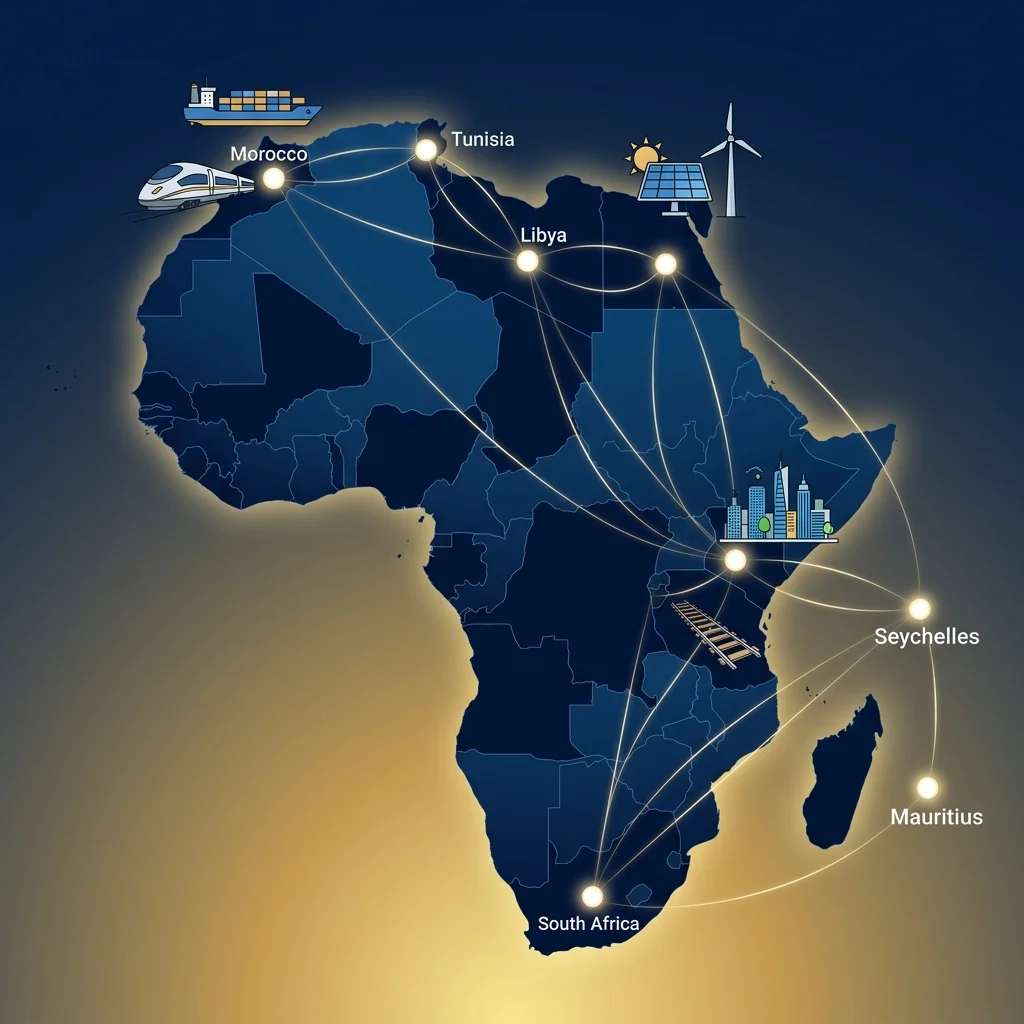
The Africa Infrastructure Development Index (AIDI) 2024 reveals seven top-performing
Africa Infrastructure Development: Top 7 Countries Leading AIDI 2024 and Major Investment Projects
Introduction: The New Frontier of African Infrastructure
The 2024 Africa Infrastructure Development Index (AIDI), published by the African Development Bank (AfDB), ranks seven countries at the top of the continent’s infrastructure performance: Seychelles (99.77), Egypt (91.43), Libya (84.84), Mauritius (82.77), South Africa (82.54), Tunisia (74.18), and Morocco (70.32) (Source: AfDB AIDI 2024). These scores reflect a composite measure of transport, electricity, ICT, and water/sanitation infrastructure.
A thematic shift underlies these rankings: African infrastructure is moving from basic, donor-funded projects toward complex, investment-backed megaprojects that attract global capital and strategic partnerships. According to the Africa Finance Corporation’s State of Africa’s Infrastructure Report 2025, the continent holds over $4 trillion in pooled domestic savings, providing a capital base that reduces reliance on external aid. Simultaneously, AfDB President Akinwumi Adesina has stated that $55 billion was invested in infrastructure during his tenure, reinforcing the institution’s role as a catalyst for private-sector engagement. The core axis of the current development model is clear: Africa is transitioning from an aid recipient to an investment destination.
---
Morocco’s Quantum Leap: A Blueprint for Transformative Growth
Morocco’s AIDI score increased by 51.24 points from approximately 19 in 2003 to 70.32 in 2024, the highest growth among major African economies (Source: AfDB AIDI 2024). This trajectory is underpinned by three flagship assets:
- Tangier-Med port: A deep-water transshipment hub that links Africa to Europe and Asia, handling over 8 million TEUs annually and serving as a logistics gateway for the region.
- Noor solar complex: One of the world’s largest concentrated solar power plants, with a total capacity exceeding 580 MW, enabling Morocco to target 52% renewable energy by 2030.
- Al Boraq high-speed rail: Africa’s first high-speed railway, connecting Casablanca and Tangier at 320 km/h, reducing travel time to 2 hours 10 minutes and integrating economic corridors.
The economic logic behind Morocco’s growth is threefold. First, its strategic geographic position on the Strait of Gibraltar allows it to capture transcontinental trade flows. Second, energy autonomy—driven by solar and wind investments—reduces import dependency and stabilises industrial input costs. Third, integration with global supply chains attracts foreign direct investment (FDI) into automotive, aerospace, and phosphates industries. These factors create a self-reinforcing cycle: infrastructure quality improves competitiveness, which attracts capital, which funds further infrastructure upgrades.
---
Green Hydrogen, Smart Cities, and Railway Megaprojects
Beyond Morocco, several major projects across the continent illustrate the scale and diversity of current investments.
Egypt has positioned itself as a global clean energy hub by signing nearly $40 billion in green hydrogen and renewable energy investment agreements (Source: Egypt’s Ministry of Electricity & Renewable Energy, 2023). These agreements cover production of green ammonia, electrolysers, and solar/wind farms in the Suez Canal Economic Zone. Egypt’s existing energy infrastructure—including the Benban solar park (1.5 GW)—provides a ready grid for scaling green hydrogen exports to Europe under the EU’s REPowerEU framework.
Kenya is advancing the Konza Technopolis smart-city project, designed as a “Silicon Savannah” to host technology companies, data centres, and a technology university. The project aims to create 20,000 direct jobs by 2030 and serves as a model for urban infrastructure integration. Separately, the Kenya–Ethiopia rail link, with estimated costs exceeding $14 billion (Source: African Development Bank & Kenya Ministry of Transport, 2024), will connect the port of Lamu to Addis Ababa, reducing logistics costs for landlocked Ethiopia and opening a new export corridor for Kenyan goods.
Tanzania–Burundi are jointly building a Standard Gauge Railway (SGR) expected to complete within 72 months, with total project costs reported between $900 million and $3 billion depending on scope (Source: AfDB, 2024). The line will connect the port of Dar es Salaam to Burundi’s economic hub of Gitega, enabling landlocked Burundi to access Indian Ocean trade and improving regional integration under the East African Community framework.
Other notable projects include the Congo–Zambia Lobito Corridor, a railway expansion backed by the AfDB and US development finance institutions, designed to export copper and cobalt from the Democratic Republic of Congo and Zambia via Angola’s Lobito port. This corridor directly addresses the critical mineral supply chain needs of the global energy transition.
UAE has committed substantial multi-billion-dollar investments toward Africa’s energy transition, including renewable projects in Egypt, Kenya, Morocco, and South Africa (Source: UAE state media WAM, 2023). These investments span solar parks, wind farms, and interconnectors, leveraging the UAE’s expertise in large-scale energy infrastructure and providing an alternative source of concessional and commercial capital.
---
From Aid to Investment: Financing the Next Wave
AfDB President Akinwumi Adesina has argued explicitly that investment must replace aid as the primary driver of African infrastructure development. This thesis is supported by quantitative evidence: Africa’s $4 trillion in pooled domestic savings (Source: AFC, 2025) provides a pool of capital that, if intermediated through institutions such as the Africa50 infrastructure platform and national sovereign wealth funds, can de-risk projects and co-invest with private partners.
The AfDB’s own track record—$55 billion in infrastructure investments during Adesina’s tenure—demonstrates the catalytic effect of multilateral development banks. These investments are increasingly structured as public-private partnerships (PPPs) and blended finance vehicles, reducing fiscal strain on governments while maintaining project quality.
However, risks remain. Currency volatility, regulatory unpredictability, and procurement delays can erode returns and deter private capital. The most successful countries—Morocco, Egypt, and Mauritius—have combined political stability, transparent legal frameworks, and targeted incentives (e.g., tax holidays, land grants) to mitigate these risks. For other nations, replicating Morocco’s 51-point gain will require institutional reforms as much as capital expenditure.
---
Outlook: Infrastructure as the Backbone of Industrialisation
The trajectory of the top seven AIDI performers suggests that infrastructure development in Africa is entering a mature phase characterised by:
- System integration: Projects are increasingly linked across sectors—energy, transport, and digital—to create holistic economic corridors.
- Green pivoting: Green hydrogen and renewable investments are shifting infrastructure from carbon-intensive to low-carbon, aligning with global net-zero goals.
- Local capital mobilisation: Domestic savings and pension funds are becoming primary financiers, reducing exposure to external shocks.
- Competitive regional hubs: Ports, logistics zones, and tech parks (e.g., Tangier-Med, Konza) are competing globally for FDI, not just regionally.
If the current investment pace continues, the infrastructure gap in Africa—estimated at $130–$170 billion per year by the AfDB—could narrow significantly within a decade. The countries that sustain reform momentum and project execution discipline will likely emerge as the continent’s industrial powerhouses, while those that fail to move beyond aid dependency risk falling further behind. The AIDI 2024 data provides a clear benchmark: the gap between the top seven and the rest is not only measurable but actionable.