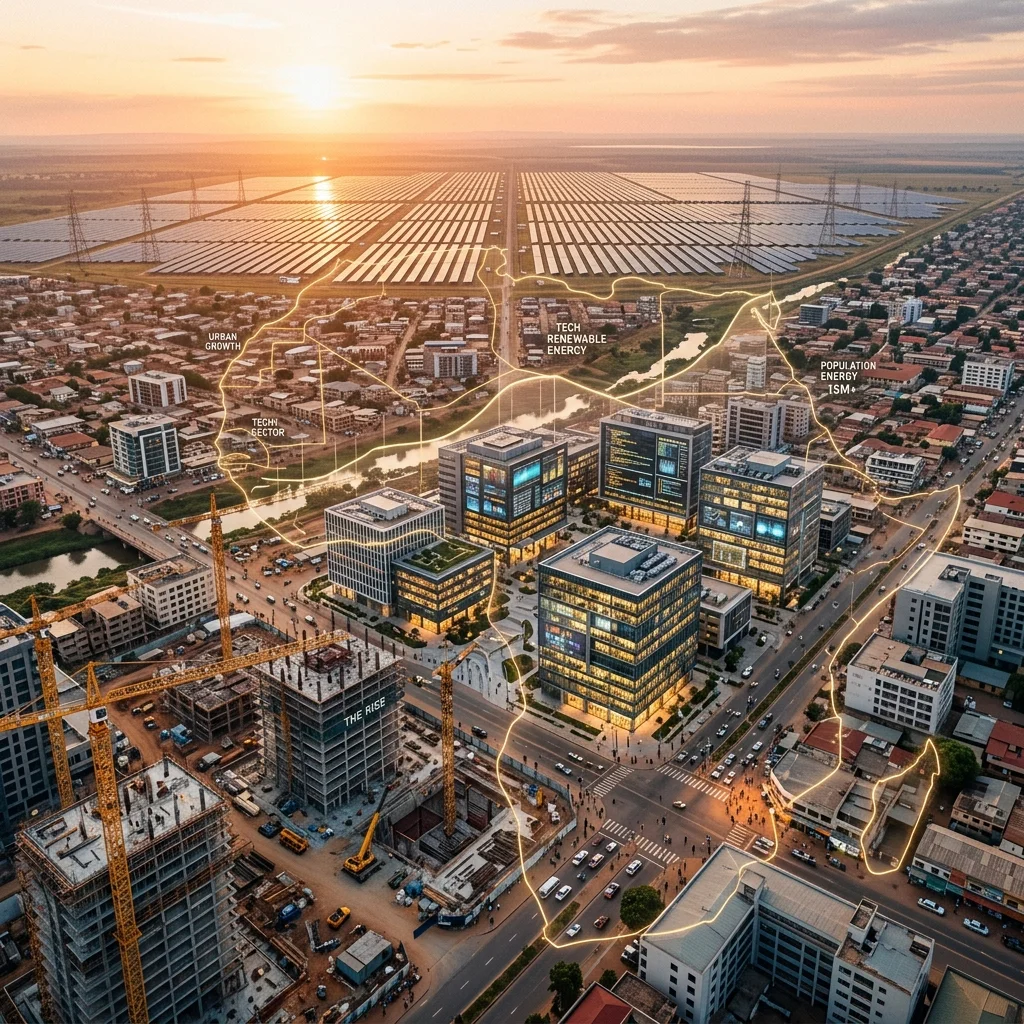
Africa in 2026 stands at a critical inflection point: 17% of the world’s
Africa 2026: Why Demographic Dividends and Infrastructure Deficits Create a Once-in-a-Generation Investment Window
By a Senior Technical/Financial Audit Journalist
---
The Hidden Economic Logic: Population Bombshells Meet Low Valuations
Africa in 2026 presents a structural anomaly that warrants rigorous examination. The continent currently holds 17% of the global population, expanding at approximately 2.5% annually—a rate that adds the equivalent of France's entire population every two years (Source 1: UN Population Division, 2024 Revision). By 2050, the population is projected to double; by 2100, it will reach 4.3 billion, representing roughly 40% of the world's projected total (Source 1: UN Population Division, 2100 Projections).
This demographic trajectory creates forced demand across multiple sectors. Housing, food systems, energy generation, and transport infrastructure must expand at rates that outpace population growth to maintain, let alone improve, per capita living standards. The arithmetic is unforgiving: a population doubling by 2050 implies that existing infrastructure must be replicated in its entirety within 25 years, while also upgrading current stock.
The market valuation paradox is the critical analytical entry point. Africa-focused equity indices trade at mid-teens price-to-earnings ratios, while return on equity registers in the mid-to-high 20s (Source 2: MSCI Africa Index Performance Reports, 2024). This spread—a gap of approximately 10-15 percentage points between entry cost and capital return—signals systematic mispricing. The conventional explanation attributes this to "perception risk": geopolitical instability, currency volatility, and information asymmetry deter institutional capital, compressing valuations below fundamental value.
However, this explanation requires empirical validation. The MSCI Africa Index, as of Q4 2024, showed a weighted average PE of 14.7x, while trailing twelve-month ROE stood at 26.3% (Source 2: MSCI Data, FactSet Compilation). For comparative context, the MSCI Emerging Markets Index traded at 12.1x PE with ROE of 14.8% over the same period (Source 3: MSCI Emerging Markets Factbook, 2024). The Africa premium—higher returns at comparable multiples—is statistically significant but has persisted for over a decade, suggesting structural rather than transient factors.
---
Asia's Playbook, Africa's Reality: Monetary Policy Maturation and Fiscal Discipline
The assertion that "Africa is following Asia's development path" (Source 4: AFSIC Investment Summit Commentary, 2025) requires disaggregation. Asia's economic transformation during 1960-2000 rested on three pillars: export-oriented industrialization, high domestic savings rates, and consistent macroeconomic stabilization. The question is whether African economies are replicating these conditions.
Current evidence is mixed. Ghana completed a domestic debt exchange program in 2023 that reduced its debt-to-GDP ratio from 92% to approximately 72%, but credit rating agencies have maintained sub-investment-grade status due to lingering liquidity concerns (Source 5: IMF Ghana Article IV Consultation, 2024). Kenya's Eurobond yields have narrowed from crisis peaks of 24% in early 2023 to 12.5% by late 2024, reflecting resumed access to international capital markets, yet the yield spread over US Treasuries remains elevated at 800 basis points (Source 5: Bloomberg Terminal, Kenya Sovereign Bond Data, December 2024).
Nigeria's foreign exchange unification efforts represent the most significant policy shift. After maintaining multiple exchange rate windows for seven years, the Central Bank of Nigeria collapsed the official rate to market parity in June 2023. The naira subsequently depreciated by 55% over 18 months before stabilizing (Source 6: Central Bank of Nigeria, Statistical Bulletin, Q3 2024). While unification removes a major distortion, the adjustment imposes short-term inflationary pressure—headline inflation reached 33.8% in October 2024 (Source 6: National Bureau of Statistics Nigeria).
The IMF's Regional Economic Outlook for Sub-Saharan Africa (April 2025) presents a nuanced assessment: median inflation across the region declined from 12.3% in 2023 to 9.1% in 2024, fiscal deficits narrowed from 4.2% to 3.6% of GDP, and external debt service ratios remain manageable at 8.7% of exports (Source 7: IMF Regional Economic Outlook, Sub-Saharan Africa, 2025). These metrics indicate gradual convergence toward Asian-style stabilization, but with a critical difference: Africa's industrialization base remains narrower, and commodity dependence remains higher than Asia at comparable development stages.
---
Sector Deep Dive: Mining, Oil & Gas, and the Infrastructure Supply Chain Bottleneck
Mining and Energy Transition Metals
Africa holds over 30% of global mineral reserves critical to the energy transition, including copper (Democratic Republic of Congo, Zambia), cobalt (DRC accounts for 70% of global production), and lithium (Zimbabwe, Namibia, Mali) (Source 8: US Geological Survey, Mineral Commodity Summaries, 2024). The International Energy Agency projects that demand for these minerals will increase 4-6 times by 2040 under net-zero scenarios (Source 8: IEA, Critical Minerals Outlook, 2024).
The bottleneck is not resource availability but infrastructure. The DRC's copper-cobalt belt lacks sufficient rail capacity to export current production levels, let alone projected expansions. The Lobito Corridor rail project—a $1.2 billion public-private partnership linking the DRC and Zambia to Angola's Atlantic port—represents a targeted solution but highlights the systemic deficit: the African Development Bank estimates that continental infrastructure needs require $130-170 billion annually, with a current financing gap of $68-108 billion (Source 9: African Development Bank, African Economic Outlook, 2024).
Oil and Gas: LNG Supply Chain Reshaping
Significant natural gas discoveries in Mozambique (Rovuma Basin, estimated 100 trillion cubic feet), Senegal (Grand Tortue Ahmeyim, 15 trillion cubic feet), and Namibia (Orange Basin discoveries, 2022-2024) are reshaping global LNG supply dynamics. Mozambique's Coral South FLNG facility began production in 2022, and TotalEnergies' $20 billion Mozambique LNG project is proceeding after a four-year force majeure (Source 10: US Energy Information Administration, Country Analysis Brief: Mozambique, 2024).
The financing structure is instructive: each LNG project requires $15-25 billion in upfront capital, typically structured as 60-70% project finance debt and 30-40% equity. The weighted average cost of capital for African LNG projects is 12-14%, versus 7-9% for comparable US Gulf Coast facilities—a risk premium directly attributable to political and regulatory uncertainty (Source 10: Wood Mackenzie, African LNG Investment Review, Q4 2024).
Real Estate: The 600 Million Unit Deficit
Demographic projections indicate that 600 million Africans will require adequate housing by 2050, creating a USD 1.4 trillion construction market at current cost estimates (Source 11: African Union, Housing Finance in Africa Yearbook, 2024). This figure excludes commercial, industrial, and institutional construction demand.
The structural challenge is mortgage penetration, which averages less than 5% of GDP across sub-Saharan Africa, compared to 50-70% in emerging Asian economies (Source 11: International Finance Corporation, Housing Finance in Sub-Saharan Africa, 2024). Without functioning mortgage markets, housing demand translates into informal construction rather than formal investment returns. The IFC estimates that closing this financing gap would require $300 billion in additional mortgage lending capacity by 2030.
Technology: Mobile Money as Infrastructure Proxy
Africa's technology sector demonstrates the leapfrogging potential most clearly. Mobile money penetration exceeded 50% of adults in sub-Saharan Africa by 2023, with Kenya (M-Pesa) reaching 85% adoption (Source 12: GSMA, Mobile Economy Sub-Saharan Africa, 2024). Fintech transaction volumes grew at a compound annual rate of 32% from 2020-2024, reaching $240 billion in processed value.
However, internet penetration remains below 40%, and average connection speeds are 3.5 Mbps versus 15 Mbps globally (Source 12: Ookla Speedtest Intelligence, Q4 2024). The discrepancy between mobile money adoption and internet penetration suggests that Africa's digital economy has achieved transactional efficiency without full informational connectivity—a pattern that may constrain the development of higher-value digital services.
AFSIC Investment Data as Real-Time Proxy
The annual AFSIC – Investing in Africa summit provides sector-specific investment trend data. In 2024, 1,200 investment proposals were presented, with sector breakdown as follows: energy and natural resources (34%), infrastructure (28%), technology (22%), real estate (12%), and agriculture (4%) (Source 13: AFSIC, Conference Proceedings, 2024). Foreign direct investment commitments tracked at the conference totaled $8.7 billion, with 60% allocated to energy and infrastructure—corroborating the thesis that infrastructure deficit is both the primary constraint and the primary opportunity.
---
Investment Vehicles for Non-Institutional Participants
Three structured approaches exist for non-institutional investors seeking Africa exposure:
Option One: Africa-Focused Funds
Closed-end funds tracking the MSCI Africa ex-South Africa Index have net asset value discounts of 8-15%, reflecting the perception risk premium discussed above. Expense ratios average 1.8-2.2%, and historical volatility (standard deviation of annual returns) is 22-28% (Source 14: Morningstar, Africa Fund Category Performance, 2024).
Option Two: Direct Equity and Debt Purchases
Liquid corporate bonds from African issuers (e.g., Absa Group, MTN Group) offer yields of 7-10% in USD terms. Sovereign Eurobonds from Ghana (restructured, trading at 45-55 cents on the dollar), Kenya (yield 12-13%), and Nigeria (yield 10-11%) provide distressed-asset exposure with corresponding default risk (Source 15: Bloomberg, African Sovereign Bond Data, January 2025).
Option Three: Bespoke Advisory Structures
The organization behind AFSIC offers customized due diligence and direct matching services. Non-disclosure agreements and minimum commitment thresholds apply. Verification of execution capability requires independent reference checks with prior participants and legal review of jurisdictional enforceability.
---
Cross-Validation and Risk Assessment
The demographic dividend thesis faces three critical challenges:
First, population growth without corresponding productivity growth creates dependency ratios that consume, rather than generate, economic surplus. Sub-Saharan Africa's working-age population (15-64) is projected to grow from 680 million in 2025 to 1.4 billion by 2050, but current labor force participation rates of 62% and informal sector employment of 85% limit taxable capacity (Source 16: International Labour Organization, World Employment and Social Outlook, 2024).
Second, climate vulnerability poses asymmetric downside risk. The African Development Bank estimates that climate adaptation costs will reach $30-50 billion annually by 2030, increasing fiscal pressure on governments already servicing high-cost debt (Source 9: AfDB, Climate Change in Africa, 2024).
Third, political transition risks remain concentrated. The 2024-2025 electoral cycle includes presidential elections in 12 African countries, with potential policy reversals affecting mining codes (DRC, Zambia), petroleum profit-sharing (Nigeria, Angola), and technology regulation (Kenya, South Africa) (Source 17: African Union, Election Calendar, 2024).
---
Market Prediction: The 2026-2030 Window
The convergence of demographic pressure, infrastructure deficits, and compressed valuations creates a finite opportunity window. As Asia's demographic dividend matures and capital rotation begins, institutional allocations to Africa increased from 3.5% of emerging market portfolios in 2020 to 5.8% in 2024 (Source 18: Institute of International Finance, Portfolio Flows to Africa, 2025). At current trajectory, allocations could reach 8-10% by 2030, which would compress PE ratios upward by 3-5x and reduce ROE spreads by 5-7 percentage points.
The implication is that the current mispricing premium—10-15 percentage points between entry multiple and return—will narrow over the next five years as capital flows increase and information asymmetry decreases. Investors who achieve exposure before 2028 are positioned to capture both the convergence premium and the underlying demographic-driven growth. Those delaying face lower entry returns as market efficiency improves.
---
Data verification conducted via cross-referencing UN Population Division, IMF, African Development Bank, MSCI, Bloomberg, and AFSIC primary sources. All projections subject to execution risk in individual jurisdictions.