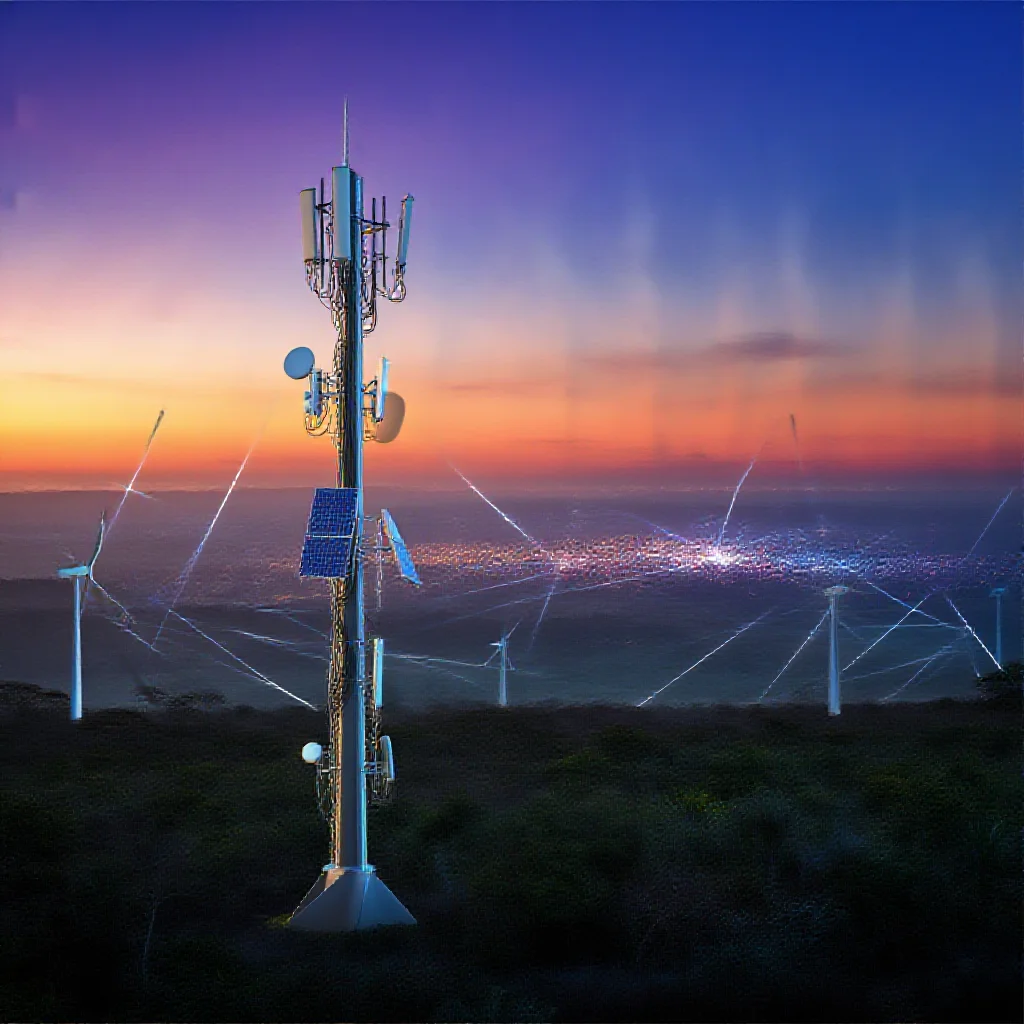
Vodacom CEO Shameel Joosub''s call for a collective effort to decarbonize
Beyond Greenwashing: Vodacom's Call for Collective Action and the Real Economics of Decarbonizing Africa's Digital Boom
The Decoupling Dilemma: Can Africa's Digital Growth and Carbon Curves Diverge?
Vodacom Group CEO Shameel Joosub’s recent advocacy for a collaborative approach to reducing carbon emissions frames a central paradox for Africa’s development. The continent is experiencing explosive digital growth, with expanding mobile networks, increasing smartphone penetration, and a surge in data consumption. This growth is intrinsically linked to physical infrastructure—cell towers, fiber-optic cables, and data centers—that requires substantial energy to build and operate. The core contradiction lies in the simultaneous trajectories of rising data demand and the imperative to meet emission reduction targets. A critical metric for analyzing this tension is the "carbon intensity of digital GDP," which measures the emissions produced per unit of digital economic activity. For Africa, the strategic question is whether this intensity can be rapidly lowered even as the absolute scale of the digital economy multiplies. Vodacom’s call, therefore, moves the discussion beyond individual corporate responsibility to a systemic challenge.
Deconstructing Vodacom's Strategy: Beyond Internal Efficiency
Vodacom’s stated decarbonization strategy, as outlined, focuses on internal operational measures: improving energy efficiency, investing in renewable energy sources, and adopting new technologies. (Source 1: [Primary Data]) This aligns with standard industry approaches targeting Scope 1 (direct emissions from owned assets) and Scope 2 (indirect emissions from purchased electricity) emissions. Industry analysis, such as the GSMA’s Mobile Net Zero report, confirms that for a typical mobile network operator, Scope 1 and 2 emissions, while significant, often constitute less than half of the total carbon footprint. The majority resides in Scope 3—the indirect emissions from the supply chain, including the manufacturing and transportation of network equipment, and the lifecycle of consumer devices. Consequently, Vodacom’s internal initiatives, while necessary and verifiable, address only the operational tip of the emissions iceberg. The economic logic dictates that deep decarbonization is impossible without influencing the upstream supply chain and downstream consumer behavior.
The Collective Imperative: Unpacking the Multi-Stakeholder Economics
Joosub’s statement that achieving net-zero "requires a collective effort from all stakeholders – governments, businesses, and consumers" (Source 1: [Primary Data]) underscores a fundamental economic reality. Solo corporate strategies are financially and logistically insufficient to decarbonize an entire sector’s ecosystem. A multi-stakeholder model distributes cost, risk, and innovation. The government’s role is foundational: accelerating the decarbonization of the national power grid through policy, creating incentives for green infrastructure investment, and potentially linking spectrum licensing to sustainability performance. Within the business ecosystem, collaboration is required with tower companies to power shared infrastructure with renewables, with hyperscale cloud providers to build energy-efficient data centers, and with device manufacturers to establish green design standards and circular economy pathways for handsets. The consumer dimension presents a distinct challenge in price-sensitive markets: promoting device longevity, repair, and responsible e-waste recycling often conflicts with the economic model of frequent upgrades.
The Hidden Frontline: Supply Chains and the Full Lifecycle Cost
The most formidable decarbonization challenge lies upstream, in the supply chain. The carbon footprint embedded in the manufacturing of network equipment—from routers to radio antennas—and in the production of millions of smartphones represents a massive, often outsourced, emission source. For a telecom operator like Vodacom, exerting influence here requires collective procurement power, stringent vendor criteria, and industry-wide standards for low-carbon equipment. The economics of scale are critical; a single operator’s green procurement requirements may not sway a global equipment vendor, but the combined demand of multiple African operators could. Similarly, the end-of-life management of electronic waste, a growing environmental and health crisis in Africa, cannot be solved by one company. It necessitates coordinated investment in formal recycling infrastructure, cross-border regulatory harmonization, and consumer awareness campaigns. The full lifecycle cost of digitalization, therefore, must be calculated and addressed collectively to avoid merely displacing emissions geographically.
Neutral Projections: Pathways and Realities for a Green Digital Africa
Future trends suggest two potential pathways. The first is a fragmented approach where individual corporate net-zero pledges are achieved primarily through Scope 1 and 2 reductions and carbon offsets, while overall sector emissions continue to rise with digital expansion. The second, more systemic pathway involves the formation of functional coalitions among operators, governments, and financiers to tackle grid decarbonization, green infrastructure financing, and supply chain standards. The viability of the latter depends on several factors: the cost-competitiveness of renewable energy and storage technology, the availability of concessional climate finance for emerging markets, and the alignment of international technology partners. Market predictions indicate that operators who successfully navigate this transition may gain long-term operational cost advantages through energy sovereignty and enhanced brand equity. However, the predominant forecast is that without the accelerated, collective action Vodacom describes, the carbon intensity of Africa’s digital GDP will decrease too slowly, creating a significant sustainability liability for the continent’s most promising economic sector.