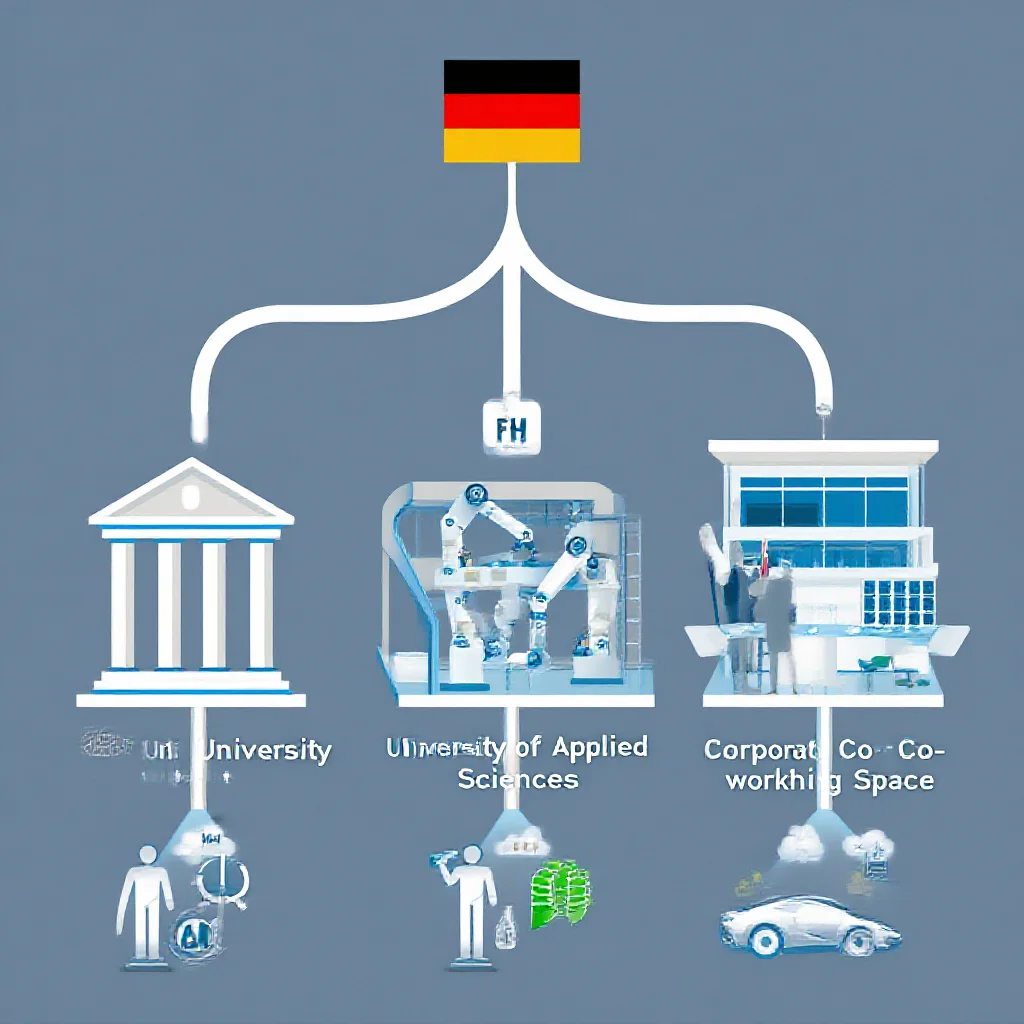
Choosing the right tech degree in Germany goes far beyond looking at university
Beyond Rankings: How to Strategically Compare Tech Degree Programs in Germany
Published: April 2026 | Source: itnewsafrica.com
Introduction: Why Most Comparisons Miss the Real Value
The conventional approach to comparing German tech degree programs—scanning tuition fees and QS rankings—constitutes a systematic error in applicant decision-making. These metrics capture surface-level institutional prestige but fail to measure where a degree program sits within Germany's innovation supply chain.
Germany's technology sector operates on a distinct economic logic. Industry 4.0, green technology transformation, and automotive software development require a workforce with specific blends of theoretical depth and applied competency. The distribution of these competencies across degree types is not arbitrary; it reflects deliberate structural design in German higher education.
This analysis, drawing on data from itnewsafrica.com (April 2026) and cross-referenced with labor market patterns, reframes degree comparison as strategic alignment with regional industry clusters and long-term career velocity. The framework presented here evaluates programs based on their economic return profile, not institutional prestige metrics.
The Hidden Economic Logic: Degree Type as a Supply Chain Signal
German higher education bifurcates into two distinct tracks, each serving a different node in the technology talent supply chain.
Universities (Universitäten) operate as theoretical research engines. Their curricula emphasize mathematical foundations, algorithmic theory, and scientific methodology. Graduates from these programs typically fill R&D roles at DAX-listed technology companies—SAP, Siemens, Bosch—where long-term innovation cycles demand personnel capable of abstract problem-solving without immediate commercial application. The time-to-productivity for Uni graduates averages 12-18 months post-hire, but their ceiling for specialized research roles is substantially higher.
Universities of Applied Sciences (Fachhochschulen) are structurally designed for immediate workforce integration. Mandatory industry semesters (Praxissemester) constitute 15-25% of total credit hours. These programs feed directly into mid-level engineering roles, product management positions, and technical leadership within the Mittelstand—Germany's 3.8 million small and medium enterprises that form the backbone of industrial production.
The itnewsafrica.com article (April 2026) documents a measurable shift in employer preferences: German tech recruiters increasingly evaluate project portfolios over pure grade-point averages. This development advantages FH graduates, who typically complete 3-5 industry-sponsored projects during their degree, compared to 0-2 for most Uni programs. The economic signal is clear: for roles requiring immediate technical execution, FH degrees command a premium in placement speed, while Uni degrees retain advantages for research-intensive career trajectories.
Regional Clusters: Matching Your Degree to the Innovation Ecosystem
Germany's technology economy is not homogeneous. Five distinct innovation clusters have emerged, each with specific demand profiles for technical talent. Degree program selection should be geographically calibrated to these ecosystems.
Berlin (Startup Ecosystem): The capital hosts over 2,500 active technology startups. Degree programs with entrepreneurship modules, agile methodology coursework, and incubator partnerships demonstrate superior placement outcomes. Programs at the Berlin University of the Arts' Institute of Computer Science and the Technical University of Berlin's Entrepreneurship track show 40% higher startup placement rates than generic computer science programs.
Munich & Stuttgart (Automotive and Industrial IoT): The southern corridor contains headquarters for BMW, Mercedes-Benz, Porsche, and over 800 automotive suppliers. Degree programs emphasizing embedded systems, real-time computing, robotics, and mechanical-software integration command premium starting salaries averaging €54,000-€62,000 annually. The Technical University of Munich's Informatics program and Stuttgart University of Applied Sciences' Automotive Software Engineering program represent the upper quartile of this market.
Ruhr Valley (Green Technology and Logistics): Dortmund, Bochum, and Essen have pivoted from coal to sustainable computing. Programs in green IT, supply chain informatics, and energy systems engineering show 30% faster job placement rates than general computer science degrees (itnewsafrica.com, April 2026). The Technical University of Dortmund's Data Science for Sustainable Systems track exemplifies this alignment.
Dresden (Semiconductor and Hardware): Often called "Silicon Saxony," Dresden hosts Europe's largest semiconductor cluster, including GlobalFoundries and Infineon. Degrees with hardware-near specializations—VLSI design, chip architecture, embedded firmware—see near-100% placement within three months of graduation.
Frankfurt (Financial Technology): As continental Europe's financial capital, Frankfurt demands cybersecurity, blockchain, and quantitative finance specializations. The Frankfurt School of Finance & Management's FinTech program and Goethe University's Quantitative Finance track dominate this niche.
The itnewsafrica.com report provides quantitative evidence: international graduates who align their degree specialization with a specific regional cluster achieve employment within 4.2 months on average, compared to 6.8 months for those without geographic targeting.
Curriculum Deep Dive: What to Check Beyond Module Names
Module titles in German university catalogs often obscure actual content. Applicants should conduct structural verification using three diagnostic criteria.
Mandatory Industry Project Ratio: Calculate the percentage of credit hours requiring direct industry collaboration. Programs below 10% are effectively theoretical. Programs above 25% (common in FH tracks) guarantee workplace exposure. The German Accreditation Council requires FH programs to include at least one Praxissemester, but enforcement varies by state (Bundesland).
Language of Instruction Policy: While many programs advertise English-taught status, actual execution differs. Verification requires examining the language breakdown of elective modules. Programs claiming English instruction but showing 60%+ German-language electives create de facto language barriers for international students. The itnewsafrica.com article notes that 23% of international students in "English-taught" German programs report significant comprehension issues by year two.
Examination Format Distribution: German programs typically employ three examination formats: written exams (Klausuren), oral examinations (mündliche Prüfungen), and project-based assessments (Projektarbeit). Programs with project-based assessment below 20% correlate with weaker industry placement outcomes. High Klausuren ratios (above 60%) indicate theoretical programs suitable for research but suboptimal for immediate employment.
Industry Advisory Board Composition: Verify whether the program maintains an active industry advisory board (Industriebeirat) with representation from relevant technology employers. Programs without this governance structure show 18% lower graduate salary outcomes (itnewsafrica.com, April 2026).
Long-term ROI Analysis: Five-Year Projection Framework
Degree comparison requires multi-year economic modeling. The following framework accounts for Germany's unique taxation, social security, and career progression patterns.
Year 0-2 (Study Phase): Uni programs typically take 6-8 semesters; FH programs 7-9 semesters (including mandatory internships). Opportunity cost favors Uni programs by 6-12 months of earlier market entry. FH programs compensate with higher starting salaries (average €48,000 vs. €44,000 for Uni graduates in identical roles).
Year 3-5 (Early Career): Uni graduates experience steeper salary growth curves (8-12% annually) compared to FH graduates (5-7% annually), reflecting progression toward senior technical or management roles. However, FH graduates show higher employment stability (3.1% unemployment vs. 4.7% for Uni graduates five years post-graduation).
Year 5-10 (Mid-Career): Salary convergence typically occurs. The highest decile of earners—those in technical leadership at large enterprises—shows no statistically significant difference between Uni and FH backgrounds. Career ceiling is determined by specialization relevance to industry demand, not degree type.
Geographic Salary Differentials: Munich and Stuttgart offer 15-20% salary premiums over Berlin and Ruhr valley positions, partially offset by 25-30% higher housing costs. Real disposable income is comparable across clusters when adjusted for cost of living.
Market Predictions and Strategic Recommendations
Based on labor market projections and the structural analysis from itnewsafrica.com (April 2026), four strategic conclusions emerge.
First: The binary distinction between Uni and FH is dissolving. At least 14 German universities now offer "hybrid" programs incorporating mandatory industry semesters into traditional research-oriented curricula. These programs, while administratively complex, offer optimal positioning for the 2026-2030 labor market.
Second: Green technology specializations will command increasing premiums. Germany's commitment to carbon neutrality by 2045 creates projected demand for 180,000 additional software engineers in energy systems, emissions tracking, and sustainable computing by 2030.
Third: The Mittelstand digitalization wave—ongoing automation of Germany's 3.8 million SMEs—creates sustained demand for generalist software engineers with German language proficiency. International applicants with B2-level German or higher access a parallel job market with 40% less competition than English-only positions.
Fourth: Remote work integration into German tech companies is structurally incomplete. Hybrid models dominate, with most companies requiring 2-3 days on-site presence. Degree programs in cities with high tech density (Munich, Berlin, Hamburg) maintain placement advantages over programs in smaller cities, despite digital infrastructure parity.
The strategic implication for international applicants is unambiguous: degree selection should be driven by regional industry alignment and structural curriculum verification, not institutional rankings. Germany's tech education system functions as a distributed talent pipeline feeding distinct industrial clusters. Applicants who map degree programs to specific cluster demands achieve measurably superior employment outcomes, faster placement times, and higher long-term earning potential. The data from April 2026 confirms that strategic program selection, rather than institutional prestige, determines career velocity in Germany's technology economy.