South Africa''s ambition to become a regional AI hub hinges not merely on
Beyond Bandwidth: How South Africa's Network Infrastructure Will Shape Its AI Future and Economic Competitiveness
Summary: South Africa's ambition to become a regional AI hub hinges not merely on algorithms and talent, but on the foundational strength of its network infrastructure. This analysis moves beyond the surface-level discussion of connectivity to explore the hidden economic logic: how network quality directly dictates the type of AI South Africa can develop, impacting everything from capital investment patterns to long-term technological sovereignty. We examine whether the nation is positioned for 'fast-follower' cloud-dependent AI or can cultivate 'sovereign' edge-computing models, and what this means for job creation, data governance, and its role in the global AI supply chain. The infrastructure gap is not just a technical hurdle but a strategic economic determinant.
The Unseen Foundation: Why AI is a Network-Centric Technology
The narrative of artificial intelligence often centers on breakthroughs in algorithms and the scarcity of specialized talent. However, this perspective obscures a more fundamental dependency: modern AI is intrinsically a network-centric technology. The development and deployment of large language models, computer vision systems, and predictive analytics are not purely software exercises; they are processes governed by the physics of data transfer and the economics of computational latency.
This dependency manifests in two distinct pillars. The first is infrastructure for AI development, specifically the training of models. This requires the movement of petabyte-scale datasets to centralized, high-performance computing clusters. The second, often more economically significant pillar, is infrastructure for AI deployment or inference. This involves delivering AI-driven insights to end-users or integrated systems in real-time, a function critically sensitive to network latency and reliability. A nation's capacity in both areas dictates the complexity and responsiveness of the AI applications it can sustain.
Empirical evidence underscores this correlation. Global analyses, such as those from the International Telecommunication Union (ITU), consistently demonstrate a strong positive relationship between national broadband penetration/quality metrics and key innovation indicators, including AI startup density and private-sector R&D expenditure. (Source 1: [ITU Digital Development Dashboard]) The network, therefore, is not a passive utility but the active substrate upon which AI ecosystems are built.
!Infographic showing complex data flow for an AI query from device to cloud and back
South Africa's Infrastructure Audit: A Dual-Track Reality
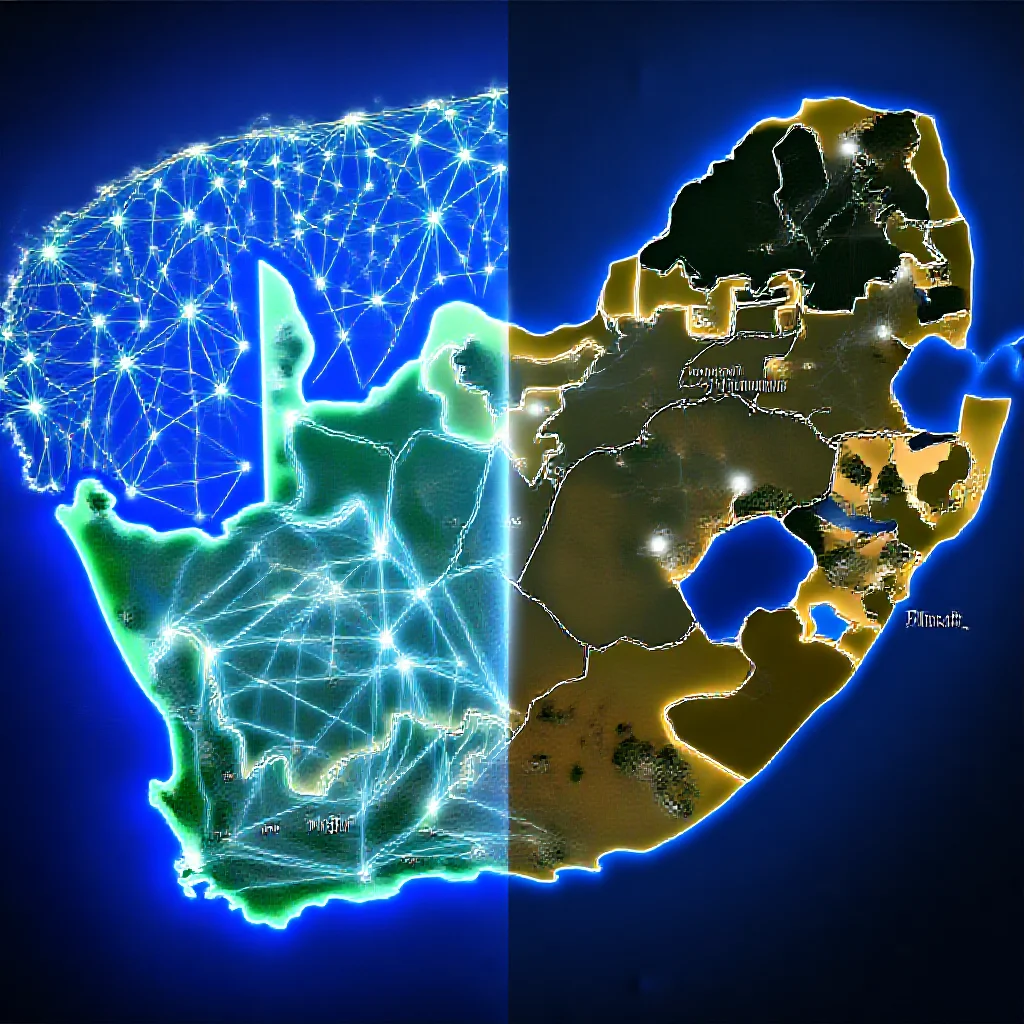
An audit of South Africa's network infrastructure reveals a dual-track reality characterized by advanced capabilities juxtaposed with systemic constraints. In urban commercial hubs like Johannesburg, Cape Town, and Durban, world-class fiber-optic backhaul provides a foundation capable of supporting sophisticated digital services. This is complemented by strategic investments in undersea cable systems, such as Google's Equiano, which enhance international bandwidth and reduce latency to global data centers. (Source 2: [South African ICASA State of the ICT Sector Report])
Conversely, critical gaps persist in township connectivity and rural backhaul, creating a fragmented digital landscape. The promise of 5G, which enables mobile edge computing essential for applications like autonomous logistics or real-time industrial IoT, faces its own realities. While operators have launched services in metropolitan areas, the pace and breadth of the rollout are constrained by spectrum availability and the high capital expenditure required for dense network builds. The economic calculus for AI firms is further distorted by two persistent factors: the relative cost of data and the unreliability of the national power grid. Load-shedding statistics from Eskom necessitate significant investment in backup power for any data-reliant operation, a cost burden that disproportionately disadvantages startups versus large, well-capitalized incumbents. (Source 3: [Eskom Load-shedding Data; Ookla Speedtest Intelligence Rankings])
!Map of South Africa showing 5G coverage, cable landing points, and load-shedding intensity
Fast Analysis vs. Slow Audit: Two Paths for South African AI
This infrastructure landscape presents two divergent strategic paths for South Africa's AI development, each with distinct economic and sovereign implications.
The 'Fast Analysis' Path is cloud-dependent. It involves leveraging the global infrastructure of hyperscale providers (AWS, Azure, Google Cloud) to access cutting-edge tools and computational resources rapidly. This path lowers initial barriers to innovation, allowing local developers to build atop globally pre-trained models. The economic risk is a trajectory toward vendor lock-in, data export dependencies, and the replication of AI solutions optimized for global, rather than local, contexts. The job creation associated with this path may skew toward integration, sales, and support roles within a global tech supply chain, potentially exacerbating a long-term 'AI brain drain' as core research and development remains offshore.
The 'Slow Audit' Path prioritizes sovereign and edge-focused development. It necessitates building robust, national-grade networks and distributed edge data centers to facilitate AI that processes data closer to its source. This model fosters the creation of unique, context-specific solutions—for example, AI models trained on local languages like isiZulu or isiXhosa, or applications tailored for precision agriculture, mining safety, or decentralized healthcare diagnostics. This path requires patient capital, coordinated policy foresight, and a focus on developing local data stewardship frameworks. The economic payoff is the potential for greater technological sovereignty, more sustainable and specialized tech employment in R&D, and intellectual property that addresses unique African challenges.
!Two-column comparison graphic of Cloud-Dependent vs. Sovereign Edge AI paths
Conclusion: Infrastructure as a Strategic Economic Determinant
The trajectory of South Africa's AI ecosystem will be less a function of isolated technological breakthroughs and more a direct consequence of strategic infrastructure investment and policy. The current dual-track reality creates a bifurcated market: a high-performance, globally integrated urban sector and a vast underserved potential market. Bridging this gap is not merely a social imperative but an economic one, as the next generation of impactful AI may well emerge from solving localized, data-intensive problems at the edge.
Market and industry predictions indicate that nations which treat advanced, resilient digital infrastructure as a core component of industrial policy will capture a disproportionate share of high-value AI activity. For South Africa, the choice is not binary but sequential. A hybrid model may emerge, utilizing global cloud platforms for specific development phases while cultivating sovereign capacity in edge deployment and locally relevant model training. The ultimate determinant of competitiveness will be whether infrastructure development is aligned with a clear vision for the type of AI economy the nation intends to build—one of passive consumption or active, sovereign creation. The network, therefore, is the first and most critical algorithm in the country's AI future.