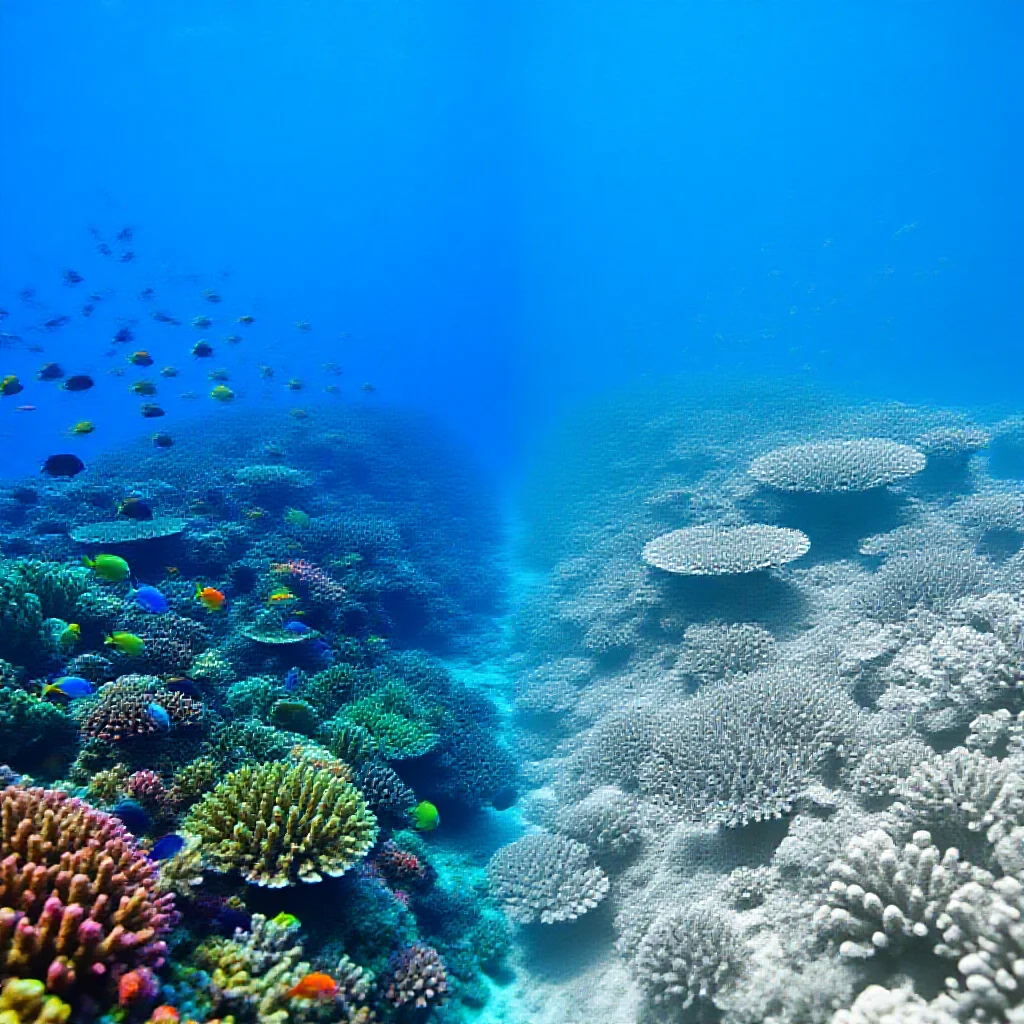
Coral reefs, covering less than 1% of the ocean floor, are engines of immense
Beyond the Bleaching: How Imaging Technology is Quantifying the Trillion-Dollar Coral Reef Crisis
Coral reefs represent one of the planet's most critical, yet rapidly depreciating, natural capital assets. Occupying less than 1% of the ocean floor (Source 1: [Primary Data]), these structures support approximately 25% of all marine species (Source 2: [Primary Data]) and directly underpin the livelihoods of an estimated 500 million people (Source 3: [Primary Data]). Since 2009, a period marked by accelerated mass bleaching events, the degradation of these ecosystems has transitioned from a gradual environmental concern to a measurable economic crisis. The central challenge has shifted from recognizing the decline to quantifying its velocity and fiscal impact. Advanced imaging technology now provides the necessary audit tools to perform this valuation, transforming conservation from a qualitative narrative into a quantitative, evidence-based discipline.
The Unseen Balance Sheet: Deconstructing the Coral Reef Economy
The ecological statistic—1% of the seabed sustaining a quarter of marine life—frames coral reefs as a hyper-efficient natural infrastructure asset. This infrastructure delivers direct economic outputs. Fisheries dependent on reef ecosystems supply a primary protein source for hundreds of millions. Global reef-related tourism generates tens of billions in annual revenue. The physical structure of a reef acts as a natural breakwater, preventing coastal erosion and mitigating flood damage; its loss necessitates investment in artificial coastal defenses. The dependency of half a billion individuals is not anecdotal but represents a vast, vulnerable human supply chain for food, income, and physical security.
The narrative of reefs "disappearing" is therefore incomplete. A more accurate financial model describes a process of natural capital depreciation. The asset is not vanishing; its structural complexity, biodiversity, and consequent service-generating capacity are eroding. This depreciation directly translates to increased risk for coastal economies, reduced yields for fisheries, and elevated insurance liabilities for coastal properties. The systemic failure lies in the historical inability to measure this depreciation in real-time, assign a reliable monetary value to the erosion, and integrate these metrics into global economic and policy frameworks.
The Resolution Revolution: How Imaging Tech Moves Us From Anecdote to Audit
The paradigm shift is driven by imaging technologies that create permanent, high-fidelity digital records of reef assets. Photogrammetry, utilizing overlapping photographs from underwater rigs, constructs precise 3D mesh models or "digital twins" of reef sections. These models provide a quantifiable baseline for surface area, structural volume, and architectural complexity—the very metrics that correlate with biodiversity and coastal protection value.
Hyperspectral and multispectral imaging capture data beyond the visible spectrum, allowing for the detection of physiological stress in coral symbionts before visible bleaching occurs. This functions as an early-warning system for asset impairment. The scale of data generated necessitates automated analysis. Machine learning algorithms are trained to classify coral species, identify disease, and calculate the percentage of bleached versus healthy tissue cover across thousands of images, achieving an audit scale and consistency impossible for human teams.
This technological suite enables rigorous temporal benchmarking. By comparing current 3D models and spectral analyses with historical imagery, the velocity of degradation since the noted acceleration post-2009 can be calculated with precision. Growth rates of resilient corals can be measured against erosion rates from acidification and bioerosion. This allows for the modeling of future scenarios not based on generalized predictions, but on extrapolated, site-specific trend lines of asset depreciation.
The Verification Layer: Embedding Credibility in Conservation Data
The transition to a data-driven conservation economy requires an uncompromising verification layer. Foundational ecological and demographic statistics, such as the 25% marine species figure, must be anchored to authoritative, peer-reviewed sources from institutions like the International Union for Conservation of Nature (IUCN) or the National Oceanic and Atmospheric Administration (NOAA). The methodology for deriving key performance indicators—such as percent live cover, structural complexity index, or calcium carbonate production rates—from imagery must be transparent and standardized to allow for cross-study comparison and auditability.
The timeline of decline is a critical component of context. The period from 2009 onwards marks the start of a modern monitoring era where imaging technology began documenting the crisis in high definition. This contrasts sharply with earlier, more anecdotal periods of observation. The data from this era provides the empirical backbone for assessing intervention efficacy. Conservation finance, including blue bonds or insurance-linked instruments, now demands this level of verifiable, repeatable measurement to de-risk investment and direct capital to the most effective preservation and restoration projects.
Analysis and Projections
The logical deduction from current trends indicates that imaging-derived audit trails will become the minimum standard for conservation funding and policy. The cause-and-effect relationship is clear: quantifiable data reduces investment risk, which unlocks larger-scale, private-sector capital for environmental asset management. The future trend points toward the integration of these biological audit data with traditional financial and risk modeling platforms. Reinsurance firms are likely to increasingly incorporate reef health metrics, as derived from satellite and underwater monitoring networks, into coastal hazard models.
The industry surrounding environmental monitoring and verification is projected to expand. Demand will grow for specialized services in underwater photogrammetry, AI-driven ecological analysis, and the development of blockchain or other immutable ledgers to host and verify conservation data. The ultimate market prediction is the formalization of a global accounting standard for natural capital, where the depreciation of assets like coral reefs is not a hidden externality but a reported liability on the balance sheets of nations and industries that depend on them. The story is no longer solely about saving coral reefs; it is about implementing a credible audit system for a critical, and critically endangered, component of planetary economic stability.