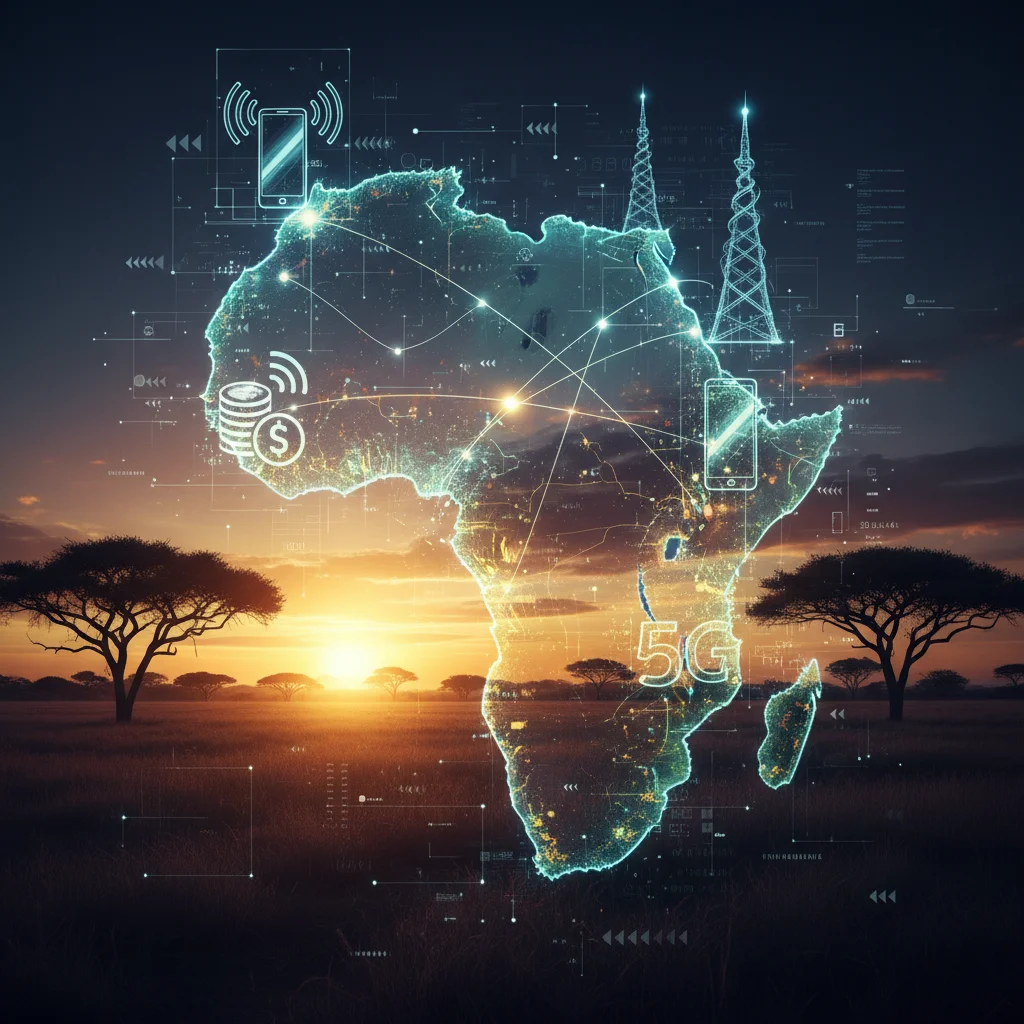
The GSMA’s May 2024 report on Sub-Saharan Africa unveils the critical role
GSMA’s 2024 Report: How Mobile Technology Is Reshaping Africa’s Digital Economy
Sub-Saharan Africa stands at a historic inflection point. While much of the developed world is grappling with the incremental upgrades of legacy infrastructure, the continent is writing a different story—one where mobile networks, not fixed broadband, are the primary engine of digital transformation. The GSMA’s May 2024 report on Sub-Saharan Africa provides a comprehensive benchmark of this shift, revealing not just adoption metrics but the underlying economic logic that makes mobile-led growth a uniquely powerful force for the region. From mobile money ecosystems that are redefining financial inclusion to affordable smartphones that are closing the access gap, the report makes clear that the backbone of Africa’s digital economy growth is wireless.
[IMAGE: Infographic showing mobile penetration vs. fixed broadband in Sub-Saharan Africa over the last decade]
---
The GSMA’s Evolution: From Industry Body to Policy Architect
The GSMA, traditionally known as the trade association for mobile operators, has transformed over the past decade into a strategic advisor for governments and international organisations. The 2024 report reflects this evolution: it is not merely a collection of statistics but a policy roadmap. The report focuses on four interconnected areas—mobile money, Internet of Things (IoT), 4G/5G rollout, and regulatory advocacy—and uses data-driven analysis to show how each component reinforces the others.
What makes the GSMA’s role distinct is its ability to synthesise operator-level data into actionable insights for policymakers. For instance, the report’s recommendations on spectrum harmonisation and tax reforms are already being cited by finance ministers across East and West Africa. By quantifying the economic impact of mobile transformation Africa, the GSMA has moved from being a lobby group to a transformation architect, shaping both private investment decisions and public infrastructure strategies.
[IMAGE: Photo of a GSMA conference panel with African telecom ministers (stock or representative)]
---
Key Drivers of Digital Transformation in Sub-Saharan Africa
The 2024 report identifies four primary accelerators that are collectively powering the region’s leap into the digital age.
Mobile Money: From Payments to Full-Financial Inclusion
The M-Pesa success story in Kenya is no longer an outlier. Today, mobile money has evolved into a comprehensive fintech ecosystem encompassing credit, savings, and insurance products. According to the GSMA report, Sub-Saharan Africa accounts for nearly 70% of the world’s mobile money transaction value. This growth is not just about convenience; it represents a fundamental shift in how households manage risk and build assets. Smallholder farmers can now access micro-insurance against drought, while urban gig workers use mobile-based savings accounts to smooth irregular income. The mobile money impact extends beyond finance—it enables other digital services by creating a trusted identity and payment layer.
Affordable Smartphones: Bridging the Access Gap
For years, the high cost of smartphones was the single biggest barrier to internet adoption. The GSMA report highlights a turning point: device prices have dropped below $30 in several markets, driven by competition from Chinese manufacturers and the proliferation of open-source operating systems like KaiOS. These low-cost smartphones, while limited in processing power, are sufficient for essential apps—messaging, mobile money, and basic browsing. The report notes that smartphone penetration in Sub-Saharan Africa reached 45% in 2023, up from 35% in 2020, and is projected to hit 60% by 2027. This trajectory is critical for digital inclusion Sub-Saharan Africa, as feature phones increasingly become a legacy technology.
Infrastructure Leapfrogging: Bypassing Fibre
One of the most striking findings in the GSMA’s 2024 analysis is how mobile networks are bypassing traditional fixed-line infrastructure. In regions where laying fibre is prohibitively expensive due to difficult terrain and low population density, mobile towers combined with satellite backhaul solutions are delivering broadband-equivalent speeds. The report cites projects in the Democratic Republic of Congo and rural Nigeria where operators are using TV White Space and low-earth-orbit satellites to connect remote communities. This leapfrogging approach means that countries can achieve near-universal connectivity without the decades-long investment cycle required for wired networks.
Policy Innovation: Spectrum, Taxes, and Digital ID
The report dedicates a full chapter to the regulatory environment, arguing that policy innovation is as important as technological innovation. Key recommendations include: harmonising spectrum licensing across borders to enable roaming and reduce costs for operators; eliminating multiple taxation on mobile services (in some countries, taxes account for 30% of the cost of data); and rolling out digital ID systems that allow mobile wallets to serve as official identification. The GSMA report 2024 shows that countries that have implemented these measures—such as Ghana’s digital address system and Nigeria’s Bank Verification Number integration—have seen accelerated digital adoption.
[IMAGE: Split image: left side shows a rural Kenyan farmer using M-Pesa on a basic phone; right shows a 5G small cell in a city]
---
Hidden Economic Logic: Reshaping Supply Chains and Labour Markets
Beyond the headline figures of subscriber growth and data consumption lies a deeper economic transformation that the GSMA report carefully unpacks.
Supply Chain Efficiency Through Mobile Platforms
In a continent where logistics infrastructure remains fragmented, mobile-enabled platforms are reducing friction in goods movement. Startups like Kobo360 (Nigeria) and Lori Systems (Kenya) connect truck owners with shippers in real time, slashing empty-return rates from 40% to below 15%. The report shows that these platforms rely entirely on mobile connectivity for tracking, payment, and communication. The result is a reduction in post-harvest losses for agricultural produce and lower consumer prices for imported goods. The multiplier effect is significant: the GSMA estimates that for every dollar invested in mobile infrastructure in Africa, the broader economy gains nearly $3.50 in GDP growth over five years, driven largely by supply chain efficiencies.
Labour Market Restructuring: New Jobs, New Risks
Mobile transformation Africa is creating entirely new job categories. The gig economy—ride-hailing, food delivery, freelance digital services—now employs an estimated 3 million people across the region, according to the report. Remote customer service roles, enabled by stable mobile internet, are allowing young workers in secondary cities to access jobs that were previously concentrated in capital cities. However, the report also warns of displacement: informal traders and small-scale intermediaries are being squeezed out as digital platforms connect buyers directly to producers. The challenge for policymakers is to manage this transition without creating a large class of digitally excluded workers.
[IMAGE: Flowchart showing mobile payment connecting farmer, trader, and retailer with reduced intermediaries]
---
Persistent Challenges: The Other Side of the Digital Divide
For all its optimism, the GSMA 2024 report does not shy away from the structural barriers that continue to limit digital inclusion Sub-Saharan Africa.
Infrastructure and Cost Gaps
Rural coverage still lags significantly. While urban areas in countries like South Africa and Kenya enjoy 4G coverage exceeding 90%, rural penetration in nations such as Niger and Chad remains below 30%. The cost of data, though declining, still represents more than 8% of average monthly income in many markets—far above the 2% threshold the UN considers affordable. The report calls for innovative financing mechanisms, such as universal service funds and infrastructure-sharing agreements, to extend coverage to underserved areas.
The Gender Gap: A Persistent Divide
One of the most stubborn challenges documented in the report is the gender gap in mobile ownership and internet usage. Women in Sub-Saharan Africa are 22% less likely than men to own a smartphone and 37% less likely to use mobile internet. The causes are multifaceted: cost, social norms, lack of digital literacy, and concerns about safety. The GSMA emphasises that closing this gap is not just a social imperative but an economic one—its models show that achieving gender parity in mobile internet could add $100 billion to the region’s GDP by 2030.
Energy Reliability: The Off-Grid Bottleneck
Mobile towers themselves are part of the problem. In many rural areas, the electrical grid is unreliable or nonexistent, forcing operators to run base stations on diesel generators. This drives up operational costs and environmental impact. The report highlights promising solutions: solar-powered towers, hybrid battery systems, and even community microgrids that share energy with nearby households. But scaling these solutions requires capital and regulatory support that many governments have been slow to provide.
[IMAGE: Graph showing mobile coverage density comparison between urban and rural areas in selected Sub-Saharan countries]
---
Conclusion: The Path Forward
The GSMA’s May 2024 report presents a clear roadmap for accelerating Africa’s digital economy growth, but it also underscores that technology alone is insufficient. The real driver of digital transformation Africa will be the policy and investment environment that enables mobile networks to reach their full potential.
The report’s central message is one of pragmatism. Rather than waiting for perfect solutions—affordable fibre, universal electricity, flawless regulation—the continent is making progress by embracing the mobile-first reality. Governments that prioritise spectrum liberalisation, tax reform, and digital ID systems will see the fastest returns. Investors who focus on the intersection of mobile money, logistics, and energy solutions will capture the largest upside. And for the hundreds of millions of Africans still offline, the path to inclusion runs through a device in their pocket.
The GSMA report is not just a snapshot of where Sub-Saharan Africa stands today. It is a strategic tool—a compass for anyone seeking to understand the economic logic behind the most significant infrastructure transformation happening on the continent in decades.
[IMAGE: Sunrise over a savanna with mobile tower silhouettes and digital data streams flowing across the horizon]