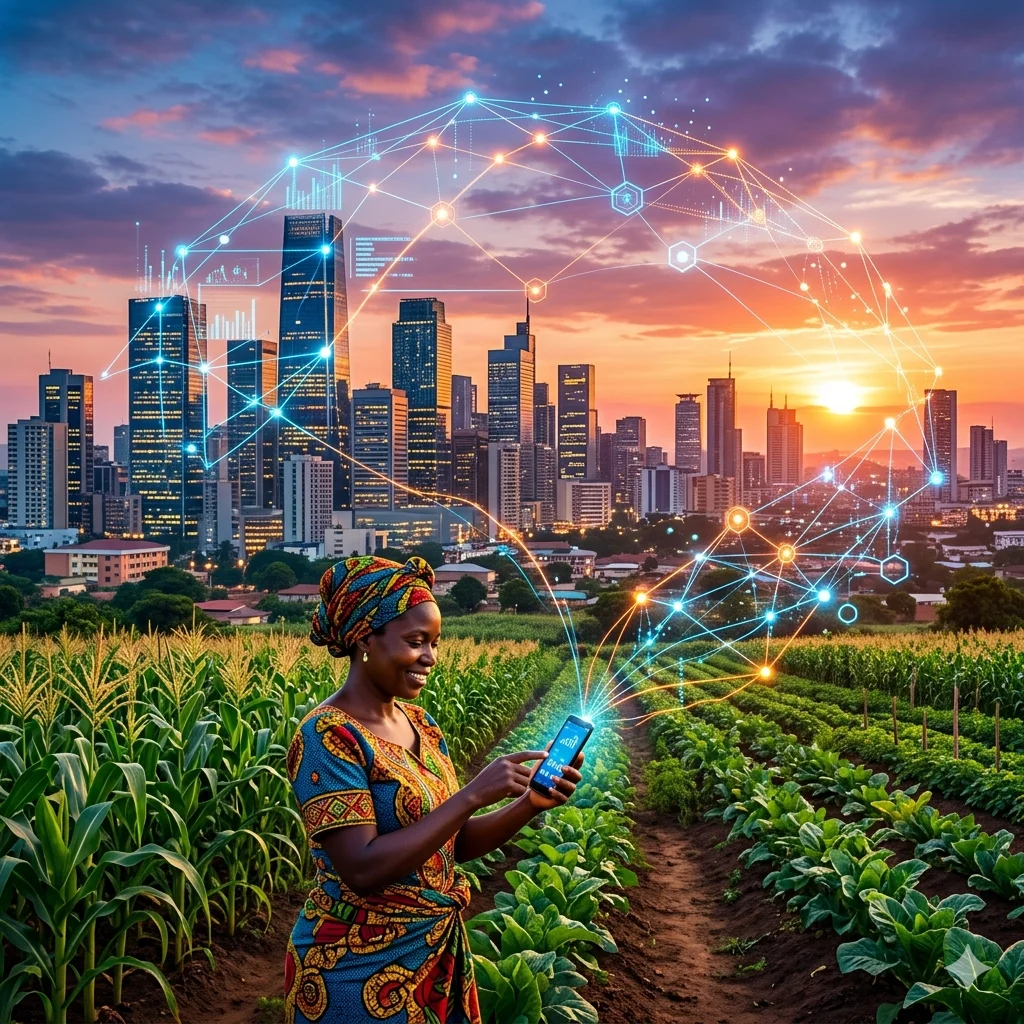
Africa''s digital economy is surging, but the narrative often stops at mobile
Africa’s Digital Transformation: From Infrastructure Gaps to Economic Sovereignty
Introduction: The Unfinished Promise of Digital Africa
Africa is home to the world’s fastest-growing digital economy, yet the dominant narrative remains stuck on two tired headlines: mobile money “leapfrogging” and the continent’s persistent connectivity gaps. In 2023, the GSMA reported that mobile technologies and services contributed 8.6% of sub-Saharan Africa’s GDP—nearly $170 billion—and mobile internet users surpassed 400 million. But to stop there is to miss the story beneath the surface.
This article reframes the transformation. Africa’s digital shift is not merely about catching up with the developed world; it is about rewriting the fundamental rules of economic participation. The continent is moving from an era of resource extraction—gold, oil, cocoa—to one of digital value creation. The question is no longer “Can Africa get online?” but “What kind of digital economy will Africans build, own, and govern?”
[IMAGE: A collage showing a traditional African market next to a digital payment QR code on a smartphone.]
Drawing on reports from the European Think Tank Group (ETTG), the GSMA, and the World Bank, we examine how the “From Gaps to Goals” lens reveals a slow-brewing structural shift. By reframing connectivity gaps as opportunities for digital sovereignty, inclusive supply chains, and platform governance, African nations are redefining what economic prosperity looks like in the 21st century.
Section 1: Beyond Leapfrogging – The Hidden Economic Logic
The term “leapfrogging” has become shorthand for Africa’s digital exceptionalism—skipping landline telephones for mobile phones, and brick-and-mortar banks for mobile money. Kenya’s M-Pesa, launched in 2007, is the archetype: a service that bypassed formal banking infrastructure to reach millions of unbanked users. But this framing, while accurate, obscures a deeper economic logic.
The Emergence of Value Layers
Digital infrastructure does more than connect people—it creates new value layers: data, trust, and digital identity. In traditional commodity-based economies, value was extracted from physical resources: a barrel of oil, a bag of coffee beans. In a digital economy, value is generated through software, algorithms, and user data. These layers can be monetised repeatedly, often with zero marginal cost once the platform is built.
Consider M-Pesa today. It is no longer just a payment system. It now enables credit scoring for smallholder farmers, micro-insurance products, and supply chain finance. When a farmer in rural Kenya sells tomatoes through a mobile platform, the transaction generates data—purchase history, price sensitivity, seasonal patterns. That data becomes an asset that can be used to extend loans or offer crop insurance, reshaping entire rural economies. Fintech Africa is therefore not a separate sector; it is the connective tissue linking agriculture, logistics, and finance.
Reorganising Value Chains
This hidden logic is playing out across other sectors. In energy, pay-as-you-go solar companies like M-KOPA use mobile data to manage remote solar home systems, turning low-income households into reliable subscribers. In logistics, platforms like Kobo360 and Lori Systems digitise trucking routes across East and West Africa, reducing empty return trips by up to 30% and cutting costs for small businesses.
The World Bank’s 2024 Digital Economy for Africa report notes that digital platforms could add $180 billion to Africa’s GDP by 2025, with agriculture and logistics capturing the largest shares. But this growth depends on something more fundamental: the transition from gaps to goals in infrastructure and governance.
[IMAGE: Infographic showing M-Pesa transaction flow from a farmer to a buyer, with data points on credit scoring.]
Section 2: From Gaps to Goals – Infrastructure and Governance
For decades, the conversation about Africa’s digital economy focused on “gaps”: low internet penetration, unreliable electricity, and a shortage of data centres. According to the GSMA, only 25% of sub-Saharan Africa’s population uses mobile internet, while the rest remain offline—often due to affordability, not availability. The median cost of 1GB of mobile data in Africa is 5% of average monthly income, far above the 2% threshold the UN considers affordable.
Closing the Hard Gaps
Recent developments are closing these gaps, but not in the ways most observers predicted. Starlink, SpaceX’s satellite internet constellation, has launched in Nigeria, Kenya, Rwanda, and several other African countries, offering speeds of up to 200 Mbps in areas where fibre is economically unviable. Meanwhile, off-grid solar and mini-grid companies are bringing electricity to communities that never had it—often with integrated mobile payment systems.
Yet as hard gaps shrink, new ones emerge: digital literacy, cybersecurity, and device affordability. The ETTG’s 2023 report on Africa’s digital transformation emphasises that “meaningful connectivity” requires more than a signal—it requires affordable devices, digital skills, and relevant local content. The goal is shifting from counting connections to measuring participation.
The Sovereignty Agenda
Perhaps the most consequential shift is in governance. African nations are beginning to assert digital sovereignty—the idea that they should control their own data, regulate foreign platforms, and build local innovation ecosystems.
Kenya’s Data Protection Act of 2019 and South Africa’s Protection of Personal Information Act (POPIA) are early steps. More aggressively, Nigeria’s proposed data protection bill seeks to require that personal data of Nigerians be stored and processed within the country. This has huge implications for Big Tech: Facebook (Meta), Google, and TikTok operate massive data centres in Europe and North America, but few in Africa. A data localisation mandate could force these companies to invest in local infrastructure, creating jobs and tax revenues.
Simultaneously, African governments are wrestling with platform regulation. How should they tax digital services provided by foreign companies? What is the proper regulatory framework for ride-hailing apps, e-commerce platforms, and gig economy employers? The African Union’s Digital Transformation Strategy for Africa (2020–2030) calls for a harmonised approach, but implementation remains fragmented.
And perhaps the most urgent governance challenge is digital identity. About 500 million Africans lack any form of official ID, making them invisible to banks, government services, and online platforms. A growing number of countries—including India’s Aadhaar-inspired systems in Nigeria and Ghana—are rolling out digital ID programs. But the tension between inclusion and privacy is acute. Who owns the data? How is it secured? Can it be used to exclude rather than include?
[IMAGE: Map of Africa with color-coded internet penetration rates and overlay of data center locations.]
Section 3: Deep Entry Point – The Supply Chain Revolution
If digital sovereignty is the macro goal, then supply chain digitisation is the micro entry point where the transformation is most tangible. Agriculture contributes about 35% of Africa’s GDP and employs over 50% of the workforce. Yet the sector is plagued by inefficiency: post-harvest losses can reach 40% for perishable goods, farmers receive less than 20% of the final retail price, and opaque supply chains create room for corruption and waste.
Platforms That Disintermediate
Digital platforms are changing this by disintermediating—cutting out layers of middlemen. Twiga Foods, based in Kenya, connects smallholder farmers directly to urban vendors. Farmers place orders via a mobile app, Twiga aggregates demand and handles logistics, and vendors receive fresh produce daily. The result: farmers get better prices (often 20–30% higher), vendors get reliable supply, and food waste drops dramatically.
Sokowatch (now Wasoko) operates similarly in East Africa, focusing on fast-moving consumer goods for informal retailers. Its platform replaces the traditional “cash-and-carry” model, where shopkeepers would travel to wholesale markets daily. Now they order via SMS or app, receive delivery within 24 hours, and access credit based on transaction history. Wasoko has expanded to six countries and processes thousands of orders daily.
The impact extends beyond individual transactions. By digitising supply chains, these platforms generate granular data that can be used for inventory management, demand forecasting, and credit scoring. The World Bank estimates that digitising agricultural value chains in Africa could reduce post-harvest losses by 15–20% and increase smallholder incomes by 30%. The GSMA’s 2023 report on mobile for development highlights that digital supply chain solutions have attracted over $500 million in venture capital in Africa since 2020, signaling investor appetite for platforms that solve real infrastructure problems.
Long-Term Structural Shift
This supply chain revolution is not simply about efficiency—it is about economic power. When a farmer in rural Tanzania can access real-time market prices, compare buyers, and receive payments instantly via mobile money, their bargaining position shifts. They are no longer at the mercy of a single trader who sets the price. They become part of a network where data is the currency of trust.
Over time, these platforms create new logistics networks that bypass established, often extractive, intermediaries. The result is a redistribution of value along the chain—more to producers, less to rent-seeking middlemen. This aligns with the broader goal of economic sovereignty: reducing dependence on foreign-controlled supply chains and building local ecosystems that capture more value.
[IMAGE: Photo of a farmer using a smartphone in a field, with a delivery truck in the background, showing the link between digital tools and logistics.]
Conclusion: The Slow Brew of a New Order
Africa’s digital transformation is not a sprint. It is a slow brew—a set of structural shifts that unfold over decades. The continent is still wrestling with hard infrastructure gaps, but the conversation has moved on. The real action lies in how African nations redefine their goals: from more connectivity to meaningful connectivity, from foreign-owned platforms to local digital ecosystems, from resource dependence to data sovereignty.
The ETTG’s report underscores that without deliberate policy action, the current digital wave could replicate old patterns of extraction—where African data fuels machine learning models in Silicon Valley, while local entrepreneurs struggle to access capital. But the counter-examples are multiplying: Rwanda’s effort to build a regional data hub, Kenya’s push for a favourable fintech regulatory sandbox, and the African Continental Free Trade Area’s digital protocol.
For the world, Africa’s digital trajectory matters beyond humanitarian sentiment. A continent that transitions from a provider of raw materials to a producer of digital services and products will reshape global economic power balances. The supply chains of tomorrow—whether for coffee, cobalt, or code—will increasingly run through African platforms. The question is whether those platforms will be built by Africans, for Africans.
As the GSMA notes, mobile money has already proven that Africa can lead where others lag. Now the challenge is to scale that model beyond payments—into supply chains, governance, and identity. The “From Gaps to Goals” framework is not just an analytical lens; it is a call to action. The gaps were never the whole story. The goals are what come next.