With a projected 55% population surge by 2050 and one billion people still
Africa's Digital Infrastructure: The $77 Billion Opportunity and the Path to Universal Connectivity
By a Senior Technical/Financial Audit Journalist
---
The Unconnected Continent: A Billion-Person Gap
Africa is the world’s youngest and fastest-growing continent. By 2050, its population is projected to increase by 55%, adding roughly one billion people (Industry projections). This growth trajectory far exceeds the global average of 6% and represents a demographic shift that will fundamentally reshape demand for digital services.
Yet today, approximately one billion Africans do not use or are not covered by mobile broadband (Industry data). This gap constitutes both a severe digital divide and a structural constraint on economic development. The paradox is clear: the continent that will add the most people in the coming decades is also the one with the largest absolute number of offline citizens.
The causal relationship is direct. Population growth, urbanization, and rising youth cohorts will intensify connectivity requirements. Without a commensurate expansion of digital infrastructure, the gap will widen, limiting access to education, financial services, healthcare, and commerce.
---
The $77 Billion Infrastructure Boom: New Models Emerge
Between 2024 and 2030, approximately $77 billion is expected to be invested in African mobile infrastructure (Capital expenditure forecasts). This capital deployment is driven by underlying demand metrics: unique mobile subscriptions in Africa and the Middle East are forecast to rise 71% by 2050, adding 800 million new connections, compared to only 15% growth in the rest of the world (Subscription growth projections).
Smartphone adoption on the continent is predicted to grow 141%, adding roughly 1.7 billion devices—more than four times the global growth rate. Data traffic across Africa is expected to increase roughly fourfold over the same period (Traffic volume estimates).
Traditional capex-heavy expansion models, however, face a structural constraint: average revenue per user (ARPU) in Africa remains significantly lower than in developed markets, and the majority of connections operate on prepaid models (Market structure data). This reality forces operators to prioritize cost efficiency over blanket coverage.
The shared tower infrastructure model, championed by firms such as Helios Towers, directly addresses this challenge. By allowing multiple mobile network operators to co-locate on a single physical tower, duplication of capital expenditure is reduced and deployment costs per site are lowered (Source: Helios Towers corporate filings). In low-ARPU environments, where every percentage point of cost reduction directly affects profitability, this model has become the dominant expansion mechanism across sub-Saharan Africa.
---
Energy Resilience: Hybrid Systems Keep Networks Online
Network uptime in Africa is critically dependent on energy availability. Unstable national power grids, frequent blackouts, and voltage fluctuations force operators to either invest heavily in backup generation or accept service degradation. Historically, diesel generators have been the default solution, but their operational costs and carbon footprint are substantial.
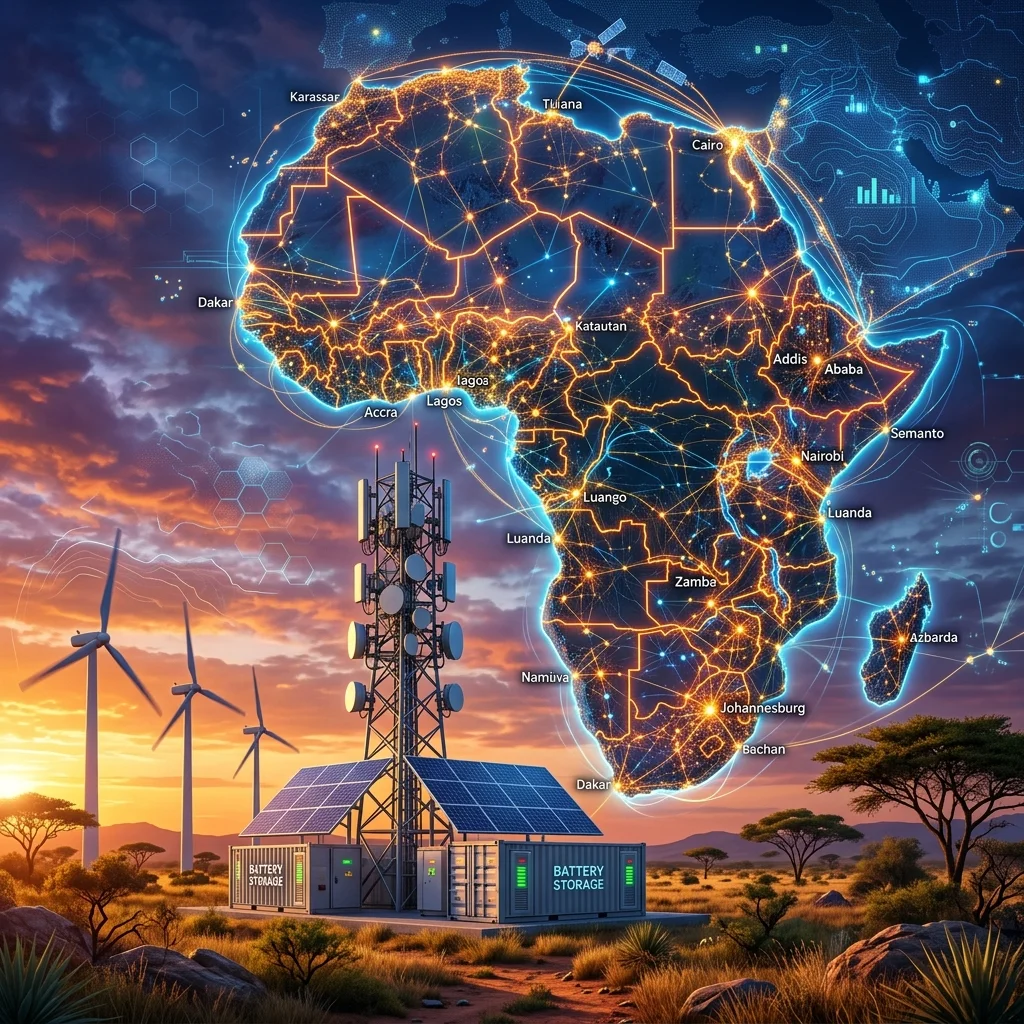
The industry response has been a systematic shift toward hybrid energy systems that combine grid power, battery storage, and renewable sources—primarily solar photovoltaic (Energy transition data). These configurations improve network uptime by providing seamless backup during grid failures, while reducing reliance on expensive diesel. Over the life of a tower site, the total cost of ownership of a hybrid system can be significantly lower than a diesel-only setup, particularly in areas with high fuel transport costs.
Helios Towers and other infrastructure providers are increasingly deploying solar-plus-battery solutions at tower sites across rural and peri-urban areas. The decision to adopt hybrid systems is not driven primarily by environmental considerations, but by a clear operational logic: consistent power reduces site visits, lowers maintenance frequency, and improves customer experience. In markets where prepaid users are highly price-sensitive, service continuity directly affects churn rates and revenue.
---
Planning the Network of the Future with AI and Digital Twins
Capital allocation decisions in African telecom infrastructure are inherently risky. Population density, traffic patterns, and demand elasticity vary widely within and between countries. Misplacing a tower by even a few kilometers can result in low utilization and poor return on investment.
Advanced Geographic Information Systems (GIS) are now being deployed to analyze population density, existing coverage, and traffic flows to optimize new site placement (GIS implementation data). These systems integrate census data, satellite imagery, and mobile network analytics to generate heatmaps of underserved areas.
Beyond site selection, operators are increasingly using AI-driven analytics and digital twins—virtual replicas of physical network assets—for real-time monitoring and predictive maintenance (Industry technology adoption reports). Digital twins allow operators to simulate network behavior under different load scenarios, identify potential failures before they occur, and schedule maintenance without disrupting service.
The combination of GIS, AI, and digital twins transforms the infrastructure planning cycle from a static, one-time exercise into a dynamic, continuously updated process. Operators can adjust deployment strategies in response to rapid urbanization, shifting population corridors, and changing usage patterns. The result is more capital-efficient rollout, reducing the risk of stranded assets in uncertain demand environments.
---
Conclusion: Toward Intelligent, Resilient Expansion
The $77 billion investment forecast for 2024–2030 represents a critical window for Africa’s digital transformation. The continent’s demographic momentum—one billion new people by 2050—will create demand that cannot be met by traditional expansion models alone. Shared tower infrastructure, hybrid energy systems, and AI-driven planning tools provide the operational architecture necessary to achieve universal connectivity within realistic cost constraints.
Two outcomes are likely. First, the shared tower model will continue to consolidate, with independent tower companies and infrastructure funds capturing an increasing share of new deployments. Second, hybrid energy will become the de facto standard for new sites, further reducing the dependence on legacy diesel generators. AI and digital twins will move from pilot projects to core planning tools, enabling operators to respond in near-real time to shifting demand.
The path to universal connectivity in Africa does not require unlimited capital. It requires capital that is deployed intelligently, resiliently, and with a precise understanding of where and how demand will evolve. The data suggests that the industry is moving decisively in that direction.
---
Data sources: Industry projections from the GSMA Mobile Economy Sub-Saharan Africa reports; capital expenditure estimates from Infrastructure Africa; technology adoption data from Helios Towers and CNBC Africa interviews; energy transition data from independent telecom analyst reports.