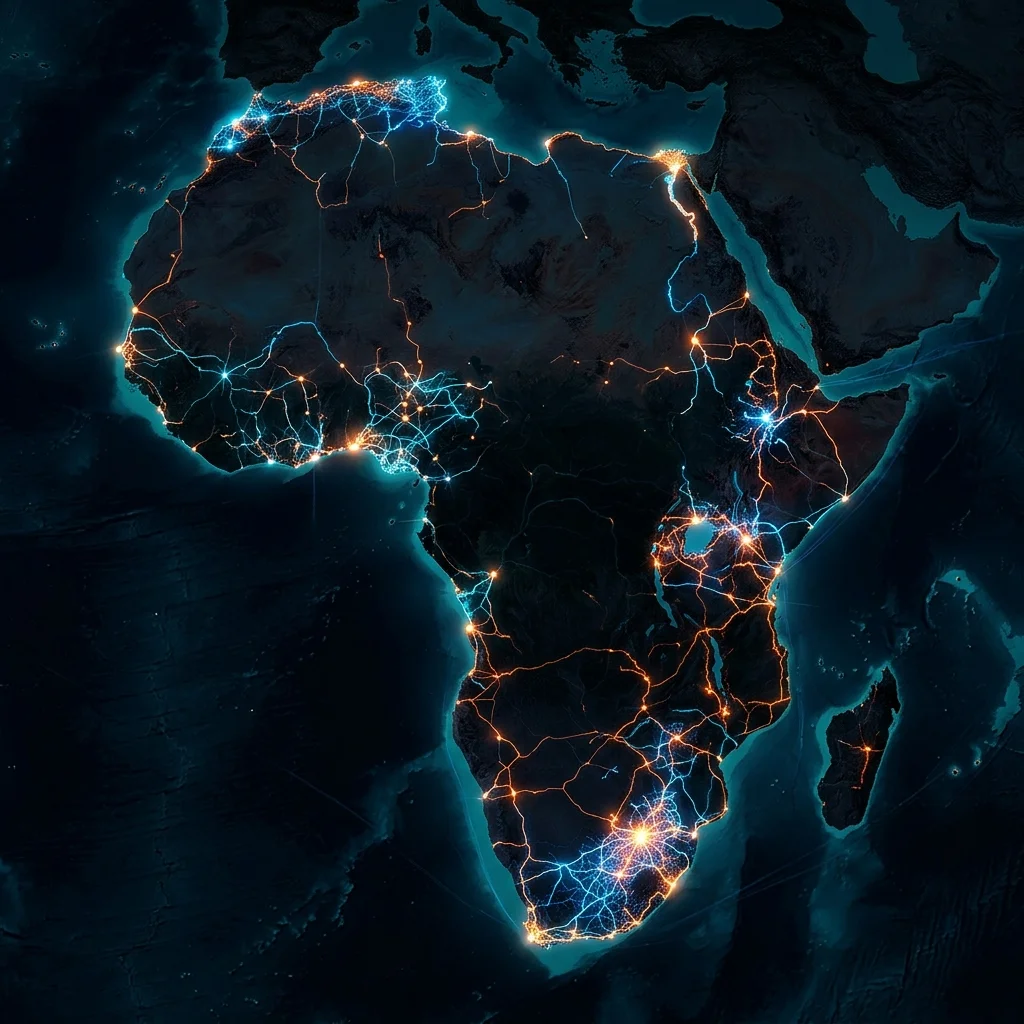
Africa''s digital economy has grown from just 1.1% of GDP in 2012 to 4.5%
Africa's Digital Economy: From $30 Billion to $712 Billion – The Uneven Path to 2050
1. The Big Picture: A Decade of Digital Growth
In 2012, Africa’s digital economy was valued at roughly $30 billion, representing just 1.1% of the continent’s GDP. By 2020, that figure had surged to $115 billion — 4.5% of GDP — a 3.8-fold increase in eight years. This explosive growth has been fueled by a combination of rapidly improving internet access, particularly through mobile broadband, a flourishing startup ecosystem, and supportive policy frameworks adopted by several governments.
The trajectory ahead is even more ambitious. According to a landmark 2020 study by Google and the International Finance Corporation (IFC), Africa’s internet economy GDP is projected to reach $180 billion (5.2% of GDP) by 2025 and an extraordinary $712 billion (8.5% of GDP) by 2050. These headline numbers suggest a transformative shift — a continent leapfrogging traditional industrial development into a digitally enabled future.
[IMAGE: A line chart showing the growth of Africa's digital economy in USD and % GDP from 2012 to 2050, with annotations for key milestones (2012, 2020, 2025, 2050).]
Yet these aggregate figures conceal a more troubling reality. The promise of a $712 billion digital economy is not a story of uniform progress. Beneath the surface lies a deepening digital divide Africa that threatens to leave millions behind. Understanding this uneven path is critical for policymakers, investors, and development agencies aiming to ensure that the continent’s digital transformation 2050 benefits all Africans, not just those in a handful of digital hubs.
2. The Stark Divide: E-commerce Readiness Across Africa
One of the most revealing snapshots of Africa’s digital inequality comes from UNCTAD’s 2020 B2C E-commerce Index. This composite index measures a country’s readiness to engage in online commerce, factoring in internet penetration, secure server availability, postal reliability, and financial inclusion — all critical enablers of a functioning digital economy.
The e-commerce readiness index scores expose an astonishing gap. South Africa leads the continent with a score of 56.5 out of 100. At the other end of the spectrum lies Niger with just 5.6 — a tenfold difference. Even among more digitally active economies, the spread is wide: Kenya scores 41.3, Morocco 45.0, Nigeria 33.7, while Senegal sits at 28.4 and Rwanda at 27.1. These numbers are not mere academic metrics; they represent the real-world ability of businesses and consumers to participate in the digital economy.
[IMAGE: A bar chart comparing UNCTAD e-commerce readiness scores for a selection of African countries (South Africa, Kenya, Nigeria, Morocco, Senegal, Niger, etc.) with clear color coding.]
The drivers of this gap go beyond connectivity. While mobile broadband coverage has expanded dramatically across the continent, digital literacy remains low in many regions. Logistics infrastructure — reliable postal and last-mile delivery systems — is underdeveloped in landlocked and rural areas. Regulatory environments vary widely: some countries have enacted progressive data protection and e-commerce laws, while others lack basic frameworks for digital transactions. Financial inclusion, particularly access to mobile money and digital payment systems, is concentrated in East Africa (led by Kenya’s M-Pesa) and parts of West Africa, but remains limited in Central and Sahel regions.
These disparities are already shaping where African tech ecosystem growth is occurring. The continent’s digital unicorns — companies like Flutterwave, Jumo, and Opay — are overwhelmingly headquartered in Nigeria, South Africa, Kenya, and Egypt. Venture capital flows follow the same pattern: in 2021, Nigeria, South Africa, and Kenya accounted for over 70% of all African tech funding. The digital economy is booming, but it is booming in a narrow band of countries.
3. Projections to 2050: A $712 Billion Opportunity – But for Whom?
The Google/IFC study that projects $712 billion by 2050 is not a guarantee; it is a scenario based on sustained investment, policy continuity, and continued infrastructure expansion. That scenario contains both promise and peril.
| Country | iGDP 2020 (% of GDP) | iGDP 2025 (% of GDP) | iGDP 2050 (% of GDP) |
|---------|----------------------|----------------------|----------------------|
| Kenya | 7.7% | 9.0% | 13.0% |
| Morocco | 5.8% | 7.5% | 11.0% |
| South Africa | 4.3% | 6.0% | 9.5% |
| Nigeria | 3.8% | 5.5% | 9.0% |
| Senegal | 3.2% | 4.8% | 8.0% |
| Ghana | 2.9% | 4.3% | 7.5% |
| Ivory Coast | 2.5% | 3.8% | 6.5% |
| Rwanda | 2.3% | 3.5% | 6.0% |
| Mozambique | 1.5% | 2.5% | 4.5% |
| Ethiopia | 1.2% | 2.0% | 3.8% |
| (Source: Google/IFC, 2020) |
[IMAGE: A table showing country-level iGDP projections for 2020, 2025, and 2050 for selected African nations, with color gradient to show relative magnitude.]
What stands out immediately is the concentration of growth. Kenya, Morocco, South Africa, and Nigeria are projected to see their internet economy GDP shares well above the continental average of 5.2% by 2025. By 2050, Kenya’s digital economy could account for 13% of its total GDP — a figure comparable to many developed nations today. Meanwhile, countries like Mozambique (4.5%), Ethiopia (3.8%), and Niger (not even included in the study due to insufficient baseline data) remain stuck in the lower tiers.
This creates what economists call a “digital poverty trap”: nations that lack the basic digital infrastructure, skills, and regulatory frameworks today will struggle to attract the investment and talent needed to build them tomorrow. Without active intervention, the gap between digital leaders and laggards will widen, not narrow, over the next quarter century.
The implications are stark. A digital economy worth $712 billion by 2050 sounds transformative for the continent as a whole. But if 80% of that value is concentrated in just 4–5 countries, the remaining 40+ nations will see only marginal benefits. Inclusive digital development is not an automatic outcome of growth; it requires deliberate policy design.
4. Structural Barriers: Why the Gap Persists
Why is Africa’s digital economy growing so unevenly? The answer lies in a cluster of structural barriers that reinforce one another.
Infrastructure deficits remain the most visible obstacle. While mobile broadband covers over 80% of Africa’s urban population, rural coverage drops to less than 30% in many countries. The Sahel and Central Africa are particularly poorly served. Fiber optic backbone networks are concentrated along coastal corridors, leaving landlocked nations dependent on expensive satellite or neighboring-country links. Electricity access is equally critical: without reliable power, data centers, servers, and even mobile phone charging become impossible. Niger, for example, has an electrification rate of just 14%.
Digital literacy and skills form the second barrier. The UNCTAD index includes a sub-component measuring the percentage of individuals using the internet — a proxy for digital capability. In South Africa that figure is 70%; in Niger it is 14%. But even where connectivity exists, many potential users lack the basic skills to navigate online services, manage digital payments, or avoid cybersecurity risks. This skills gap disproportionately affects women, rural populations, and older generations.
Regulatory fragmentation adds another layer. Africa has 54 different countries with 54 different sets of rules governing data protection, e-commerce, digital taxation, and cross-border data flows. The African Continental Free Trade Area (AfCFTA) includes a digital trade protocol, but implementation is still years away. For startups trying to scale across borders, navigating this patchwork is prohibitively costly, which is why most African tech companies remain focused on their home markets.
Financing and access to capital further concentrates digital growth. Venture capital preferentially flows to countries with large English-speaking populations, established legal systems, and visible exit opportunities. Nigeria and South Africa benefit from deep pools of local and diaspora capital, while francophone West Africa and Lusophone countries struggle to attract even early-stage funding. The result is a self-reinforcing cycle: digital leaders attract more investment, enabling them to build more infrastructure and talent, widening the gap with followers.
5. What It Will Take to Bridge the Divide
If Africa is to achieve a genuinely inclusive digital development path to 2050, the current trajectory must change. The Google/IFC projection of $712 billion is not a ceiling — it is a baseline that could be exceeded or missed depending on policy choices made today.
Targeted infrastructure investment is the most urgent priority. International development finance, blended with private capital, must focus on expanding broadband and electricity to the Sahel, Central Africa, and rural areas everywhere. Initiatives like the World Bank’s Digital Economy for Africa initiative and the African Development Bank’s “Desert to Power” solar program offer templates, but need to be scaled dramatically.
Digital public goods — such as open-source digital identity systems, interoperable payment rails, and government e-services — can lower the barrier for latecomers. Rwanda’s Irembo platform and India’s Aadhaar model show how governments can leapfrog traditional bureaucracy. Adopting similar approaches across lower-readiness countries could accelerate their digital maturity without requiring expensive proprietary systems.
Regional harmonization of digital regulations is critical. The AfCFTA’s digital trade protocol should be fast-tracked to create a single digital market, reducing fragmentation and enabling cross-border e-commerce and data flows. This is especially important for landlocked nations that rely on neighboring countries’ ports and payment systems.
Human capital development must go beyond basic connectivity. Every digital economy strategy should include programs for digital literacy, coding skills for youth, and support for women entrepreneurs. Countries like Kenya and Rwanda have shown that investing in education and training can create a virtuous cycle of talent attraction and startup formation.
Finally, measurement and accountability matter. The UNCTAD e-commerce readiness index, while useful, is updated infrequently. A more granular, real-time tracking tool for digital divide Africa at the sub-national level would help policymakers identify hotspots of exclusion and target interventions precisely.
6. The Road Ahead: A Choice Between Two Africas
The narrative of Africa’s digital economy is not one of simple progress. It is a story of dazzling potential and stubborn inequality. From $30 billion in 2012 to a projected $712 billion in 2050, the numbers are impressive — but they obscure a continent divided between digital haves and have-nots.
Without a deliberate shift toward inclusive digital development, by 2050 we may see two Africas: one consisting of tech hubs like Nairobi, Lagos, and Cape Town, deeply integrated into the global digital economy, and another comprising the Sahel, the Horn, and Central Africa, still struggling with basic connectivity and digital literacy.
The choice is not inevitable. The same mobile technology that enabled Kenya’s M-Pesa to bring banking to the unbanked can be deployed to deliver education, healthcare, and agricultural information to remote villages. The same fiber optic cables that connect coastal capitals can be extended inland. The same digital public goods that empowered Rwanda’s government can be adopted by Niger and Chad.
Africa’s digital transformation to 2050 is not just a question of technology. It is a question of political will, regional cooperation, and investment prioritization. The $712 billion prize is within reach — but only if the entire continent participates in the journey.
[IMAGE: A stylized digital map of Africa at night, with bright glowing network lines and nodes concentrated in coastal and southern regions (South Africa, Kenya, Nigeria, Morocco), while large interior and Sahel regions remain dimly lit or dark. The contrast between illuminated and shadowed areas visually represents the uneven digital development. No text, no watermark. Cinematic, high contrast, with subtle blue and orange neon tones.]