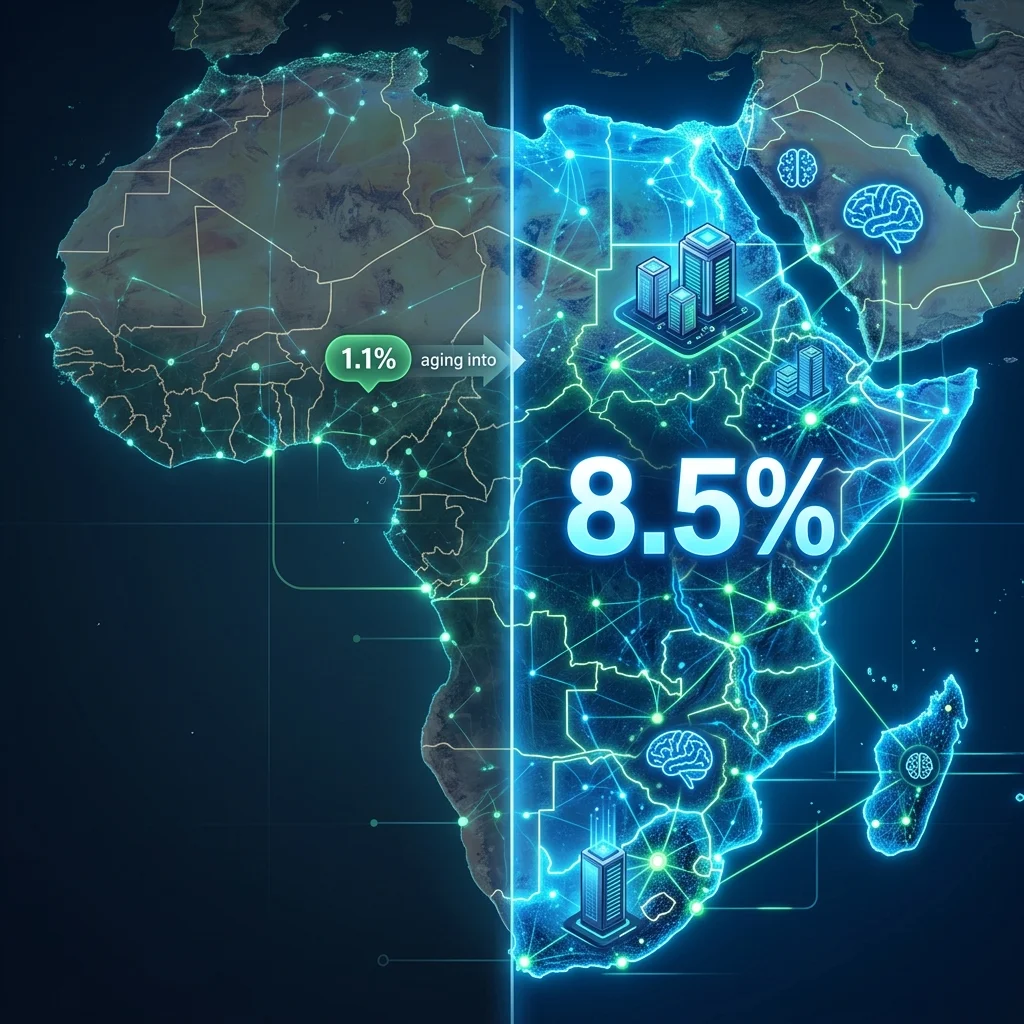
Africa’s digital economy is on a trajectory that few global markets can match.
Africa’s Digital Economy: From 1.1% to 8.5% of GDP – The Cloud-Edge and AI Revolution
The continent’s digital transformation is rewriting economic rules, but infrastructure gaps and energy constraints will determine whether the trajectory holds.
In 2012, Africa’s digital economy contributed just 1.1% of the continent’s total GDP. By 2025, that share is expected to reach 5.2% — a near fivefold increase in thirteen years. And by 2050, it is projected to hit 8.5%, signalling a fundamental restructuring of Africa’s economic base from resource-driven to digitally powered growth.
[IMAGE: Line chart showing digital economy share of GDP from 2012 to 2050 with key milestones at 2012, 2025, 2030, and 2050.]
These figures, sourced from Mordor Intelligence, place Africa among the fastest-growing digital markets globally. The Africa Digital Transformation Market is valued at USD 30.24 billion in 2025 and is forecast to more than double to USD 63.31 billion by 2030, representing a compound annual growth rate (CAGR) of approximately 16%.
But beneath the headline numbers lie critical infrastructure and supply-chain challenges that will determine whether this momentum can be sustained — or accelerated.
The Digital Tipping Point: Africa’s Economic Shift
The jump from 1.1% to 5.2% of GDP in just over a decade is not linear, nor is it accidental. It reflects a confluence of factors: rapidly falling data costs, aggressive fiber-optic cable deployment along the continent’s coasts and hinterlands, and a wave of mobile-first services that bypassed legacy infrastructure.
What makes the 2050 projection of 8.5% particularly meaningful is its implication for economic structure. Historically, Africa’s GDP has been dominated by commodities (oil, minerals, agricultural raw materials) and subsistence agriculture. A digital economy share of 8.5% would place it on par with the current digital contributions of middle-income economies in Southeast Asia and Latin America — a sign that the continent is not just catching up, but leapfrogging.
The shift is already visible in the growth of digital-native industries: mobile money transactions in Sub-Saharan Africa now exceed those in many developed markets; fintech startups attracted over USD 1.3 billion in venture capital in 2024 alone; and e-commerce platforms like Jumia and Wasoko are building pan-African logistics networks. Yet the underlying enabler — the digital infrastructure layer — is where the real transformation is happening.
Market Dynamics: Cloud Edge Leads, AI Accelerates
The Africa Digital Transformation Market is not a monolithic entity. Two segments stand out: cloud edge computing, which currently commands the largest market share, and artificial intelligence, which is growing at the fastest pace.
[IMAGE: Infographic showing market size growth bars from 2025 to 2030 (USD 30.24B to USD 63.31B) and sector breakdown: cloud edge (largest slice), AI (fastest-growing slice), others.]
Cloud edge computing leads because it solves a fundamental problem: across much of Africa, connectivity is unreliable, latency is high, and centralised cloud data centres are often hundreds or thousands of kilometres away. By processing data closer to where it is generated — at the network edge — cloud edge reduces latency, cuts bandwidth costs, and enables real-time decision-making. This is critical for applications like precision agriculture (sensor data from remote farms), mobile financial transactions (low-latency fraud detection), and remote healthcare diagnostics.
Artificial intelligence is the fastest-growing segment, driven by three use cases that are leapfrogging traditional models:
- Fintech: AI-powered credit scoring using mobile money transaction history is expanding financial inclusion to millions of unbanked individuals.
- Agri-tech: Machine learning models analyse satellite imagery and weather data to provide crop yield predictions and pest alerts to smallholder farmers.
- E-learning: Adaptive learning platforms use AI to personalise content for students in under-resourced schools, often delivered via low-end smartphones.
Crucially, cloud edge and AI form a virtuous cycle. Edge deployments generate massive streams of real-time data, which in turn train and refine AI models. Those AI models then optimise edge infrastructure — for example, by predicting network congestion and rerouting traffic, or by automatically adjusting energy consumption at data centres. This interdependence means that investments in one segment directly accelerate the other.
The Ecosystem Accelerators: Demographics, Smartphones, and Investment
Three drivers are fuelling this digital transformation: a young, tech-savvy population, rising smartphone penetration, and intensifying investment from both local startups and global tech giants.
Demographics: Africa has the world’s youngest population, with a median age of approximately 19 years. This cohort has grown up with mobile phones and is digitally native. They are not only consumers of digital services but also creators — from app developers in Nairobi and Lagos to content creators in Accra and Johannesburg. This demographic dividend provides a ready market for digital products and a deep talent pool for innovation.
Smartphone penetration is the critical catalyst. In 2015, less than 30% of the population had a smartphone. By 2025, that figure is expected to exceed 50% in major economies, and it is projected to pass 70% in key markets like South Africa, Nigeria, and Kenya by 2030. Affordable devices — some selling for under USD 50 — are unlocking mobile-based services that were previously inaccessible.
[IMAGE: Photo montage of young Africans using smartphones in urban and rural settings, with overlay of startup logos like Flutterwave, M-KOPA, and Andela.]
Investment flows are accelerating. Global tech companies including AWS, Microsoft, and Google are building local data centres and cloud regions across the continent. AWS has announced plans for data centres in South Africa and Nigeria; Microsoft launched its first African data centre region in Cape Town in 2019 and continues to expand; Google’s cloud region in Johannesburg went live in 2024. These investments are not just about hosting — they provide local compute power that reduces data sovereignty concerns and improves application performance.
Local startups are also scaling rapidly. Consider the case of agri-tech: platforms like Apollo Agriculture in Kenya and Aerobotics in South Africa use satellite imagery and AI to help farmers optimise inputs and reduce losses. Or e-learning: platforms like uLesson in Nigeria and Eneza Education in Kenya deliver curriculum-aligned content via low-bandwidth mobile apps, reaching students who previously had no access to digital learning tools. These examples show how digital transformation is solving real-world bottlenecks in food security and education — two of the continent’s most pressing challenges.
Infrastructure and the Path to 2050: The Hidden Supply Chain
Despite the optimism, the path to 8.5% of GDP is not guaranteed. Beneath the growth projections lies a set of infrastructure and supply-chain constraints that are often underestimated in market reports.
Energy: Data centres and edge nodes require reliable, affordable electricity. Africa’s grid infrastructure is notoriously unstable — many countries experience daily blackouts, and the average cost of commercial electricity in Sub-Saharan Africa is two to three times higher than in developed economies. Data centre operators are increasingly turning to solar-plus-battery microgrids to ensure uptime. This creates a new demand stream for renewable energy, but also a capital-intensive upfront cost that can slow deployment.
[IMAGE: Photo of a solar-powered data centre facility in an African setting, with cooling units and server racks visible.]
Fiber connectivity: Cloud edge and AI require high-bandwidth backhaul to central cloud regions. While undersea cable connectivity has improved dramatically (more than a dozen new cables have been laid around the continent since 2020), the last mile remains a bottleneck. Many rural areas still lack fiber access; edge nodes there must rely on satellite or microwave links, which introduce latency and capacity limitations.
Talent: The AI segment, in particular, faces a severe skills shortage. Training advanced machine learning models requires specialised data scientists and engineers, who are scarce across the continent. Local inference — running AI models on edge devices — is more feasible, but it still requires a workforce that understands deployment, monitoring, and model optimisation. Without targeted upskilling programs and partnerships with universities, this talent gap could slow the adoption of AI-powered services.
Data governance: As African governments introduce data localisation laws (e.g., Nigeria’s Data Protection Act, South Africa’s POPIA), cloud edge and AI providers must navigate a patchwork of regulations. This creates complexity but also opportunity: local data centres become a compliance necessity, further driving investment.
Policy implications: To sustain the trajectory to 2050, governments must prioritise three areas: (1) incentivising private investment in renewable energy for digital infrastructure, (2) accelerating fiber and spectrum allocation for rural connectivity, and (3) reforming education curricula to include digital skills, data science, and AI literacy from secondary school onward.
The Long View: What 8.5% of GDP Really Means
An 8.5% share of Africa’s projected 2050 GDP — estimated at over USD 15 trillion by some models — would represent a digital economy worth more than USD 1.2 trillion. That is not just a growth story; it is a transformation of the continent’s economic identity.
Achieving that figure will require sustained investment in the cloud-edge and AI backbone that underpins it. The good news is that the incentives are aligned: a young population hungry for services, global technology companies seeking new markets, and a wave of local entrepreneurs building solutions for African problems.
The challenge is to ensure that the physical infrastructure — energy, fiber, talent — keeps pace with the digital ambition. If the hidden supply chain is addressed, Africa’s digital economy could well surpass the 8.5% mark. If not, the numbers on the chart may remain an aspiration rather than a reality.
For now, the trajectory is clear. The continent has crossed the tipping point. The question is no longer whether Africa will become a digital economy, but how fast and how evenly the benefits will be distributed.
[IMAGE: Stylized map of Africa glowing with digital networks and nodes, with a small '1.1%' on the left aging into a bold '8.5%' on the right, overlaid with futuristic data centre and AI brain symbols.]