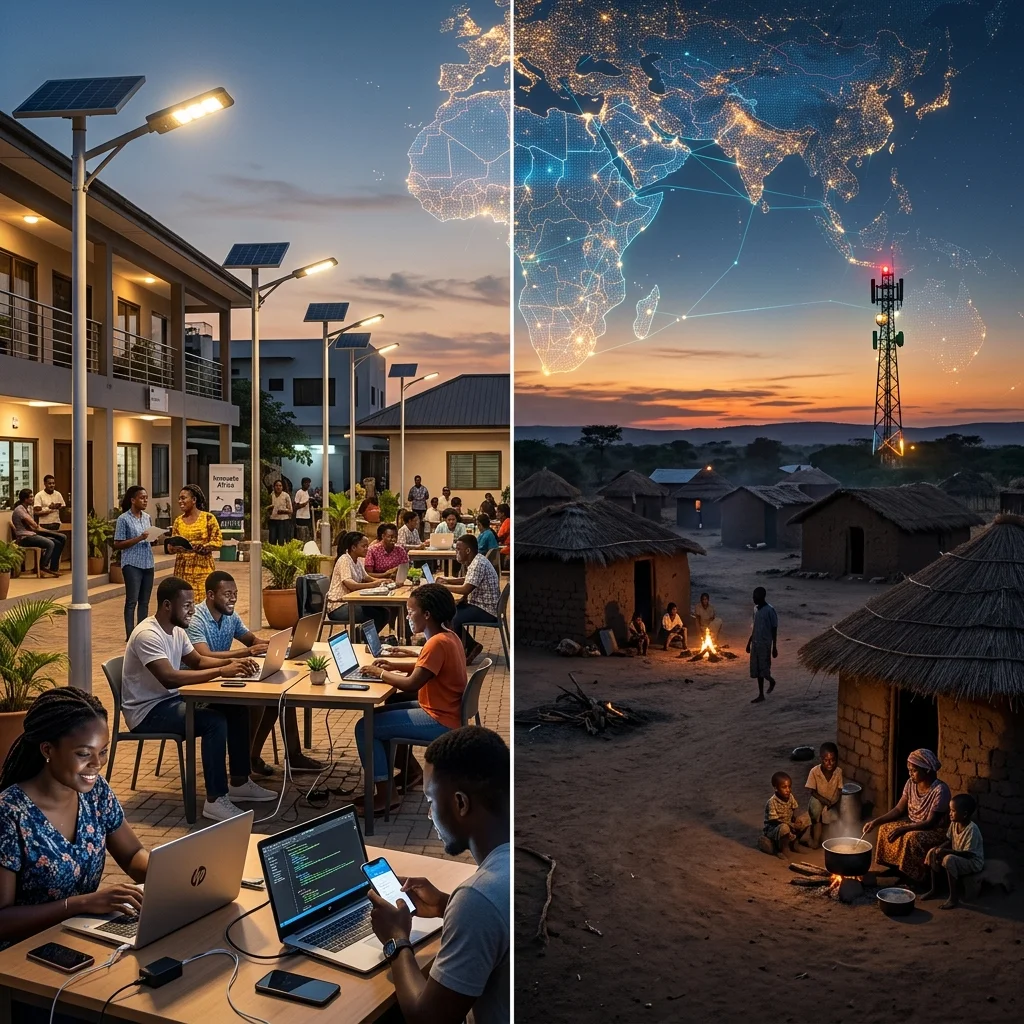
Africa’s internet economy is on a trajectory to reach $712 billion by 2050,
Africa’s Digital Economy at a Crossroads: $712 Billion Potential vs. Deep Structural Divides
By a Senior Technical/Financial Audit Journalist
---
The Promise: Africa’s Digital GDP Tipping Point
Africa’s internet economy is projected to reach $712 billion by 2050, representing 8.5% of the continent’s GDP — an economic contribution equivalent to adding the entire current GDP of Switzerland to the continent’s output (Source: IFC/Google Joint Estimate). The World Bank further estimates a near-term boost of $180 billion to continental GDP by 2025, driven primarily by mobile payments and e-commerce expansion.
The trajectory is statistically unambiguous. Internet users in Africa surged from 10% of the population in 2010 to 43% in 2023, representing over 570 million connected individuals (Source: World Bank Digital Development Data). This compound annual growth rate exceeds every other global region. Mobile connections now total over 1.2 billion, creating a device-to-population ratio that suggests multiple SIM ownership rather than universal access.
The African Development Bank (AfDB) characterizes this transformation with measured optimism: “Africa’s digital economy is emerging as one of the most promising sectors for economic growth and transformation.” The statement reflects observable trends — but the underlying structural mechanics deserve closer scrutiny.
---
The Hidden Economic Logic: Fintech as the Entry Drug, Not the Destination
Venture capital inflows into African startups reached a record $6.5 billion in 2022, with over 60% concentrated in fintech (Source: Startup Funding Reports, AfDB). This concentration creates a market perception that Africa’s digital story is predominantly a payments story. The data partially supports this: digital payment transaction volumes are expected to surpass $40 billion by 2025, while the broader African e-commerce market is projected to exceed $75 billion by 2028 (Source: McKinsey Africa Digital Outlook).
However, transaction volume alone does not capture value creation. The critical analytical distinction lies between payment facilitation and economic transformation. Mobile money platforms — M-Pesa, Flutterwave, Chipper Cash — have successfully converted informal savings into digital capital, yet credit penetration across most African markets remains below 5% (Source: AfDB Financial Inclusion Metrics). This suggests that the infrastructure for moving money exists, but the infrastructure for deploying it productively does not.
The real economic multiplier lies in connecting digital payments to supply chain financing for smallholder farmers and SMEs. Smallholder farmers constitute 60-70% of Africa’s labor force but access less than 1% of formal credit (Source: FAO/World Bank Agricultural Finance Data). Without this linkage, fintech remains a high-volume, low-margin utility rather than a capital allocation engine.
The fintech market’s projected compound annual growth rate of 10% over five years (Source: Industry Analyst Consensus) is robust but masks significant regional concentration. Kenya, Nigeria, South Africa, and Egypt absorb the vast majority of investment, while landlocked and francophone nations remain structurally excluded from this capital flow.
---
The Infrastructure Paradox: Electricity, Fiber, and the Missing Middle
The most numerically striking contradiction in Africa’s digital trajectory is the electricity gap. Nearly 600 million people lack access to electricity (Source: International Energy Agency, AfDB Energy Data), even as the continent adds 57 million new mobile subscribers annually. Devices without power are economically inert.
Rural internet access stands at 28%, compared to 56% in urban areas (Source: ITU/GSMA Connectivity Reports). Fiber-optic network deployment remains concentrated in three countries — Kenya, Nigeria, and South Africa — leaving landlocked nations dependent on expensive satellite backhaul or limited terrestrial links. This creates a “missing middle” problem: Tier-1 cities have connectivity, remote rural areas are entirely disconnected, and the peri-urban zones where most economic activity occurs are caught in between.
Evidence linking electricity access to digital job creation is quantifiable. AfDB studies in sub-Saharan Africa demonstrate that a 10% increase in electricity access correlates with a 3.2% increase in digital sector employment over a five-year lag period (Source: AfDB Infrastructure and Employment Study). This correlation suggests that energy policy is not separate from digital policy — they are structurally interdependent.
Rwanda and Ghana have implemented progressive digital policies that offer a replicable blueprint. Rwanda’s Smart Rwanda Master Plan achieved over 90% 4G population coverage through public-private infrastructure sharing. Ghana’s National Digital Property Addressing System created a foundational layer for e-commerce logistics. However, scaling these models requires cross-border energy integration — the African Single Electricity Market initiative remains in early implementation, and completion timelines are uncertain.
---
The Talent Time Bomb: 230 Million Jobs Need Digital Skills by 2030
The AfDB estimates that over 230 million jobs in sub-Saharan Africa will require digital skills by 2030 (Source: AfDB Jobs for Youth Strategy). This figure must be cross-referenced against current training capacity. Organizations such as Andela and Moringa School have trained tens of thousands of software developers — but the scale mismatch is severe.
Over 60% of Africa’s population is under 25 years old (Source: UN Population Division), creating a demographic profile that could either generate a massive digital workforce or a structural unemployment crisis. The market consensus among training providers is that current output meets less than 5% of projected demand (Source: Industry Training Capacity Assessments).
The skill deficit extends beyond coding. Digital literacy — the ability to use digital tools for commerce, logistics, and communication — is required across all sectors. The World Bank’s Digital Economy for Africa initiative targets universal digital literacy by 2030, but current school systems, particularly in rural areas, lack the infrastructure to deliver this.
The talent scarcity affects investor behavior. Venture capital firms increasingly cite talent acquisition costs as the primary constraint on scaling operations in Africa, particularly for growth-stage companies requiring mid-level engineering and product management talent. This operational friction reduces the net present value of digital investments and extends path-to-profitability timelines.
---
The 2050 Projection: Scenario Analysis
The $712 billion projection by 2050 is not a forecast — it is a scenario based on continued growth at current rates (Source: IFC/Google Modeling Parameters). Three alternative scenarios warrant consideration:
Scenario 1: Accelerated Integration (Probability: 25%) — Cross-border energy markets materialize, fiber networks extend to landlocked nations, and digital skills training scales to meet demand. Under this scenario, the $712 billion figure could be exceeded by 15-20%, with the internet economy reaching 10-11% of GDP.
Scenario 2: Fragmented Growth (Probability: 50%) — Current trends persist: fintech continues to attract capital, but electricity and connectivity gaps remain unresolved. The $712 billion figure is achieved but concentrated in 4-5 countries, creating digital enclaves surrounded by disconnected populations.
Scenario 3: Infrastructure Constraint (Probability: 25%) — Energy poverty, policy fragmentation, and talent scarcity create binding constraints. Growth decelerates, and the internet economy reaches $400-500 billion by 2050, with the percentage of GDP contribution remaining below 6%.
The outcome will be determined by policy decisions made in the next 3-5 years, particularly regarding cross-border energy integration, universal digital literacy mandates, and spectrum allocation for rural connectivity (Source: World Bank Digital Policy Framework).
---
Market Implications and Neutral Predictions
The data supports four conclusions:
First, Africa’s digital economy is capital-rich in payments infrastructure but capital-poor in productivity-enabling applications. Investors should differentiate between payment processing companies (high volume, low margin) and platforms that connect payments to lending, logistics, and supply chains.
Second, the fintech market’s 10% CAGR projection is sustainable only if regulatory harmonization improves. Currently, 30+ separate regulatory regimes govern digital financial services across Africa (Source: AfDB Regulatory Index), creating compliance costs that limit cross-border scalability.
Third, e-commerce growth to $75 billion by 2028 depends on logistics infrastructure that currently does not exist outside major urban corridors. Last-mile delivery costs in African markets are 3-5 times higher than in Southeast Asia (Source: Logistics Cost Comparison Studies), compressing margins and limiting addressable market size.
Fourth, the 230 million digital skills requirement by 2030 will not be met through traditional education systems. Alternative credentialing models — employer-led training, competency-based certification, and remote work integration — will be necessary to close the gap.
The quote attributed to multiple development institutions — “The time to act is now—Africa must fully embrace its digital potential to shape the future of its economy” — is factually accurate but operationally insufficient. The structural data indicates that digital transformation in Africa is not primarily a technology problem. It is an energy problem, a regulatory problem, and a human capital problem — in that order.
The $712 billion figure remains achievable. But it requires acknowledging that the headline projection conceals more than it reveals about the distribution, sustainability, and real economic impact of Africa’s digital growth.