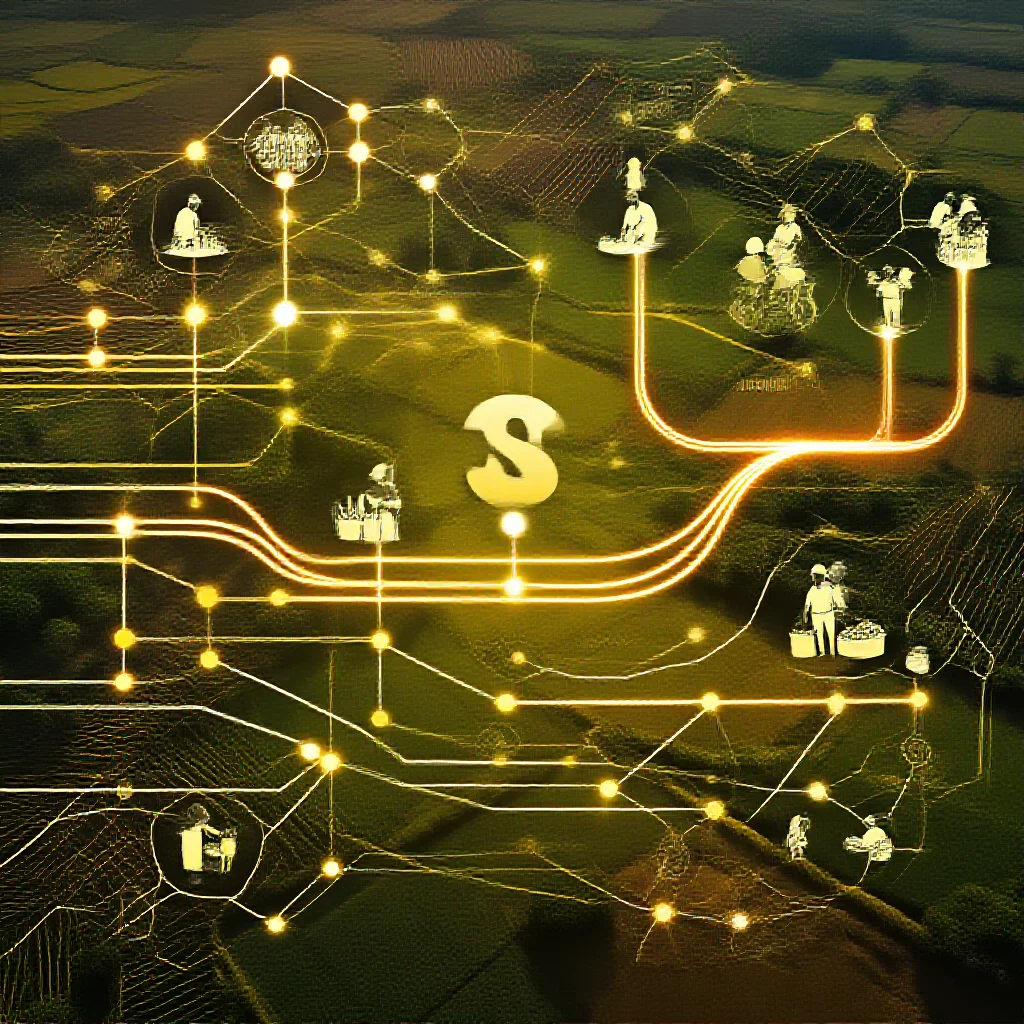
Winich Farms is not just another agri-tech marketplace. By embedding financial
Beyond Payments: How Winich Farms is Rewiring Africa's Agricultural Finance from the Transaction Up
Summary: Winich Farms is not just another agri-tech marketplace. By embedding financial services directly into commodity trade flows, the Nigerian startup is building a new financial infrastructure layer for agriculture. This analysis explores how its model of transaction-anchored finance—using proprietary data from real trades to underwrite credit—addresses systemic gaps in market access and capital. With over $50M in transaction volume and rapid growth, Winich's approach represents a fundamental shift from digitizing existing processes to creating a new, data-driven economic architecture for one of the world's most critical yet underserved sectors.
---
The Infrastructure Gap: More Than Just a Marketplace
The foundational challenge in African agriculture is not a lack of participants but a deficit of structured financial and logistical rails. Conventional solutions have often focused on digitizing isolated components—payments, listings, or credit applications—without integrating them into a cohesive system. This leaves the underlying fragmentation and information asymmetry intact.
Winich Farms, founded in 2020, was established on a thesis that addresses this systemic gap. The company’s objective is not to be a transactional intermediary but to construct a unified platform that serves as foundational infrastructure. This platform simultaneously provides market access, facilitates payments, and extends credit, all within a single, closed-loop environment. The model contrasts with agri-tech approaches that layer financial products onto existing, often informal, trade relationships. Instead, Winich’s architecture is designed from the ground up to make finance a native feature of trade, thereby creating a new operational substrate for agricultural value chains.
The Embedded Finance Engine: Finance as a Feature of Trade
The operational core of Winich’s model is the direct embedding of financial services into commodity transactions. This is executed through products like produce collateralised credit (PCC) and inventory financing (BNPL). These are not standalone loan products but are algorithmically triggered by and contractually tied to specific, verified trades on the platform.
The strategic advantage of this mechanism is the generation of proprietary, real-time transaction data. Every trade executed—connecting almost 200,000 farmers with off-takers (Source 1: [Primary Data])—produces a verified data point encompassing price, volume, timing, and counterparty reliability. This data asset becomes the primary input for dynamic risk assessment and financial product design. As founder Riches Attai states, the differentiation lies in "embedding finance directly into trade, allowing us to generate proprietary transaction data, finance real economic activity, and build a more scalable and defensible model" (Source 2: [Executive Statement]). The underwriting logic is thus anchored not on static collateral but on the flow of real economic activity.
Data as the New Collateral: Building a Defensible Economic Moat
This model represents a fundamental shift in the basis of trust and capital allocation within agriculture. Historically, access to formal finance has been gated by physical collateral—land titles, machinery—assets that are often unavailable or poorly documented for smallholder farmers and SMEs. Winich’s approach substitutes physical collateral with transactional data.
The long-term implication is the construction of a significant economic moat. The verified trade flow data is a non-replicable asset that grows in value and predictive power with each transaction. It enables more granular, dynamic risk pricing, moving the sector away from blanket "high-risk" categorization. This data-centric approach promises greater capital efficiency, as credit is extended specifically against imminent or in-progress economic activity rather than against static balance sheets. Attai notes this enables the company to "underwrite risk more effectively and unlock capital at scale in a historically underserved sector" (Source 2: [Executive Statement]).
Scale and Traction: Validating the Model in the Nigerian Crucible
The commercial and operational metrics reported by Winich Farms provide quantitative validation of its infrastructure thesis. The company has achieved over US$50 million in Gross Merchandise Value and Total Payment Volume (Source 1: [Primary Data]), with growth reported at double-digit rates month-on-month (Source 1: [Primary Data]). This scale, achieved in its core Nigerian market, signals early network effects and deepening engagement across both supply and demand sides of its marketplace.
The company’s pre-Series A funding round secured in June 2025 (Source 1: [Primary Data]) indicates institutional investor validation of its trajectory and model. The revenue architecture leverages this traction through a dual-engine model: margins on the physical commodity trade are complemented by fees and interest derived from embedded finance products. This creates a reinforcing cycle where trade volume generates data, which enables more finance, which in turn facilitates more trade.
Future Trajectory: From National Proof-of-Concept to Regional Architecture
Winich Farms’ current focus remains on deepening its infrastructure within Nigeria, one of Africa’s largest and most complex agricultural economies. Success in this market serves as a robust proof-of-concept for data-driven, embedded finance in agriculture. The company has indicated selective exploration of expansion into structurally similar markets, such as Egypt.
The logical future trend suggests a potential evolution from a multi-sided marketplace into a pure financial infrastructure provider. The proprietary data sets and underwriting algorithms developed could, in time, form the basis of a platform-as-a-service model for other participants in the agricultural ecosystem, including banks, insurers, and government agencies. The fundamental shift Winich exemplifies—from digitizing points in a chain to building a new, data-rich architecture—poses a competitive challenge to traditional financiers and agri-tech intermediaries alike. Its continued growth will test the scalability of transaction-anchored finance as a new paradigm for economic development in frontier sectors.