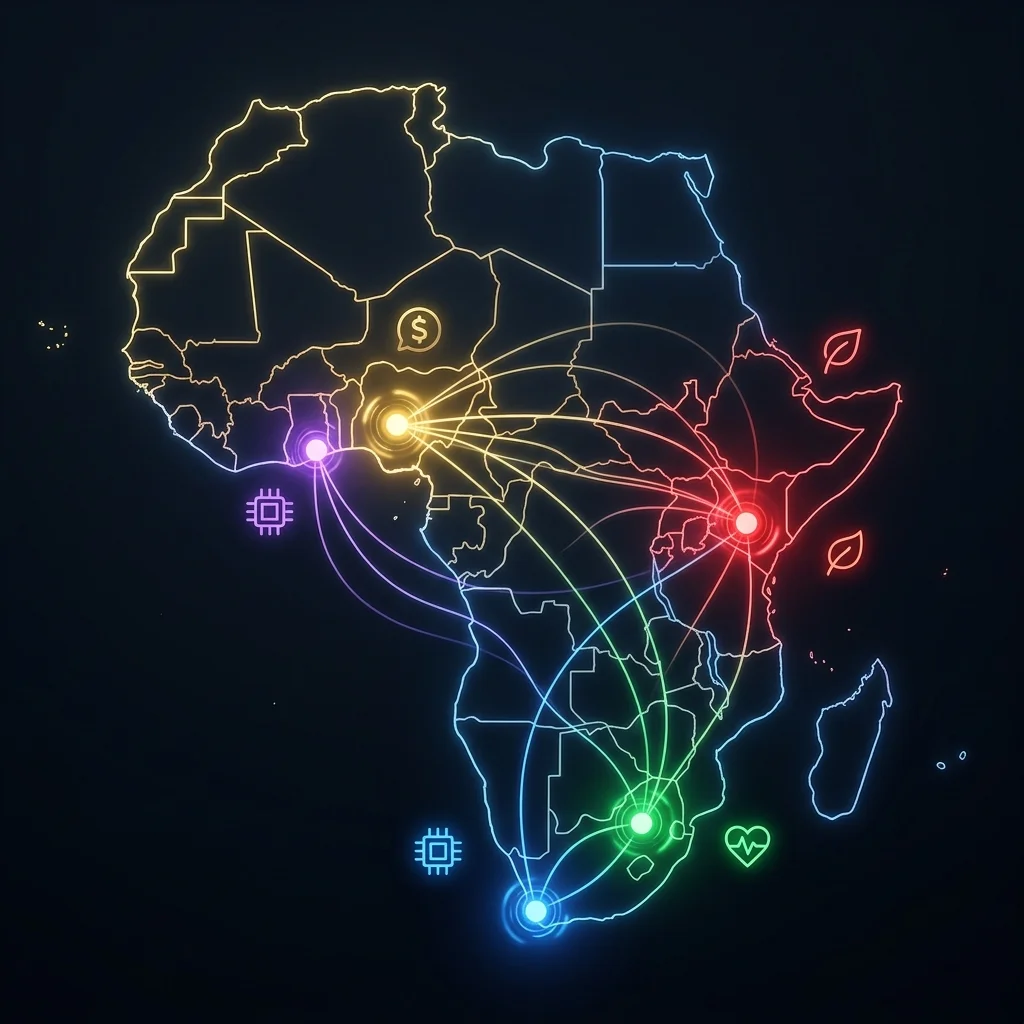
The GSER 2025 rankings reveal a critical shift in Sub-Saharan Africa''s
Beyond Lagos & Nairobi: The Hidden Specialization Driving Sub-Saharan Africa’s Startup Ecosystem Rankings in GSER 2025
Publication Date: August 26, 2025
Source Analysis: Global Startup Ecosystem Report 2025 (Startup Genome)
---
Introduction: The End of the "One Africa" Narrative
The Global Startup Ecosystem Report 2025 (GSER 2025) ranks the top five Sub-Saharan African startup ecosystems as Lagos, Nairobi, Cape Town, Johannesburg, and Accra. Aggregate metrics confirm that "Sub-Saharan Africa’s startup hubs, led by Lagos and Nairobi, show rising global momentum" (Source: Startup Genome, GSER 2025). However, the headline ranking obscures a more structurally significant development: these ecosystems are no longer competing on identical metrics. They are specializing.
The data reveals a functional division of labor. Lagos ranks #1 in Funding but #2 in both Performance and Talent & Experience. Johannesburg is #1 in Knowledge. Cape Town is #1 in Talent & Experience. This dispersion of top scores across different cities indicates that Sub-Saharan Africa’s startup landscape is maturing into a network of specialized nodes rather than a single, monolithic market. The critical question is no longer which ecosystem is "best," but which ecosystem is optimized for which function—and what that means for capital allocation, talent deployment, and sectoral growth.
---
Section 1: The "Specialization Thesis" – Why Lagos is Rich but Not the Smartest
Lagos dominates the region in raw capital deployment, securing the #1 ranking in Funding (GSER 2025, Sub-Saharan Africa category). Yet the same report places Lagos at #2 in Talent & Experience, trailing Cape Town. This divergence points to a structural bottleneck: an abundance of financial capital without a proportionate density of skilled operational talent.
The data supports a "capital glut" hypothesis. Lagos attracts outsized venture funding—driven largely by its fintech sector, which accounts for a disproportionate share of regional deal flow. However, the #2 Talent & Experience ranking suggests that the labor market cannot scale at the same velocity. Founders in Lagos face higher recruiting costs, longer hiring cycles, and greater reliance on imported talent. This creates a dependency on other regional hubs for human capital.
Conversely, Johannesburg’s #1 ranking in Knowledge indicates a different specialization. The city’s deep research and commercialization infrastructure—rooted in mining technology, financial services engineering, and industrial R&D—positions it as the region’s fundamental research engine. Johannesburg’s knowledge advantage is not accidental; it reflects decades of institutional investment in universities, corporate R&D labs, and patent-generation capacity.
The ordinary reporting narrative stops at "Lagos is #1." The structural insight is that Lagos’s funding leadership masks a talent deficit that must be filled by other ecosystems. Johannesburg supplies knowledge. Cape Town supplies talent. Lagos supplies capital. This tripartite division represents a self-correcting regional system, not a fragmented one.
---
Section 2: Cape Town – The Talent Magnet Redefining "Cluster" Thinking
Cape Town’s #1 ranking in Talent & Experience (GSER 2025) is the most analytically significant outlier in the Sub-Saharan Africa dataset. Unlike Lagos, where funding concentration drives the ranking, Cape Town’s leadership is supply-side: it produces and attracts high-quality human capital.
Three structural factors explain this. First, the University of Cape Town and Stellenbosch University generate a consistent pipeline of STEM graduates, particularly in biomedical sciences and engineering. Second, Cape Town’s lifestyle and infrastructure attract expatriate talent, including returning African diaspora professionals and European remote workers. Third, a growing culture of deep-tech entrepreneurship—rather than quick-service fintech—favors ventures that require PhD-level domain expertise.
The sector linkage is direct. Healthtech requires deep domain talent: clinicians, biologists, regulatory specialists. Climatetech requires environmental engineers and materials scientists. These verticals cannot scale in ecosystems that lack talent density. Cape Town’s #1 Talent & Experience ranking makes it the defensible location for investors seeking exposure to these capital-intensive, research-dependent sectors.
GSER 2025’s methodology for Talent & Experience likely weights metrics including STEM graduate output, founder prior startup experience, and senior technical hiring availability. By those measures, Cape Town is the region’s only ecosystem that scores competitively with mid-tier European tech hubs in talent density.
---
Section 3: The Sectoral Playbook – Fintech, Healthtech, and Climatetech as Competitive Differentiators
The GSER 2025 identifies fintech, healthtech, and climatetech as the region’s three dominant verticals. These sectors map directly onto the specialization thesis.
Fintech is Lagos’s domain. High funding volumes, dense mobile money infrastructure, and regulatory experimentation (e.g., Nigeria’s Payment Service Bank licenses) create an environment where capital deployment velocity is high. Lagos does not need to be the talent leader to dominate fintech; it needs to be the liquidity leader.
Healthtech clusters in Cape Town and Nairobi. Cape Town’s talent density supports ventures requiring clinical validation and regulatory navigation. Nairobi’s strength in mobile-first health delivery platforms (e.g., telemedicine, pharmacy logistics) aligns with its performance in digital infrastructure.
Climatetech is emerging across Johannesburg and Cape Town. Johannesburg’s knowledge base in mining and resource extraction provides foundational expertise for carbon capture, energy efficiency, and sustainable materials. Cape Town’s water crisis experience created a generation of climatetech entrepreneurs focused on resource management.
The predictive implication: investors seeking fintech returns should prioritize Lagos for capital efficiency. Investors seeking deep-tech defensibility should prioritize Cape Town for talent retention. Investors seeking research-intensive commercializations should prioritize Johannesburg for knowledge assets.
---
Section 4: Cross-Validation – What the Rankings Say About Ecosystem Maturity
Comparing the five ecosystems across four dimensions—Funding, Performance, Talent & Experience, Knowledge—reveals a maturity gradient.
| Ecosystem | Funding Rank | Performance Rank | Talent & Experience Rank | Knowledge Rank |
|-----------|--------------|------------------|--------------------------|----------------|
| Lagos | #1 | #2 | #2 | Not Top 3 |
| Nairobi | #2 | #1 | #3 | Not Top 3 |
| Cape Town | Not Top 3 | Not Top 3 | #1 | Not Top 3 |
| Johannesburg | Not Top 3 | Not Top 3 | Not Top 3 | #1 |
(Source: GSER 2025, Sub-Saharan Africa Category Rankings)
Lagos and Nairobi achieve high rankings in Funding and Performance—metrics that reward execution speed and capital attraction. Cape Town and Johannesburg score on input-side metrics (Talent, Knowledge) that correlate with long-term innovation capacity but not immediate output velocity.
This divergence suggests a two-speed region. Lagos and Nairobi represent the "current state" of African tech—fast, funded, fintech-heavy. Cape Town and Johannesburg represent the "future state"—research-intensive, talent-constrained in the short term, but structurally positioned for depth. Accra, while not scoring top in any individual sub-category, benefits from proximity to Lagos and English-language talent pools, functioning as a secondary node.
---
Market/Industry Predictions
Based on the GSER 2025 specialization data, three neutral predictions emerge for the 2026-2028 window:
- Lagos will experience a talent bottleneck correction. As funding continues to outpace labor supply, Lagos-based companies will increasingly establish satellite engineering offices in Cape Town and Johannesburg. Cross-ecosystem talent mobility will become a formal strategy, not an ad-hoc practice.
- Healthtech and climatetech funding will shift toward Cape Town and Johannesburg. As venture capital rotates away from pure fintech toward regulated, capital-intensive verticals, the ecosystems with the talent and knowledge base to support these sectors will capture disproportionate share of later-stage funding.
- Regional specialization will accelerate institutional arbitrage. Investors will develop ecosystem-specific theses: "Lagos for growth-stage fintech, Cape Town for seed-stage deep tech, Johannesburg for R&D spinouts." The aggregate rankings will matter less than the ability to navigate sub-network advantages.
The GSER 2025 data does not support a narrative of any single "winning" ecosystem. It supports a narrative of functional differentiation. Sub-Saharan Africa’s startup landscape is no longer a market. It is a network of specialized asset classes, each optimized for a different stage of the venture lifecycle. The sophisticated investor will read not the composite ranking, but the sub-scores.
---
Data sources: Global Startup Ecosystem Report 2025 (Startup Genome). All rankings refer to the Sub-Saharan Africa category unless otherwise specified.