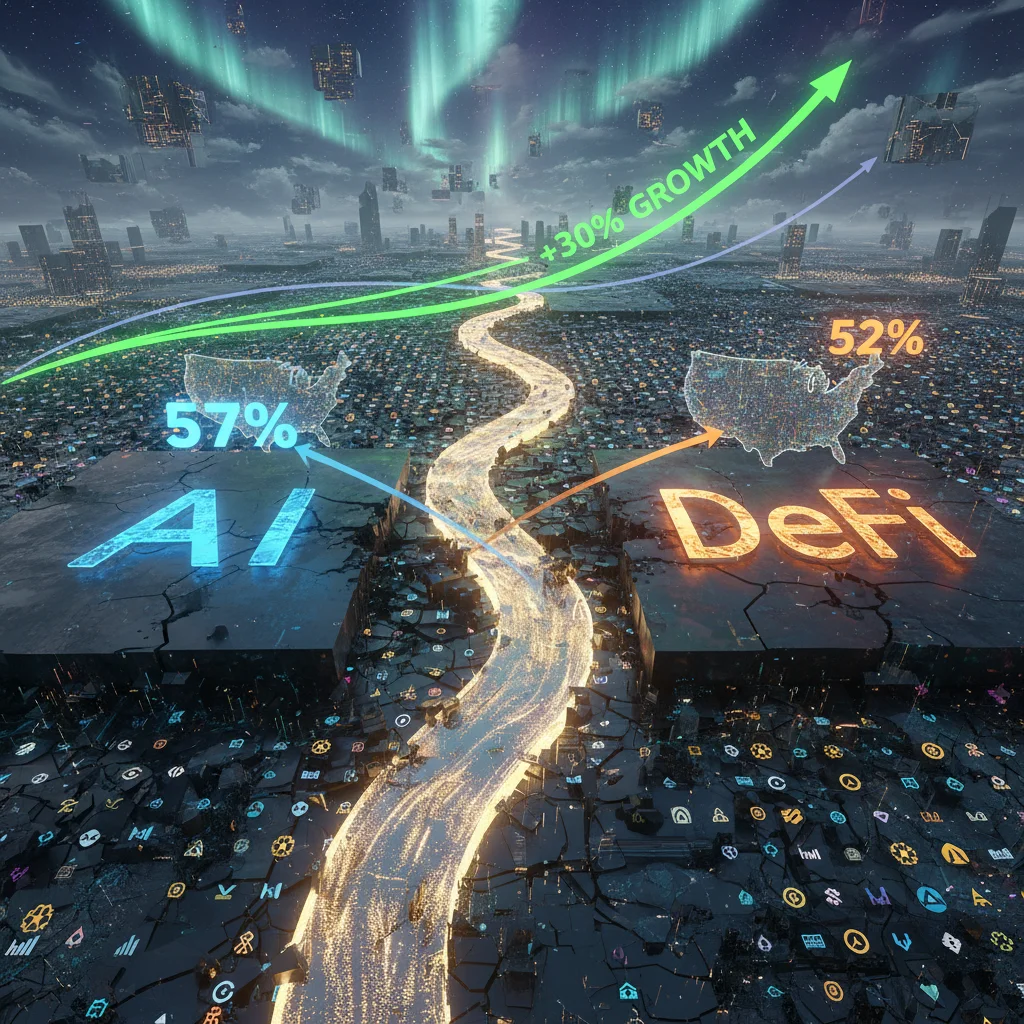
Global venture funding hit $314 billion in 2024, with over a third flowing
Navigating the New Frontier: Strategic Alignment in the Age of AI and DeFi Dominance
Introduction: The Polarization of Capital and Opportunity
Global venture funding reached $314 billion in 2024, with more than one-third of that capital flowing into artificial intelligence startups. This single statistic captures a structural shift in investor attention that is reshaping entire ecosystems. While AI companies raised over $100 billion, other sectors—from enterprise SaaS to biotech—saw their share of the pie shrink relative to 2023 levels.
[IMAGE: A stacked bar chart comparing 2023 vs 2024 VC allocation by sector (AI, DeFi, other).]
The immediate question for founders, venture capitalists, and corporate innovation leaders is no longer whether to adopt AI, but how to realign strategy when the market’s center of gravity moves so rapidly. For startups that are neither AI-native nor blockchain-focused, the pressure to justify their existence in a funding environment that rewards AI and DeFi narratives is immense. This article offers a deep-dive into the macroeconomic logic behind these shifts, regional disparities, and the hidden risks for non-AI sectors—drawing on data from Crunchbase and IDC to build a strategic roadmap for capital allocation in a polarized era.
The AI Tide: From Experiment to ROI Engine
Enterprise generative AI adoption surged from roughly 55% in 2023 to 75% in 2024, according to IDC. At the same time, early adopters reported an average return on investment of 3.7x—a figure that has turned AI from a speculative experiment into a measurable efficiency driver. Crunchbase data confirms that AI captured over one-third of the total $314 billion venture capital pie, a concentration not seen since the dot-com boom.
[IMAGE: Line graph showing generative AI adoption curve (2023–2024) with ROI overlay.]
The AI market is projected to grow at a compound annual rate of 30% through 2030. This trajectory means that early movers have already locked in scale advantages through proprietary data, specialized models, and integration moats. Later entrants, whether pure AI startups or incumbents adding AI capabilities, will need differentiated use cases that avoid direct competition with well-funded giants.
The strategic implication for non-AI startups is clear: investors now expect AI to be a capability layer, not a nice-to-have. A SaaS company that does not embed generative features risks being perceived as legacy technology, regardless of its revenue growth. Founders must ask: can we leverage existing data to build predictive models? Can we automate customer workflows with LLMs? The answer must be "yes" to maintain investor confidence in the current funding climate.
DeFi’s Silent Ascent: Revenue Per User as a Strategic Metric
While AI dominates headlines, decentralized finance has been quietly building an alternative capital pool. DeFi market revenue is forecast to reach $26.2 billion in 2024, with an average revenue per user of $1,378. That ARPU dwarfs traditional fintech metrics: for comparison, major neobanks often hover below $200 per user. DeFi’s premium user base—typically sophisticated, risk-tolerant, and high-transaction-volume—makes it an attractive asset class for VCs seeking high-margin bets.
[IMAGE: Infographic illustrating DeFi revenue breakdown and ARPU vs traditional finance.]
Blockchain-based lending, automated market making, and tokenized real-world assets are driving a parallel stream of venture capital that competes with AI for dollars. This creates a bifurcated market: AI and DeFi together commanded roughly 45% of all VC funding in 2024, leaving other verticals fighting for scraps.
For startups in adjacent verticals—compliance technology, custodial services, digital identity, and regulatory reporting—the DeFi wave offers a growth vector without requiring direct entry into lending or decentralized exchange operations. By building the rails that make DeFi scalable and compliant, these companies can ride the sector’s expansion while maintaining their own strategic identity. The key is to align with DeFi’s revenue-per-user dynamics: target high-value institutional clients rather than retail mass markets.
The US vs. MENA: A Tale of Two Funding Ecosystems
Geography is becoming an increasingly critical dimension of strategic alignment. The United States continues to capture roughly 57% of global venture capital annually—a dominance that concentrates innovation but also breeds herd behavior. In 2024, US-based AI startups alone raised more capital than the entire European startup ecosystem combined. This funding concentration means that a startup incorporated in Silicon Valley enjoys higher valuation benchmarks, easier access to follow-on capital, and a deeper pool of AI talent.
[IMAGE: World map with color-coded VC flows, highlighting 57% to US and 52% of MENA flowing to Saudi Arabia.]
Meanwhile, the Middle East and North Africa region is emerging as a counterbalance. MENA startups raised $2.6 billion in 2023, and preliminary 2024 data suggests continued growth, with Saudi Arabia accounting for 52% of that total—a direct result of the Saudi Vision 2030 push to diversify the economy away from oil. This state-driven innovation model provides stability and large anchor investments from sovereign wealth funds, but it also imposes limits. Exit optionality is more constrained than in US markets: IPOs are fewer, secondary markets are thinner, and acquisition appetite from local conglomerates is narrower in scope.
For a startup choosing between the US and MENA, the strategic decision hinges on type of capital and timeline. US investors prioritize rapid scale and global market capture, often demanding high burn rates and aggressive product iteration. MENA investors, particularly state-linked funds, tend to favor longer horizons, deep integration with national development goals, and partnerships with government entities. A startup solving local infrastructure problems—logistics, smart city infrastructure, financial inclusion—may find MENA’s patient capital more suitable than US hyper-growth expectations.
The deeper insight is that funding polarization is not just about AI vs. non-AI; it’s also about geography. The US ecosystem forces startups to be either AI-native or risk marginalization, while MENA allows space for non-AI ventures that align with state priorities. Founders must assess not only what they build, but where they build it.
Conclusion: Crafting a Polarization-Proof Strategy
The data from 2024 paints a clear picture: capital is flowing disproportionately to AI and DeFi, and this trend will intensify through the rest of the decade. For startups and investors, the old playbook of diversification for diversification’s sake no longer works. Instead, strategic alignment must now account for three forces:
- AI as a universal capability – every startup, regardless of sector, should evaluate how generative AI can enhance its core offering or reduce costs. Companies that ignore this will see their valuation multiples compress.
- DeFi as a revenue model benchmark – the high ARPU of DeFi users signals that premium monetization is possible even in volatile markets. Non-blockchain startups can learn from DeFi’s user engagement strategies, especially in loyalty, tokenization, and community governance.
- Geography as a strategic variable – choosing between US capital efficiency and MENA state-backed stability is not a binary; it’s a continuum. Hybrid models—US incorporation with MENA revenue—are increasingly feasible and can hedge against regional downturns.
The hidden risk for non-AI sectors is not that they will disappear, but that they will become invisible to investors. Companies that fail to articulate how they fit into the new paradigm—either by embedding AI, riding DeFi infrastructure, or leveraging a geographic niche—will find the funding window closing. Those that do embrace the polarization will discover that the same forces that concentrate capital also create concentrated opportunities. The key is not to fight the tide, but to navigate it with clarity of purpose and rigorous alignment between strategy, market, and capital source.
[IMAGE: A futuristic abstract landscape showing two large tectonic plates labeled 'AI' and 'DeFi' shifting the ground beneath a field of small startup logos; a glowing money flow splits 57% toward a US-icon and 52% toward a Saudi-Arabia silhouette; digital chart lines project a 30% growth curve upward; no text, no watermark, ultra-realistic 4K render.]