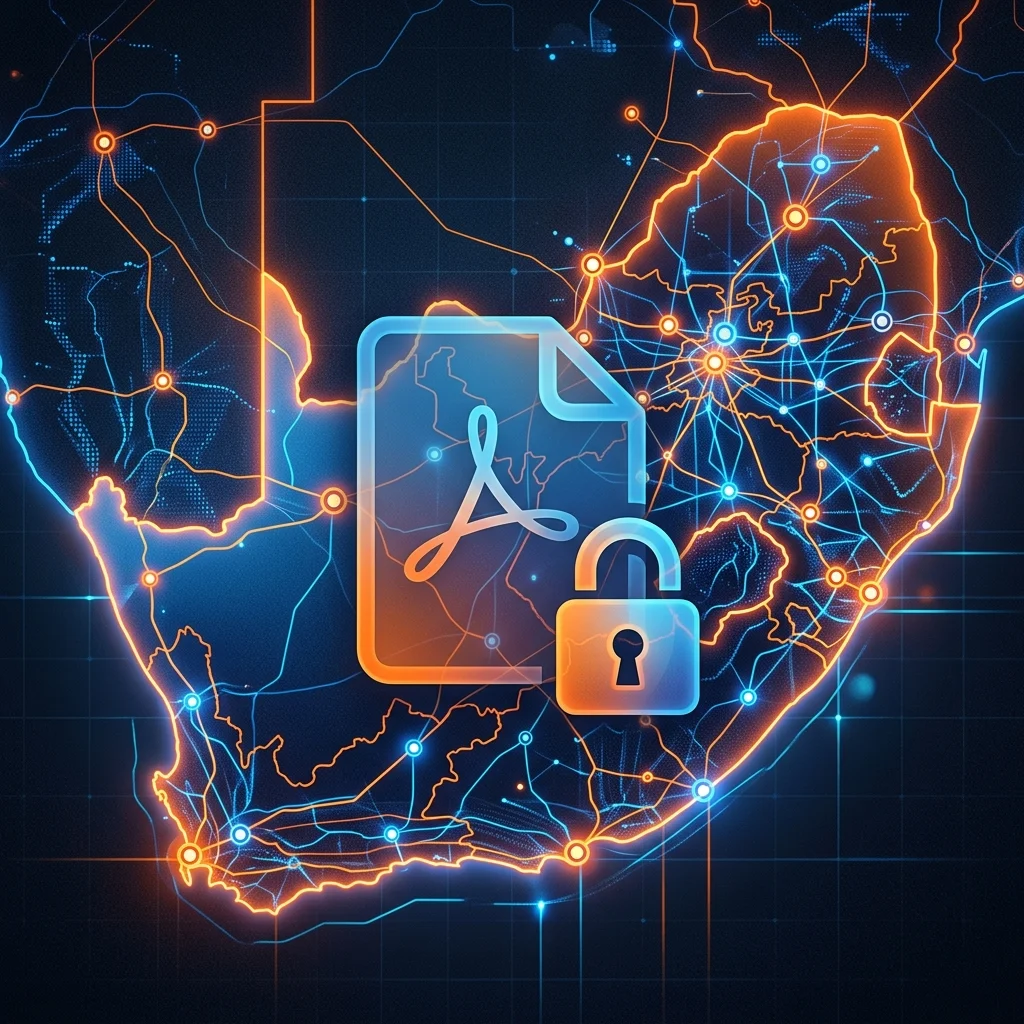
The UNDP published a startup ecosystem map for South Africa in August 2024,
UNDP's Locked PDF Reveals South Africa Startup Ecosystem Map—But Data Remains Inaccessible
In August 2024, the United Nations Development Programme (UNDP) published a file titled meet_the_toshikas_-_startup_ecosystem_map_south_africa.pdf. The 7166-kilobyte document, ostensibly a startup ecosystem map for South Africa, should have been a goldmine for investors, policymakers, and researchers tracking Africa startup ecosystem trends. Instead, it has become a case study in data accessibility challenges: the PDF is in binary format, completely resistant to text extraction, and its contents remain locked from automated analysis. What can we learn from a file that won't open?
[IMAGE: Screenshot of file metadata showing filename "meet_the_toshikas_-_startup_ecosystem_map_south_africa.pdf", size 7166 KB, date August 2024, with a symbolic padlock overlay]
The Locked PDF: What We Know from Metadata
The binary nature of the file suggests either intentional obfuscation, a corrupted encoding, or a design choice that prioritized visual layout over machine readability. Standard PDF-to-text tools return garbled sequences of bytes, no words, no tables, no extractable data. Yet the metadata itself offers three critical pieces of information.
First, the UNDP produced the map—placing it within the agency's broader work on sustainable development and economic inclusion. Second, the file explicitly targets South Africa's startup ecosystem, a sector that has drawn growing international attention. Third, the filename introduces an intriguing term: "Toshikas." Why would a development agency embed a colloquial or acronymic term in an official mapping exercise?
Possible explanations for the locked format include design complexity (interactive maps rendered as flattened images), file corruption during upload, or a conscious decision to restrict automated scraping—though the latter seems counterproductive for a document intended to inform public policy. Regardless of the cause, the locked PDF symbolizes a larger frustration in the African innovation landscape: data that exists but remains operationally out of reach.
South Africa's Startup Ecosystem: A Growing Force
Despite the inaccessible PDF, South Africa's startup environment is well-documented through other sources. The country hosts over 500 active South Africa startups, more than any other sub-Saharan African nation except Nigeria and Kenya by total venture capital raised. In 2023 alone, South African startups secured approximately $700 million in funding, with fintech, healthtech, and cleantech leading the charge.
Cape Town has emerged as the continent's second most active tech hub after Nairobi, driven by a concentration of accelerators like AlphaCode and venture studios such as Founders Factory Africa. Johannesburg's financial services expertise fuels a fintech boom—companies like Yoco and Jumo have reached unicorn valuations. Durban contributes strength in logistics and green technology.
[IMAGE: Infographic showing top startup sectors in South Africa 2023-2024: Fintech 42%, Healthtech 18%, Cleantech 12%, Logistics 10%, Edtech 8%, Others 10%; with funding round examples like Yoco $83M Series C, Jumo $120M Series C, Aerobotics $17M Series B]
The UNDP's interest in mapping this ecosystem is strategic. The agency's Sustainable Development Goals (SDGs) framework explicitly ties digital entrepreneurship to job creation, poverty reduction, and digital inclusion. A comprehensive startup map can help identify gaps in support infrastructure, direct funding to underserved regions, and align private sector innovation with public development targets. That is precisely why the locked state of this particular map is so frustrating.
Who Are the 'Toshikas'? Decoding the Report's Focus
The filename meet_the_toshikas demands interpretation. "Toshikas" is not a widely recognized term in startup literature, South African colloquial language, or any major African language. Several hypotheses emerge:
- A proper name: Possibly a misspelling of "Toshikas" derived from a surname or community. No prominent Toshika family or organization appears in public records related to South African entrepreneurship.
- An acronym: Could stand for "Technology, Open Systems, Human Intelligence, Knowledge, and Sustainability" or similar—but no established acronym matches.
- A local initiative: The term might refer to a specific program or cohort within the UNDP's ecosystem work. For instance, some development agencies use playful names for entrepreneur networks (e.g., "Toshiko" in Japanese means "child of the age," but no direct link to South Africa).
The most plausible explanation is that "Toshikas" is a coined term—perhaps a blend of "tech ecosystems" in a local language or a nickname for a group of early-stage founders. Without access to the PDF content, we can only speculate. What the filename does confirm is that the UNDP map profiles stakeholders, funding flows, and support organizations within a specific subset of the ecosystem. The existence of such granular mapping, even if locked, signals growing formalization of ecosystem knowledge in South Africa.
[IMAGE: Word cloud combining "Toshikas" with related terms: ecosystem, UNDP, startups, funding, map, South Africa, innovation, entrepreneurs, tech hubs, accelerators; alongside African startup ecosystem terms like Silicon Cape, MEST, 4Di Capital]
The Data Accessibility Challenge in African Innovation
This locked PDF is not an isolated incident—it reflects a systemic data accessibility problem across the African innovation landscape. Development agencies, government bodies, and even private research firms frequently publish valuable data in formats that resist machine readability: scanned images of tables, password-protected PDFs, or proprietary formats behind paywalls. A 2023 report by the African Data Revolution initiative found that only 12% of development-related datasets in Africa are available in open, structured formats.
The consequences are tangible. AI-driven analysis—natural language processing of startup reports, geospatial mapping of innovation clusters, or real-time monitoring of funding flows—relies on clean, extractable data. When key documents like the UNDP map are locked, researchers must either manually transcribe or simply abandon the analysis. This creates information asymmetries: well-resourced organizations can afford to decode messy data, while smaller local startups and policymakers lose out.
Efforts to improve the situation exist. The African Union's Digital Transformation Strategy calls for open data standards. UNDP itself has launched open data portals for some programs. But adoption remains uneven, and the default publishing practice still leans toward PDF over CSV, JSON, or API-accessible formats. The irony is that the same agency producing a startup map—designed to foster an innovation ecosystem—has inadvertently created a barrier to that ecosystem's data-driven growth.
What a Startup Ecosystem Map Should Include (and Why It Matters)
To understand what was lost, consider the typical components of a UNDP startup ecosystem mapping exercise. These maps generally identify:
- Stakeholders: incubators, accelerators, co-working spaces, university innovation hubs, angel networks, venture capital firms
- Funding sources: government grants, development finance institutions, private equity, diaspora capital
- Regulatory environment: company registration processes, visa regimes for foreign founders, tax incentives
- Sectoral strengths: fintech, agritech, healthtech, cleantech concentrations
- Infrastructure gaps: internet connectivity, electricity reliability, transport links
- Talent pipelines: coding bootcamps, university engineering programs, mentorship networks
For investors, such maps reduce due diligence costs and highlight overlooked opportunities. For policymakers, they inform where to allocate resources—building a digital hub in an underserved township or adjusting visa rules to attract tech talent. For startups themselves, maps reveal competitors, partners, and funding pathways. The locked PDF prevents all these stakeholders from extracting actionable intelligence.
Toward Open Data in African Startup Ecosystems
The UNDP has an opportunity to turn this frustration into a best-practice example. By republishing the map's underlying data in an open format (e.g., CSV tables with geographic coordinates, funding amounts, and entity types), the agency could demonstrate commitment to the open data principles it advocates. Doing so would align with the African Data Revolution's call for "data as a public good" and set a precedent for future ecosystem mapping exercises.
In the meantime, researchers and investors must rely on alternative sources. Organizations like Briter Bridges, Africa: The Big Deal, and Partech publish annual African tech funding reports with downloadable databases. The South African Startup Tracker maintained by local venture capital firm 4Di Capital offers quarterly funding data. These resources, while valuable, lack the systemic mapping that a national-level UNDP study should provide.
Conclusion: Metadata Is Not Enough
The locked UNDP PDF offers a stark reminder: in the age of big data and AI, a document that cannot be read by machines is nearly as useless as one that does not exist. The metadata—a filename, a file size, a publication month—provides tantalizing clues but cannot substitute for the ecosystem intelligence that lies encoded but trapped within the binary.
For South Africa's startup scene, the message is mixed. The country's ecosystem is vibrant, well-funded, and increasingly recognized by development agencies. But the very tools designed to document and support that growth remain inaccessible. As the UNDP contemplates its next steps, it should consider a simple question: What good is a map that no one can read?
[IMAGE: A stylized map of South Africa with glowing digital nodes and interconnecting lines representing startup hubs, overlaid with a semi-transparent PDF icon that appears partially locked, in vibrant orange and blue gradients, no text, no watermark]