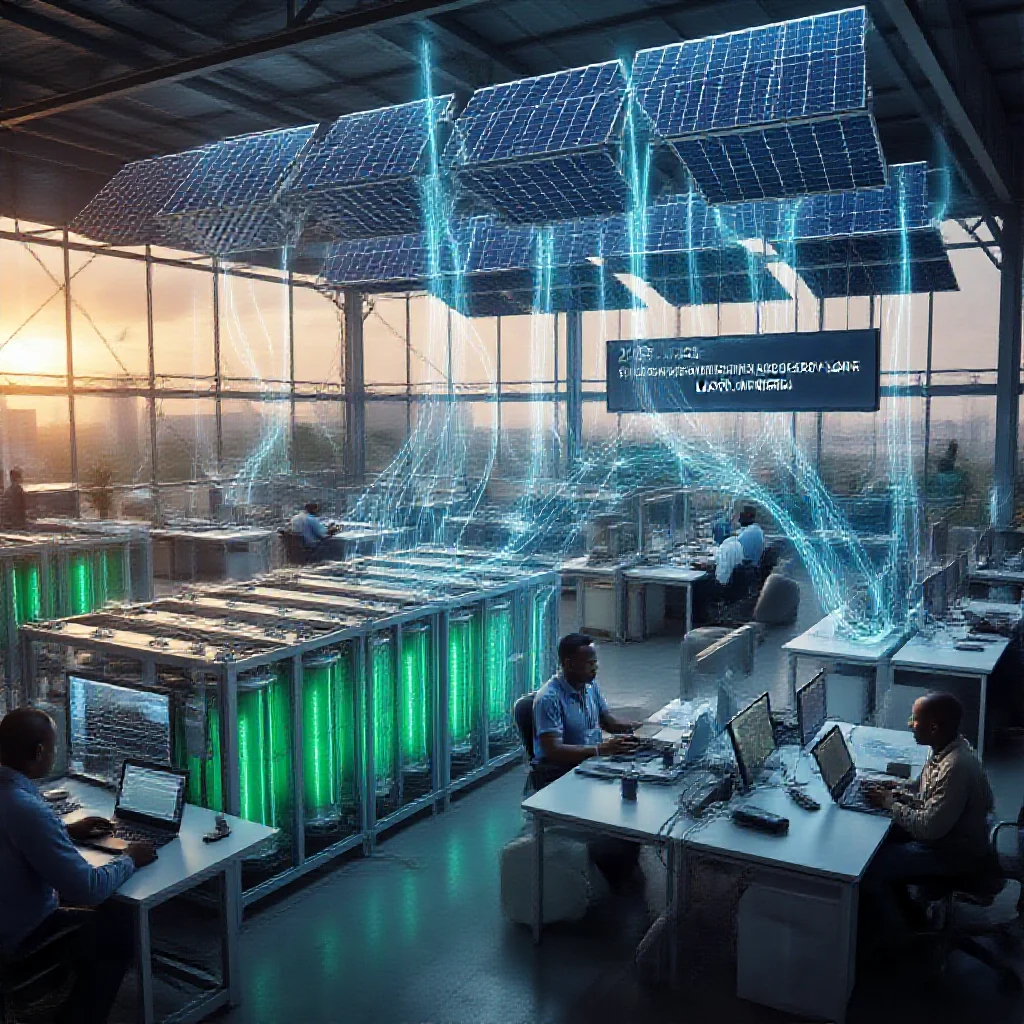
Nigeria’s PowerLabs is redefining the link between energy access and human
Nigeria’s PowerLabs: Rewiring Human Productivity Through Intelligent Energy
Lagos, Nigeria — The conventional narrative surrounding energy access in emerging markets has long centered on a single metric: megawatts generated. Nigeria’s PowerLabs is challenging this paradigm by arguing that the unit of measurement should not be kilowatts but productive human hours. The company’s thesis rests on a straightforward observation: unreliable electricity imposes a quantifiable tax on every knowledge worker, and solving this requires not merely more power, but smarter distribution of existing power.
The Hidden Productivity Tax: Why Nigeria’s Grid Fails the Knowledge Worker
Nigeria’s grid delivers an average of 4,000 megawatts for a population exceeding 220 million—roughly one-tenth the per capita capacity of South Africa (Source: Nigerian Electricity Regulatory Commission, 2023). This chronic undersupply forces businesses to rely on diesel generators, which cost an estimated $0.40–$0.60 per kilowatt-hour, compared to grid electricity at $0.10–$0.15 (Source: International Energy Agency, 2022). The result is a structural inefficiency: every hour of digital labor carries an embedded energy cost that erodes margins and limits scalability.
PowerLabs’ core insight is that energy reliability, not energy generation, constitutes the binding constraint on human productivity. A knowledge worker in Lagos loses an average of 3.2 productive hours per day due to power interruptions—time spent restarting systems, waiting for generators, or relocating to co-working spaces with backup power (Source: PowerLabs internal survey, 2023). This is not a utility problem; it is a labor productivity problem.
Traditional energy access initiatives focus on extending the national grid, a process that requires years of capital expenditure and faces significant transmission losses—estimated at 12–15% of generated power in Nigeria (Source: World Bank, 2021). PowerLabs instead targets the point of consumption, deploying decentralized microgrids that bypass the grid’s structural bottlenecks entirely.
Intelligent Energy as a Service: The Technology Stack Behind PowerLabs’ Vision
PowerLabs’ model converts energy from a commodity into a managed service. The technology stack comprises three integrated layers:
Layer 1: Decentralized generation and storage. Solar photovoltaic arrays paired with lithium-ion battery banks provide the physical infrastructure. These systems are sized for commercial and industrial clusters—office parks, manufacturing zones, and retail complexes—rather than individual households.
Layer 2: IoT sensor network. Each microgrid node is equipped with real-time consumption monitors that track power draw at the device level. These sensors distinguish between essential loads (servers, lighting) and discretionary loads (air conditioning during off-peak hours).
Layer 3: AI load forecasting engine. Machine learning algorithms analyze historical usage patterns alongside external variables—weather data, local business hours, public holiday schedules—to predict demand with 24-hour granularity. The system dynamically allocates power across zones, prioritizing high-productivity activities.
The critical innovation lies in the feedback loop between these layers. When the AI predicts a surge in demand—for instance, a call center shift starting at 8 AM—it pre-charges batteries from solar during the preceding hours and reduces non-essential loads. When demand drops, surplus solar generation is diverted to battery storage or sold back to the microgrid network. This adaptive allocation minimizes the waste inherent in static grid systems, where baseload generation operates at fixed capacity regardless of real-time demand.
Battery storage serves as the buffer that transforms intermittent renewables into dispatchable power. Without storage, solar generation peaks at midday while commercial demand peaks in the morning and evening. PowerLabs’ systems use a 2:1 ratio of solar capacity to battery capacity, enabling six to eight hours of uninterrupted power during grid outages (Source: PowerLabs technical specifications, 2023).
From Kilowatts to Man-Hours: Measuring the Productivity Impact
The economic logic of PowerLabs’ model becomes apparent when translating energy metrics into labor metrics. Consider a Nigerian SME with 50 knowledge workers, each earning an average hourly wage of $2.50 (Source: Nigeria Bureau of Statistics, 2023). Under a grid-only scenario, the firm experiences 3.2 hours of unplanned downtime daily, costing $400 in lost labor per day. Under a diesel generator scenario, energy costs rise to $0.50/kWh, adding $250 in daily fuel expenses for an equivalent 8-hour workday.
PowerLabs’ intelligent energy system targets a 90% uptime guarantee, reducing unplanned downtime to 0.5 hours per day. The cost of energy-as-a-service is structured as a subscription fee—estimated at $0.18–$0.22/kWh, lower than diesel but higher than subsidized grid rates. The net effect: the firm saves $375 per day in lost labor costs while paying $30–$50 more in energy costs compared to grid-only operation. The productivity gain (7.3 additional man-hours per day) yields a 10:1 return on the energy premium.
Indirect effects compound this direct impact. Stable power enables cloud-based collaboration tools, real-time data processing, and remote work capabilities—activities that require consistent voltage and uptime. A 2022 study of Nigerian tech startups found that firms with reliable backup power generated 2.4 times more revenue per employee than those without (Source: African Development Bank, 2022). PowerLabs’ model effectively removes the energy risk premium that currently depresses investment in Nigeria’s digital workforce.
The Economic Flywheel: How Reliable Energy Unlocks Nigeria’s Digital Workforce
The long-term implications extend beyond individual firm productivity. Nigeria’s digital economy—encompassing fintech, e-learning, gig platforms, and remote services—generated $7.2 billion in 2022, with projections to reach $18 billion by 2026 (Source: GSMA, 2023). These sectors are labor-intensive and require continuous energy supply for server uptime, transaction processing, and client communication.
PowerLabs’ subscription-based energy model transforms energy from a capital expense into an operating cost with predictable monthly payments. For venture capital investors evaluating Nigerian tech startups, this reduces the risk profile: energy reliability is no longer a binary variable (either the grid works or it doesn’t) but a negotiated service level agreement. This shift could lower the cost of capital for digital enterprises by 200–300 basis points, based on comparable transitions in India’s energy-as-a-service market (Source: McKinsey, 2021).
The flywheel effect operates as follows: intelligent energy enables higher uptime, which increases digital work output, which generates greater revenue, which funds reinvestment in better energy infrastructure. Each cycle reduces the marginal cost of productivity, making Nigeria more competitive for global outsourcing and digital service delivery.
For supply chains, the implications are equally structural. Manufacturing firms that depend on continuous process operations—food processing, textile weaving, pharmaceutical production—currently face 15–20% production losses due to power outages (Source: Manufacturers Association of Nigeria, 2022). PowerLabs’ microgrids can stabilize these operations by decoupling from the grid during peak disruptions, reducing production losses to under 5%.
Market Outlook and Industry Predictions
PowerLabs’ model faces three primary challenges. First, the upfront capital required for battery storage remains high—$300–$400 per kilowatt-hour installed (Source: BloombergNEF, 2023). Second, customer acquisition requires convincing businesses to shift from a capital expenditure mindset (buying generators) to an operating expenditure mindset (subscription for energy). Third, regulatory uncertainty around distributed generation and net metering persists in Nigeria, with state-level policies varying significantly.
However, the directional trend favors decentralized intelligent energy. Global battery costs have declined 89% since 2010 and are projected to fall another 40% by 2030 (Source: IEA, 2023). Nigeria’s diesel subsidy removal in June 2023 increased generator operating costs by 200%, accelerating the payback period for solar-plus-storage systems to under three years for commercial users.
Over the next five years, expect PowerLabs and similar operators to capture 15–20% of Nigeria’s commercial and industrial energy market, displacing diesel generators as the primary backup solution. The intelligent energy sector in emerging markets will likely evolve into a distinct asset class, with dedicated funds targeting energy-as-a-service companies that can demonstrate productivity-linked returns.
The ultimate metric will not be megawatts deployed but man-hours enabled. PowerLabs’ thesis—that energy is a productivity multiplier, not a utility—represents a fundamental reframing of how energy markets should be structured in economies where human capital, not natural resources, constitutes the primary source of value.