The global startup landscape is undergoing a quiet transformation. While
How Emerging Startup Ecosystems Are Redefining Global Innovation in 2025
Introduction: The Great Rebalancing of Startup Gravity
For more than a decade, the global startup value chain has been stubbornly concentrated in a handful of Western and Chinese mega-hubs. Silicon Valley, Beijing, and Paris alone commanded the lion's share of venture capital, talent, and exits. But the latest data from Startup Genome's 2025 Global Startup Ecosystem Report reveals a paradoxical shift: while AI funding becomes even denser in those three cities, entire ecosystems in Asia, the Middle East, and Eastern Europe are catapulting into top rankings at an unprecedented pace.
Seoul added over $100 billion in ecosystem value to break into the global Top 10. Busan, a port city often overshadowed by its capital, climbed 80 places in the emerging ecosystem rankings since 2023. Abu Dhabi, with its state-backed compute infrastructure and regulatory clarity, is attracting AI-first startups that would have previously defaulted to Palo Alto. Even small nations like Estonia now lead the world in unicorns per capita.
This raises a fundamental question: Are we witnessing the emergence of a truly multi-polar innovation world, where new hubs succeed not by copying Silicon Valley’s blueprint but by specializing in areas where they hold structural advantages? The evidence suggests yes. And for investors and policymakers, the implications are profound.
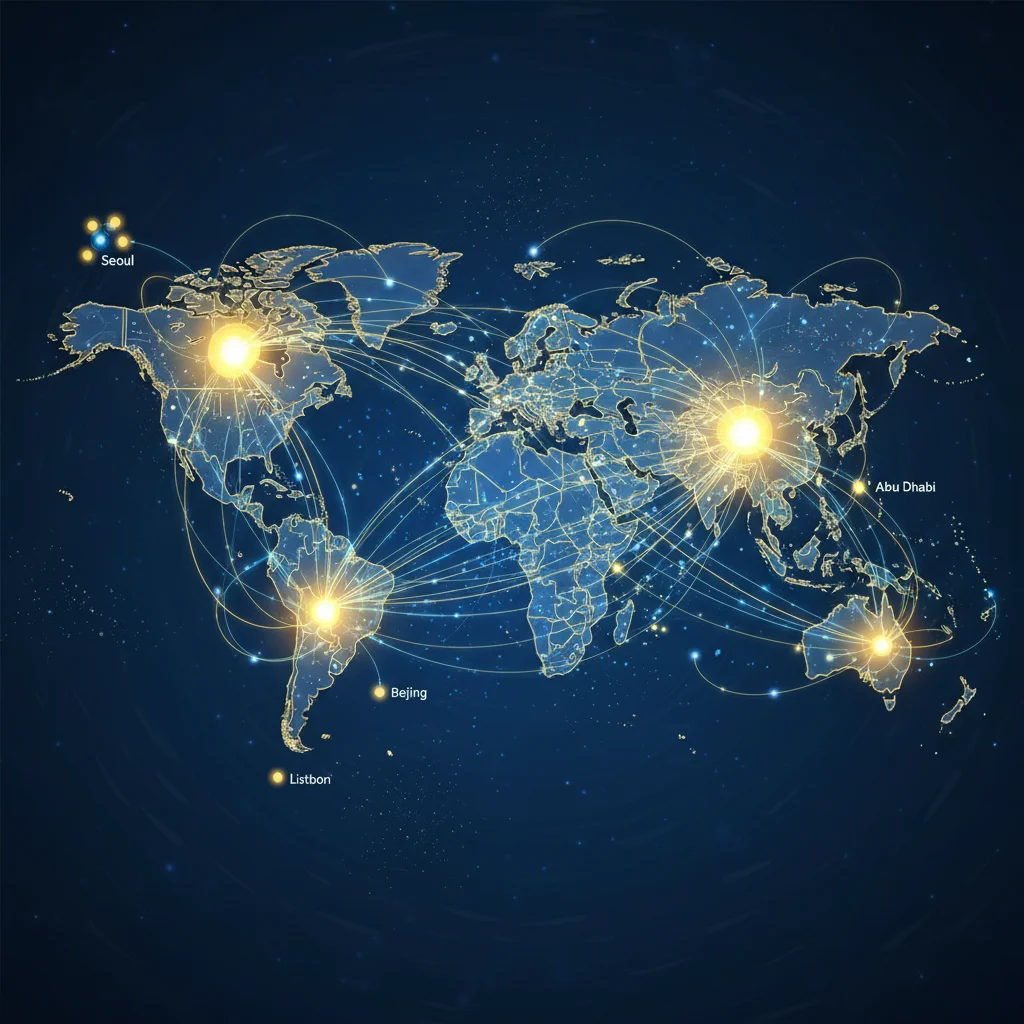
[IMAGE: World map heatmap of startup ecosystem value changes from 2020 to 2025, showing rapid growth in Seoul, Busan, Abu Dhabi, and Lisbon while traditional hubs show slower relative gains]
---
The AI Paradox: Hyper-Concentration Meets New Frontier Hubs
Artificial intelligence remains the most capital-intensive and capital-concentrated sector in the startup universe. Startup Genome’s data shows that only eight ecosystems globally qualify as truly “AI-native,” meaning at least 15% of all startup funding flows to AI-first companies. Among those, Silicon Valley, Beijing, and Paris alone capture an astonishing 80% of global AI funding.
On the surface, this suggests that the barriers to building an AI ecosystem are insurmountable. The infrastructure required—massive compute clusters, proprietary datasets, regulatory sandboxes, and deep pools of AI PhDs—is expensive and slow to replicate. Yet a small number of well-funded, state-led hubs are proving that the narrative is not ironclad.
Abu Dhabi is the most striking counter-example. The emirate has invested heavily in world-class compute infrastructure, including access to advanced GPU clusters and sovereign cloud capabilities. More importantly, it offers regulatory clarity that many Western jurisdictions lack. The UAE’s Artificial Intelligence and Digital Economy Council has created a streamlined licensing framework for AI startups, covering everything from autonomous vehicles to healthcare algorithms. Combined with concentrated corporate demand—particularly from energy, logistics, and finance—Abu Dhabi has become a magnet for AI-first startups that want to deploy at scale rather than chase the next funding round.
Startup Genome identifies Abu Dhabi as an emerging global AI hub, noting that its share of AI funding has grown faster than any other ecosystem outside the top three. The lesson is clear: deep capital access alone is not enough, but when paired with regulatory foresight and a clear use-case environment, even a mid-sized city can break into the AI club.
[IMAGE: Infographic comparing AI funding distribution among top hubs vs. emerging ones – a pie chart showing 80% captured by Silicon Valley, Beijing, and Paris, with a growing wedge for Abu Dhabi, Seoul, and Tel Aviv]
---
Seoul and Busan: A Two-Speed Miracle in South Korea
Perhaps no country illustrates the rebalancing better than South Korea. Seoul has undergone a transformation that is almost unprecedented in the history of startup ecosystem rankings. Just five years ago, the city hovered outside the global Top 30. Today it sits comfortably in the Top 10, having added over $100 billion in ecosystem value—a growth rate that outstrips almost every other major hub.
What drove this leap? Three factors stand out. First, government-backed deep tech. South Korea’s Ministry of SMEs and Startups has channeled billions into semiconductor, biotech, and advanced manufacturing startups through programs like the “K-Startup Grand Challenge” and dedicated deep-tech funds. Second, strong corporate R&D spillover. Companies like Samsung, LG, and SK Hynix have not only invested directly in startups but also provided talent pipelines and pilot facilities. Third, a vibrant and increasingly globalized founder community—Seoul now ranks among the top five ecosystems for international founder presence.
Yet the more interesting story may be Busan. South Korea’s second-largest city has climbed 80 places in Startup Genome’s Emerging Ecosystem Rankings since 2023, including a jump of ten ranks in the latest year alone. This is not a fluke. Busan’s rise is the result of targeted specialization. The city has focused on marine technology (leveraging its port), fintech (building on a strong regional banking sector), and cultural content (film, gaming, and K-pop related tech). Rather than trying to replicate Seoul’s deep-tech model, Busan has carved out niches where it can compete globally.
The Busan example offers a powerful lesson for second-tier cities worldwide: you do not need to build the next Silicon Valley. You need to identify a domain where you have natural advantages—geography, industry heritage, or policy flexibility—and double down. South Korea is now creating a multi-hub model, with Seoul as the powerhouse and Busan as a rising challenger. The spillover effects are real: startups in Busan can access Seoul’s investor network while enjoying lower operating costs and a less frenetic pace.
[IMAGE: Photo of Busan's startup co-working space with a view of the port, showing a mix of marine tech and fintech company logos]
---
Canada’s Fading AI Advantage and the Small-Nation Unicorn Phenomenon
While Seoul and Busan surge, other established ecosystems are losing ground. Canada, once touted as a top-tier AI destination thanks to the Vector Institute and Toronto’s deep learning talent, has seen its relative AI advantage fade. Startup Genome data shows that Canada’s share of global AI funding has declined as other hubs—particularly Abu Dhabi, Seoul, and Singapore—have built their own compute and research infrastructure. The lesson is that “brain drain” can reverse just as quickly as it started; talent is increasingly global and no longer anchors an ecosystem permanently.
Meanwhile, a different pattern is emerging among small nations. Estonia, with a population of just 1.3 million, now leads the world in unicorns per capita—a metric that rewards density over absolute size. The country has produced at least ten billion-dollar companies, including Bolt, Skype-born successes, and a string of fintech and cybersecurity startups. Its secret is not massive government spending but rather a digital-first regulatory environment (e-estonia), a strong education system in STEM, and a diaspora network that connects founders to international capital. Similar patterns are emerging in Lithuania, Latvia, and even Malta, where the “unicorn per capita” metric has become a badge of honor.
For investors, this signals a shift in due diligence. Rather than automatically favoring startups from recognized mega-hubs, investors are increasingly looking at ecosystem-specific advantages. A deep-tech startup from Busan may have better access to marine industry testbeds than one from San Francisco. An AI startup from Abu Dhabi may have a clearer regulatory path to deployment. The global innovation landscape is no longer about geography—it is about specialization.
---
What the Data Means for Investors and Policymakers
The implications of this rebalancing are twofold. For investors, the next decade’s outsized returns will come from ecosystems that are currently under-priced by global venture capital. The startup genome data for 2025 shows that emerging hubs—Busan, Abu Dhabi, Lisbon, Warsaw, and Hyderabad—offer significantly lower valuations for early-stage companies that are often more capital-efficient and have clearer go-to-market paths due to domestic demand. The risk is not the geography itself but the ability to scale globally. The best startups in these ecosystems are already building for international markets from day one.
For policymakers, the message is straightforward: do not try to replicate Silicon Valley. Build on what you have. South Korea’s success with Seoul and Busan came from leveraging existing industrial strengths. Abu Dhabi’s rise came from regulatory clarity and compute infrastructure. Estonia’s unicorn density came from digital governance. The common thread is specialization, not imitation.
The next unicorn may well come from a limestone-based material startup in Japan that is leveraging local mineral resources for carbon-negative construction. Or from a deep-tech hub on the Arabian Gulf that is applying AI to desalination and renewable energy. The era of homogenous startup growth is ending. What is emerging is a truly multi-polar innovation world—messier, more competitive, and far more interesting.
[IMAGE: Futuristic skyline of a city like Busan or Abu Dhabi with glowing startup hub nodes, representing the new multi-polar innovation landscape]