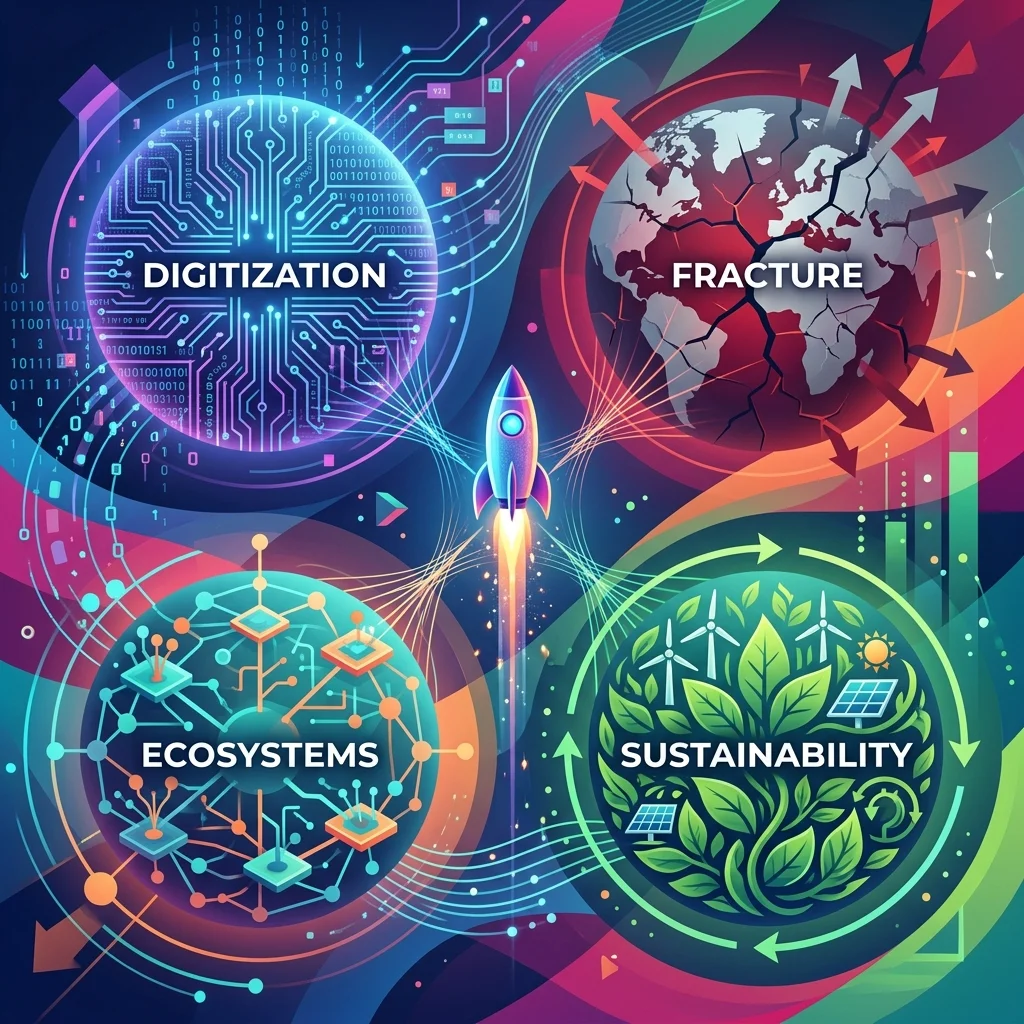
A 2025 study in the Journal of International Business Policy introduces the
The DEFS Framework: How Digitization, Ecosystems, Fracture, and Sustainability Are Reshaping Startup Internationalization
1. Introduction: The New Dynamics of Startup Internationalization
For decades, startup internationalization followed a relatively predictable logic: identify a foreign market with unmet demand, adapt the product, secure distribution, and scale. That model, rooted in opportunity-seeking behavior and linear value chains, is now being upended by forces far more complex than market size or cultural distance. A 2025 study published in the Journal of International Business Policy introduces a structured lens to capture these shifts: the DEFS framework, which stands for Digitization, Ecosystems, Fracture, and Sustainability.
[IMAGE: A world map with glowing nodes and arrows indicating shifting trade and investment flows]
Global technological acceleration and geopolitical realignments are driving four simultaneous transitions that fundamentally alter how startups create, capture, and deliver value across borders. Startups can no longer rely solely on traditional market-entry strategies; they must instead navigate a world where digital agents make autonomous decisions, platform ecosystems define competitive dynamics, fractured geopolitics redraw trade corridors, and sustainability becomes a core strategic imperative.
The DEFS framework, proposed by Shaker A. Zahra and Niron Hashai, synthesizes decades of international entrepreneurship (IE) research into a coherent toolbox for policymakers and startup leaders. This article examines each transition in depth, explores its policy implications, and provides actionable insights drawn from literature reviews and case studies. The goal is to equip governments and entrepreneurs with a forward-looking guide for thriving in an interconnected yet increasingly contested global economy.
2. The DEFS Framework: Four Transitions Reshaping International Entrepreneurship
The DEFS framework identifies four major transitions that are collectively redefining how startups internationalize. Rather than operating in silos, these transitions interact and reinforce one another, creating new dynamics that demand a fundamental rethinking of international business strategy.
Digitization has evolved from an operational enabler—think cloud computing and e-commerce—into a strategic agent. Digital technologies now act as autonomous decision-makers, with artificial intelligence (AI) algorithms determining market entry timing, pricing, and even product localization. This shift raises critical questions about data sovereignty, algorithmic accountability, and the regulatory frameworks needed to govern cross-border digital activity.
Ecosystems replace the traditional linear value chain model with networks of platforms, multilateral collaborations, and interdependent actors. A startup’s success in foreign markets increasingly depends on its ability to plug into existing digital platforms (e.g., Amazon, Alibaba, Salesforce) or build its own ecosystem of partners, investors, and users. This ecosystem-centric view fundamentally changes how startups access resources, acquire customers, and scale internationally.
Fracture captures the reality of a world where geopolitical tensions, trade wars, and national security concerns fragment global markets. Market contestability—the ease with which new entrants can access foreign markets—is declining in some regions while opening in others. Forced diversification of supply chains, technology decoupling, and sanctions create both barriers and opportunities, pushing startups to develop multi-regional strategies rather than relying on a single global approach.
Sustainability shifts the focus from pure growth to long-term resilience and alignment with the United Nations Sustainable Development Goals (SDGs). Environmental, social, and governance (ESG) criteria are no longer optional; they are becoming prerequisites for accessing capital, winning government contracts, and building brand trust. Sustainability redefines competitive advantage by rewarding startups that embed circular economy principles, carbon neutrality, and social impact into their international expansion plans.
[IMAGE: A diagram showing four interconnected pillars labeled D, E, F, S with arrows linking them]
These four transitions collectively demand a redefinition of startup international activities. As Zahra and Hashai argue, the traditional logic of opportunity exploitation in foreign markets must be replaced by a logic of connectivity—connecting people, money, ideas, and intellectual capital across borders. Startups that master this connectivity will be best positioned to navigate the complexities of the 21st-century global economy.
3. Digitization as a Strategic Agent: Policy Implications
The first transition—digitization—goes far beyond the adoption of digital tools. When AI algorithms can autonomously decide which foreign markets to enter, how to price products, and which local partners to engage, the role of digital technologies shifts from supportive to strategic. This creates both opportunities and regulatory headaches.
For startups, digital agents can dramatically reduce the cost and time of internationalization. AI-driven market analysis tools can scan thousands of data points—regulatory changes, consumer sentiment, competitor movements—in real time. However, these same technologies raise concerns about bias, transparency, and accountability. If an AI system makes a flawed market-entry decision, who bears the liability? How do different jurisdictions’ data protection laws (e.g., GDPR in Europe, China’s Cybersecurity Law) interact when algorithms process cross-border data?
Policy recommendations:
- Update digital infrastructure policies to support cross-border data flows while protecting privacy and security. This includes harmonizing data localization requirements and encouraging mutual recognition agreements between regulatory regimes.
- Establish open innovation sandboxes where startups can test AI-driven internationalization strategies in a controlled environment, with regulatory oversight that doesn’t stifle experimentation.
- Invest in digital trade agreements that clarify rules for AI-generated content, algorithmic decision-making, and cross-border data sharing. The Digital Economy Partnership Agreement (DEPA) model offers a starting point for modular, flexible frameworks.
- Provide affordable access to AI capabilities for startups in emerging economies. Public-private partnerships can offer subsidized cloud computing and AI training datasets tailored to local market conditions.
Startups themselves must invest in digital governance capabilities—ensuring their AI systems are explainable, auditable, and compliant across multiple jurisdictions. Those that treat digitization as merely an operational upgrade will miss the strategic imperative: using digital agents to build competitive advantage rooted in connectivity, not just efficiency.
4. Ecosystem-Centric Internationalization: Building Networks of Trust
The second transition—ecosystems—reflects the reality that modern startups rarely go it alone. International success increasingly depends on embedding within or orchestrating networks of platforms, partners, investors, and users. The proliferation of digital platforms has lowered entry barriers but also created new dependencies. A startup that relies on a single e-commerce platform for global distribution is at the mercy of that platform’s algorithm changes, fee structures, and policy shifts.
[IMAGE: A network diagram showing interlinked nodes representing startups, platforms, investors, and users across different countries]
Ecosystems also encompass non-digital actors: local incubators, university research labs, diaspora networks, and government trade promotion agencies. The most successful internationalizing startups are those that can navigate this dense web of relationships, leveraging trust and reputation to gain access to resources unavailable through markets or hierarchies.
Policy recommendations:
- Support cross-border ecosystem building through funding for international accelerator programs, startup exchanges, and joint innovation hubs. Programs like Startup Chile and France’s La French Tech have shown how government-backed ecosystem development can attract and retain international talent.
- Strengthen diaspora engagement as a bridge between home and host markets. Policies that facilitate remittances, knowledge transfer, and co-investment can turn diaspora communities into powerful ecosystem nodes.
- Regulate platform power to ensure fair access and prevent anti-competitive behavior. If a handful of global platforms control the gateways to international markets, startup diversity suffers. Antitrust enforcement and data portability requirements can level the playing field.
- Encourage open standards and interoperability so startups can easily connect multiple ecosystems without being locked into a single platform. Industry-led consortia and government procurement policies can push for common APIs and data formats.
For startup leaders, the lesson is clear: invest in relationship-building as much as product development. Internationalization is no longer a linear path from home market to foreign market; it is a simultaneous process of weaving into multiple ecosystems, each with its own trust dynamics, cultural norms, and regulatory expectations.
5. Fractured Geopolitics: Navigating Contestability and Diversification
The third transition—fracture—is perhaps the most disruptive for startups that grew accustomed to a relatively open global economy. Geopolitical tensions between the United States and China, the Russia-Ukraine war, trade restrictions on technology exports, and rising nationalism have fractured global markets. The concept of “market contestability”—the ease of entering and competing in foreign markets—is now highly variable across regions and sectors.
For startups, this means that a single internationalization strategy may no longer suffice. A deep-dive into the Chinese market, for example, may require navigating technology transfer requirements, data localization laws, and potential decoupling from U.S. supply chains. European markets demand compliance with increasingly stringent ESG regulations and digital services taxes. Meanwhile, emerging markets in Southeast Asia, Africa, and Latin America offer growth opportunities but with higher regulatory unpredictability and infrastructure gaps.
Policy recommendations:
- Develop multi-regional trade strategies that reduce dependence on any single geopolitical bloc. Governments can negotiate bilateral investment treaties, mutual recognition of standards, and visa facilitation for startup founders.
- Create geopolitical risk assessment tools tailored for startups, accessible through trade promotion agencies. These tools should cover sanctions exposure, technology export controls, and political stability indicators.
- Support forced diversification by offering incentives for startups to establish dual-headquarters, redundant supply chains, or multi-jurisdictional intellectual property protection. Export credit agencies can provide political risk insurance for smaller firms.
- Protect startups from technology decoupling by investing in open-source alternatives and research collaborations that transcend geopolitical divides. International science partnerships remain vital even when trade relations are strained.
Startups must themselves build geopolitical agility—monitoring policy shifts in real time, maintaining flexible legal structures, and developing contingency plans for sudden market exits. Those that treat fracture as a threat to be managed rather than a reality to be leveraged will miss opportunities. For instance, some startups have profited from sanctions by offering compliance software, while others have pivoted to serve markets that larger multinationals have abandoned due to political risk.
6. Sustainability as a Strategic Imperative: From Growth to Resilience
The fourth transition—sustainability—completes the DEFS framework by embedding long-term resilience into the very logic of internationalization. For decades, startup growth was measured primarily by revenue, market share, and valuation. Today, environmental impact, social equity, and governance transparency are emerging as equally important metrics, driven by investor demand, consumer preferences, and regulatory mandates.
Sustainability is not just a moral imperative; it is a competitive differentiator. Startups that can demonstrate carbon neutrality, circular supply chains, and fair labor practices gain preferential access to capital, corporate partnerships, and government contracts. The European Union’s Corporate Sustainability Reporting Directive (CSRD) and the International Sustainability Standards Board (ISSB) are creating a global reporting baseline that will soon affect any startup seeking cross-border financing.
[IMAGE: A green globe with renewable energy icons, circular arrows, and growing plants, surrounded by factory and office buildings]
Policy recommendations:
- Integrate SDG alignment into trade promotion and export finance. Governments can provide preferential loan terms or expedited customs clearance for startups meeting verified sustainability criteria.
- Harmonize sustainability reporting standards across jurisdictions to reduce compliance costs for startups. The ISSB framework provides a common language that can be adopted in phases.
- Support green technology transfer through patent pools, open licensing, and tax incentives. Startups in clean energy, circular materials, and sustainable agriculture often struggle to scale across borders due to intellectual property barriers.
- Encourage sustainable entrepreneurship education in international business curricula, linking startup incubators with university programs on circular economy and ESG metrics.
For startup founders, sustainability must move from a compliance burden to a strategic asset. This means embedding circular design principles from day one, building transparent supply chains, and using sustainability data as a core input for market selection. Investors increasingly apply ESG screens before writing checks; startups that wait to address sustainability until they are already internationalizing will find themselves locked out of lucrative markets and funding pools.
7. Synthesizing the DEFS Framework: A Policy Roadmap for the New Global Economy
The four transitions of the DEFS framework are not independent phenomena. Digitization enables ecosystems to function at scale; ecosystems amplify the effects of fracture by creating cross-border networks that can be disrupted by geopolitical shocks; sustainability pressures drive new forms of digitization (e.g., energy-efficient AI, carbon tracking tools). Understanding these interconnections is essential for coherent policymaking.
[IMAGE: An integrated circular diagram showing how Digitization, Ecosystems, Fracture, and Sustainability feed into each other, with policy levers at the center]
Policymakers should adopt a holistic approach that addresses all four transitions simultaneously. A fragmented approach—for example, promoting digitization without considering fracture or ecosystems without sustainability—risks creating unintended consequences. The following principles can guide policy design:
- Adaptive regulation. Instead of static rules, create regulatory frameworks that can evolve with technological and geopolitical shifts. Sunset clauses, regulatory sandboxes, and principle-based guidance offer flexibility.
- Inclusive access. Ensure that startups in emerging economies and underrepresented regions can benefit from the DEFS transitions. Digital divides and unequal ecosystem development can worsen global inequality if left unaddressed.
- Cross-ministerial coordination. Traditional trade policy, digital policy, climate policy, and innovation policy often sit in separate government silos. The DEFS framework demands integrated action across these domains.
- Evidence-based experimentation. Use pilot programs, randomized controlled trials, and real-world data to test policy interventions before scaling them nationally or internationally.
For startup leaders, the DEFS framework provides a mental model for scanning the external environment and making strategic choices. Rather than treating internationalization as a linear expansion, founders must view it as a dynamic process of building connectivity across four dimensions: digital capability, ecosystem embedding, geopolitical resilience, and sustainability performance. The startups that excel in all four will be the ones that define the next era of global business.
8. Conclusion: From Exploitation to Connectivity
The DEFS framework marks a significant evolution in our understanding of international entrepreneurship. The days when a startup could simply identify an attractive foreign market, adapt its product, and rely on distribution partners are over. Today’s global environment demands a more sophisticated approach—one that recognizes the strategic role of digitization, the power of ecosystems, the reality of geopolitical fracture, and the urgency of sustainability.
The takeaway for policymakers is clear: invest in infrastructure, regulation, and incentives that help startups build connectivity across all four dimensions. For entrepreneurs, the message is equally stark: those who ignore any of these transitions do so at their peril. The winners of the next decade will be those who navigate the DEFS framework with agility, foresight, and a willingness to redefine what internationalization means in an interconnected yet fractured world.
As Zahra and Hashai’s research demonstrates, the shift is not merely tactical but conceptual. International entrepreneurship must move from a logic of exploiting opportunities to a logic of connecting people, money, ideas, and intellectual capital. The DEFS framework provides the map. Now it is up to policymakers and startup leaders to chart the course.