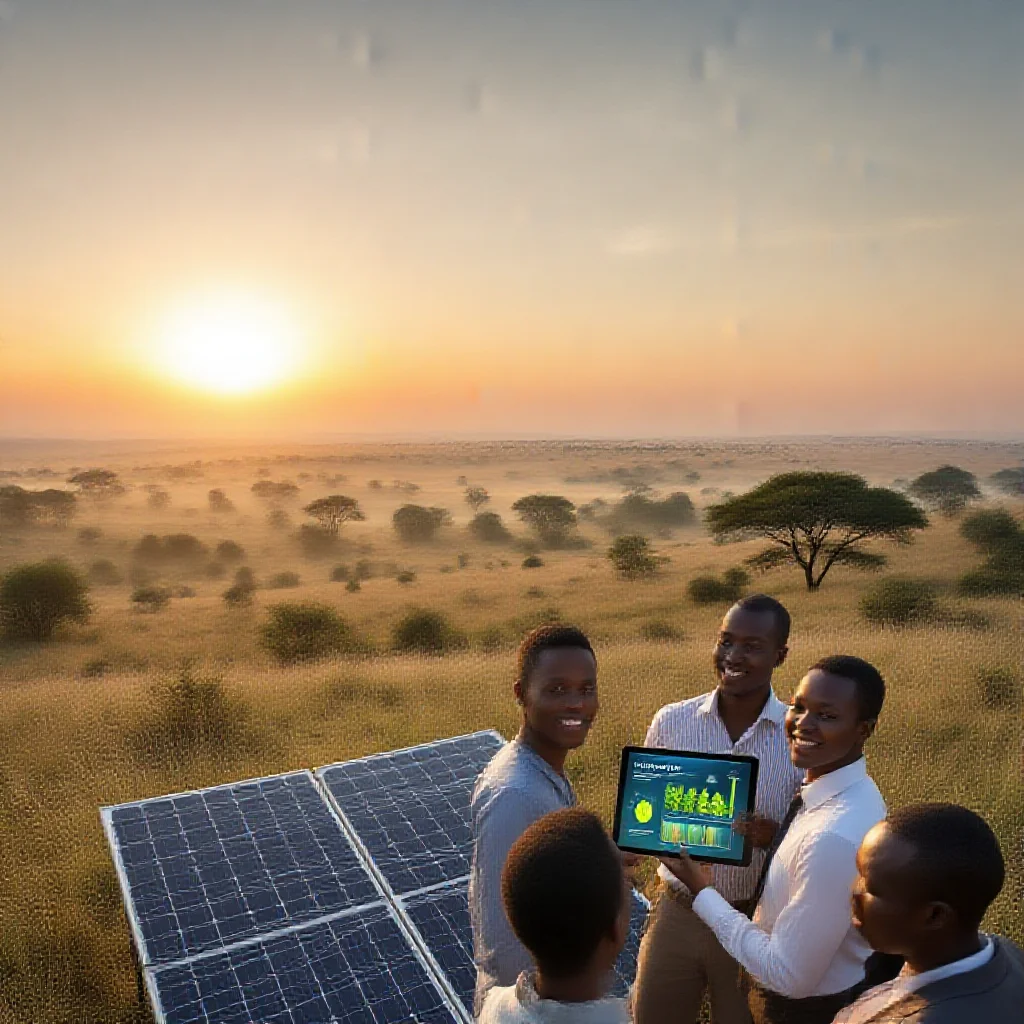
The Botswana Innovation Fund's 12-month Climate-Tech Startup Accelerator
Beyond Funding: Botswana's Climate-Tech Accelerator as a Blueprint for Southern Africa's Green Transition
Introduction: More Than a Startup Programme – A Strategic Economic Pivot
The Botswana Innovation Fund (BIF) has initiated a 12-month Climate-Tech Startup Accelerator Programme. (Source 1: [Primary Data]) The programme will select up to ten startups, providing seed funding of up to BWP 500,000 (approximately USD 36,000), alongside mentorship and market access facilitation. (Source 1: [Primary Data]) This intervention extends beyond conventional startup support. It represents a strategic component of Botswana's broader economic pivot, a deliberate shift from a historic reliance on diamond extraction toward cultivating a knowledge-based, climate-resilient economy. The accelerator functions as a targeted instrument within this national strategy, explicitly focusing on renewable energy, water conservation, sustainable agriculture, and waste management. (Source 1: [Primary Data])Deconstructing the Model: The Hidden Logic of Sector Selection
The programme’s sectoral focus is not arbitrary but a direct response to quantified national vulnerabilities. Each targeted domain—renewable energy, water, agri-tech, and waste—corresponds to a critical pressure point in Botswana's economy and environmental security.In renewable energy, the strategic aim is to reduce dependency on imported electricity, which constitutes a significant portion of the national supply. Startups in this sector are positioned to develop localized generation, storage, and management solutions. The water conservation focus addresses acute national water stress, where demand frequently outstrips renewable supply. Solutions here aim to enhance efficiency in agriculture, which consumes over 40% of national water withdrawals, and in urban systems. The sustainable agriculture mandate targets the nation's reliance on food imports, seeking to boost yield and resilience through technology, thereby plugging a gap in the national supply chain. Finally, the waste management segment aligns with circular economy principles, aiming to convert a linear cost center into a source of material recovery and value creation. The programme’s design indicates an intent to foster startups that can initiate domestic value chains in these high-priority, import-substitution areas.
The Funding Calculus: Is BWP 500,000 Enough to Seed a Value Chain?
The seed funding offered, BWP 500,000 per startup, requires contextual benchmarking. Globally, early-stage climate-tech grants can range from $50,000 to over $250,000. The BIF’s allocation is modest, aligning more with regional accelerator standards than international deep-tech funding rounds.This funding level indicates a primary focus on the "proof-of-concept" and early validation stages rather than commercial scaling. The financial calculus suggests the programme is in a "pipeline-building" phase for the national climate-tech ecosystem. The critical analysis posits that the non-financial components—structured mentorship, technical support, and market access facilitation—may constitute the programme's higher value proposition. (Source 1: [Primary Data]) For startups navigating Botswana's specific regulatory frameworks, commercial partnerships, and procurement landscapes, this guidance is potentially more catalytic than the seed capital alone. The model bets on leveraging expert networks to de-risk early-stage ventures, with the funding serving as runway for demonstration pilots.
Timeline as a Strategy: The 12-Month Race from Ideation to Pilot
The programme’s temporal structure is a strategic variable. Applications opened on April 9, 2026, with a deadline of May 31, 2026. (Source 1: [Primary Data]) This window aligns with the conclusion of the southern African fiscal year and precedes key agricultural planning cycles, allowing selected agri-tech ventures to align their development with the coming growing season.The 12-month duration itself functions as a "pressure cooker" model. For software-based solutions in data analytics or platform development, this timeline may be sufficient to achieve a minimum viable product and initial pilot. However, for hardware-intensive climate-tech—such as novel solar thermal systems, water purification hardware, or bio-digestion units—a 12-month period is typically insufficient to move from ideation through prototyping, testing, certification, and to a field-deployable pilot. The programme’s design, therefore, likely selects for ventures with existing prototypes or business models that can achieve tangible validation milestones within the constrained timeframe. It is a test of rapid iteration and focused execution rather than foundational research and development.
The Regional Ripple Effect: Can Botswana Become a Climate-Tech Hub?
The programme’s structure offers a replicable template for other resource-rich, climate-vulnerable nations in Southern Africa. By explicitly linking startup support to national import dependency and resilience gaps, Botswana is prototyping an economic development model that others in the region, facing similar structural challenges, could adapt.The potential for Botswana to evolve into a regional climate-tech hub hinges on the programme’s ability to generate demonstrable success stories. If startups graduate with validated technologies that address locally relevant problems—such as off-grid cooling for agriculture or low-cost water metering—they gain inherent advantages for scaling into neighboring markets with comparable climates and economic structures. The programme’s provision of market access facilitation is a critical lever here, potentially connecting startups to regional corporates and development finance institutions. However, the hub thesis will be tested by the availability of follow-on growth capital. The accelerator can create a pipeline, but a sustainable ecosystem requires a subsequent series of investment vehicles capable of financing scale-up.
Conclusion: A Laboratory for Climate-Resilient Development
The Botswana Innovation Fund’s Climate-Tech Startup Accelerator Programme is a laboratory experiment in economic transition. Its measurable outcomes will not be solely in the number of startups created but in their aggregate impact on specific national metrics: renewable energy capacity added, water efficiency gained, reduction in specific food import volumes, and waste diversion rates.The neutral prediction is that the programme will successfully identify and de-risk a cohort of early-stage ventures, with a subset achieving operational pilots by the end of the 12-month term. The greater uncertainty lies in the post-programme trajectory. The long-term viability of this model as a blueprint for Southern Africa will be determined by the establishment of a contiguous funding ladder and the formulation of supportive public procurement policies that prioritize locally developed climate solutions. The programme is a necessary and analytically sound first step in constructing a climate-resilient value chain from the ground up.