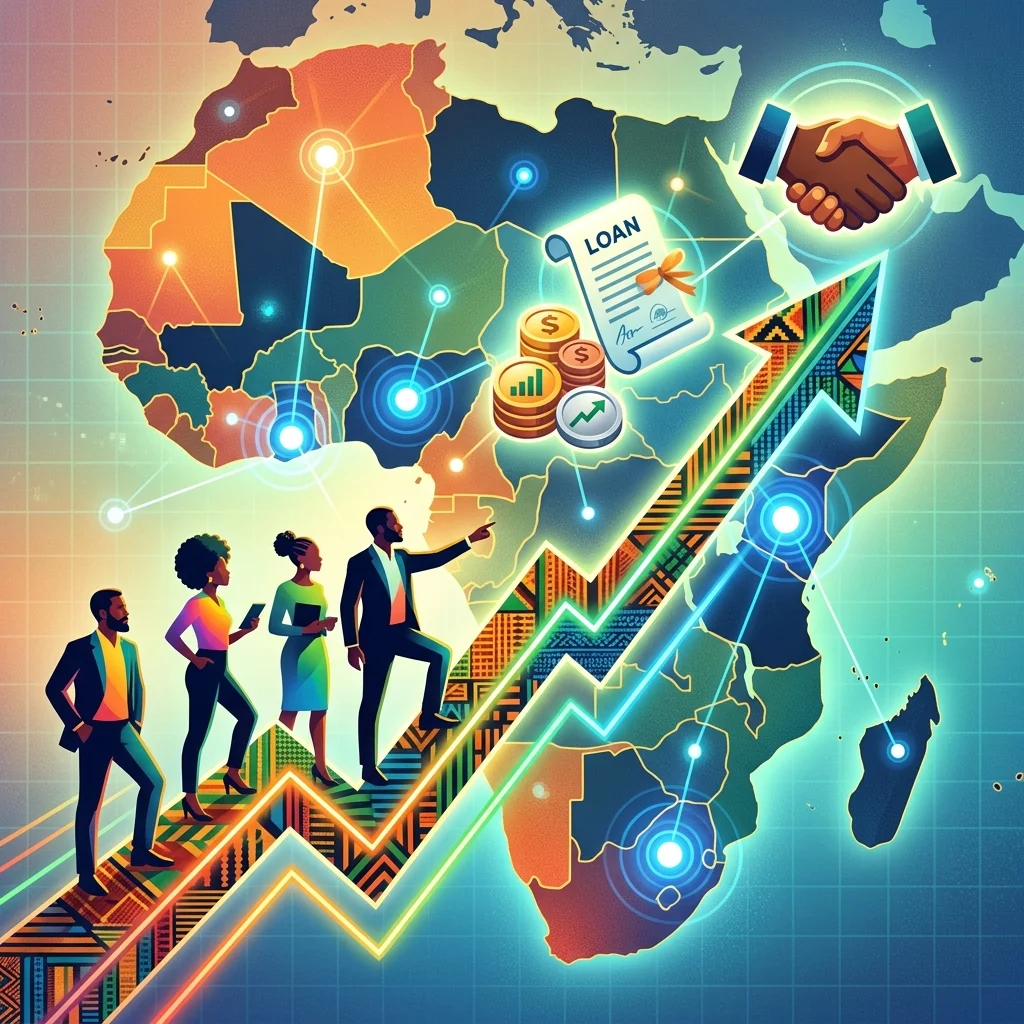
Africa''s startup ecosystem is experiencing a structural transformation.
Africa's Startup Revival: $3.1B in 2025, Debt Surge, and the Rise of Local Capital
After a brutal venture winter in 2024 that saw startup funding drop to just $2.2 billion, Africa’s entrepreneurial ecosystem has staged a powerful comeback. In 2025, total capital raised by African startups surged to $3.1 billion, according to data from Launch Base Africa. The recovery, however, is not simply a return to the boom years of 2021–2022. Beneath the headline numbers lies a structural transformation: debt financing now accounts for 45% of all capital raised, Kenya has emerged as the continent’s undisputed venture capital hub, and local investors are participating in nearly one-third of all transactions. A record 22% of Africa’s working-age population is now engaged in starting or running a new business. This article unpacks the hidden logic behind these data points — a shift from speculative equity to sustainable debt, the rise of regional hubs, and the deepening of homegrown capital.
[IMAGE: Line chart showing Africa startup funding from 2020 to 2026, highlighting the 2024 dip and 2025 rebound, with annotations for "venture winter" and "recovery".]
---
1. From Venture Winter to Recovery: The $3.1 Billion Inflection Point
The numbers tell a story of resilience. After a sharp contraction in 2024 — when only $2.2 billion flowed into African startups, down nearly 40% from the previous year — the ecosystem bounced back decisively in 2025, reaching $3.1 billion. While still below the peaks of 2021 and 2022, the rebound signals that investor confidence is returning, albeit with a more cautious and selective approach.
What drove the recovery? Three macro factors stand out. First, macroeconomic stability improved across several key markets: median inflation across sub-Saharan Africa receded to 4.5%, and the region’s GDP growth is projected at 4.4% for 2026–2027. Second, the debt market matured, offering startups an alternative to dilutive equity. Third, local capital deepened, with homegrown funders stepping in to fill gaps left by retreating international venture capitalists.
Crucially, the recovery is not evenly distributed. Capital is concentrating in startups that can demonstrate revenue and path to profitability, rather than chasing growth-at-all-costs. This new discipline is reflected in the shifting composition of deal types — a theme we explore in the next section.
---
2. The Debt Revolution — Why 45% of Startup Capital Now Comes from Loans
Perhaps the most striking structural shift in Africa’s startup ecosystem is the explosion of debt financing. In 2025, debt deals accounted for 45% of total funds raised — up from roughly 20% in previous years. The median debt deal size now stands at $7.5 million, versus $2.1 million for equity rounds.
This pivot is not a temporary anomaly. It reflects a fundamental maturation of the ecosystem. Early-stage startups still rely on equity to validate their ideas, but growth-stage companies with proven unit economics are increasingly turning to debt for expansion capital. Debt allows founders to retain ownership while accessing larger sums for inventory financing, working capital, and equipment purchases.
Compared to other emerging markets — Latin America and Southeast Asia, for example — Africa’s debt penetration is now among the highest. The shift also attracts a new class of yield-seeking investors: development finance institutions, impact funds, and commercial banks that prefer fixed-income instruments over equity risk.
For startups, the switch to debt requires stronger financial discipline. But for the ecosystem as a whole, it signals a move away from speculative hype and toward sustainable business models.
[IMAGE: Infographic comparing equity vs debt funding rounds in African startups, showing percentage split (45% debt, 55% equity), median deal sizes ($7.5M debt, $2.1M equity), and typical use cases such as inventory financing and working capital.]
---
3. Kenya's Ascent — How a Single Country Captured One-Third of All Venture Capital
Kenya raised $933.6 million in 2025, capturing nearly one-third of all venture capital flowing into Africa. This makes the East African nation the top VC destination on the continent, overtaking traditional leaders Nigeria and South Africa.
What explains Kenya’s meteoric rise? The country has built a well-orchestrated ecosystem that combines regulatory innovation, sectoral focus, and strong diaspora networks. The Central Bank of Kenya’s regulatory sandbox has enabled fintech startups to test products with less friction. Meanwhile, a robust agritech sector — fueled by the country’s large agricultural base and mobile money penetration — has attracted capital from both global and local investors.
Kenya’s success also highlights a broader trend: regional competition is intensifying. Nigeria, once the undisputed leader, saw its share of VC funding decline amid currency volatility and regulatory uncertainty. South Africa remains a key hub but lags behind in early-stage deal flow. Egypt, buoyed by its large tech talent pool, is also rising.
What can other countries learn from Kenya’s model? A stable regulatory environment, a diversified sector mix beyond fintech, and active local investor networks are proving to be the winning formula.
[IMAGE: Heatmap of Africa showing VC investment density, with Kenya highlighted and a magnifying glass zooming into key sectors: fintech, agriculture, renewable energy. Other top destinations (Nigeria, South Africa, Egypt) shown with lower density.]
---
4. Macro Tailwinds — GDP Growth, Low Inflation, and 11 Fastest-Growing Economies
The startup revival is occurring against a backdrop of improving macroeconomic fundamentals. Sub-Saharan Africa’s GDP is projected to grow at 4.4% in 2026–2027, driven by infrastructure investments, digitalization, and structural reforms. Inflation, a major headwind in 2023, has moderated to a median of 4.5% across the region.
Perhaps most telling: 11 African nations rank among the world’s fastest-growing economies in 2025. These include countries as diverse as Ethiopia, Rwanda, Côte d’Ivoire, and the Democratic Republic of Congo. The breadth of growth signals that the entrepreneurial opportunity is not limited to a few established hubs.
The African Continental Free Trade Area (AfCFTA) adds a powerful long-term tailwind. By creating a single market of 1.7 billion people by 2030, AfCFTA could unlock $110 billion in manufacturing gains and $397 billion in services revenue. For startups, this means access to a borderless market that reduces trade friction and opens up new opportunities for cross-border e-commerce, logistics, and supply chain solutions.
These macro factors are not just background noise — they directly influence startup viability. Lower inflation reduces cost pressures on young companies, while GDP growth expands the addressable market for new products and services.
---
5. Local Capital Deepens — Regional Investors and New Funds Reshape the Landscape
The most encouraging development for the long-term health of Africa’s startup ecosystem is the rise of homegrown capital. In 2025, local funders participated in 31% of all transactions — up from less than 10% a decade ago. This shift reduces the ecosystem’s dependence on foreign venture capital, which can be volatile and subject to global risk appetite.
Moreover, $736 million in new Africa-focused venture funds closed between 2025 and 2026, according to data from AVCA and local fund managers. These funds are increasingly managed by African teams who understand local market dynamics, regulatory environments, and cultural nuances. They are also more likely to invest in sectors that have long been overlooked by international VCs, such as healthcare, education, and climate adaptation.
The growth of local capital is intertwined with the debt revolution. Many of the new funds are structured as debt or mezzanine vehicles, providing growth-stage startups with non-dilutive financing. This synergy is creating a virtuous cycle: as startups succeed and repay their loans, local funders gain confidence and deploy more capital.
The implications are profound. A startup ecosystem that can recycle local capital effectively is far more resilient to global shocks. It also fosters deeper ties between investors and founders — relationships built on shared context rather than distant boardrooms.
[IMAGE: Bar chart comparing the share of transactions involving local funders over time (2015: 8%, 2020: 18%, 2025: 31%). A second panel shows $736M in new Africa-focused venture funds closed in 2025–2026, broken down by debt vs equity funds.]
---
Conclusion: A More Mature, Resilient Ecosystem
The Africa startup ecosystem in 2025–2026 is not just recovering — it is transforming. The shift from equity-driven speculation to debt-backed sustainability, the emergence of Kenya as a powerhouse hub, the supportive macro environment, and the deepening of local capital all point to a more mature and resilient foundation.
Challenges remain: currency volatility, regulatory fragmentation, and talent shortages still constrain growth. But the structural changes underway suggest that the next wave of African entrepreneurship will be built on firmer ground. As AfCFTA gradually integrates markets and local investors grow their war chests, the continent’s startup story is entering a new chapter — one defined not by hype, but by real revenue, real jobs, and real impact.
For founders, investors, and policymakers, the message is clear: the venture winter is over, but the rules of the game have changed. Those who adapt will thrive.