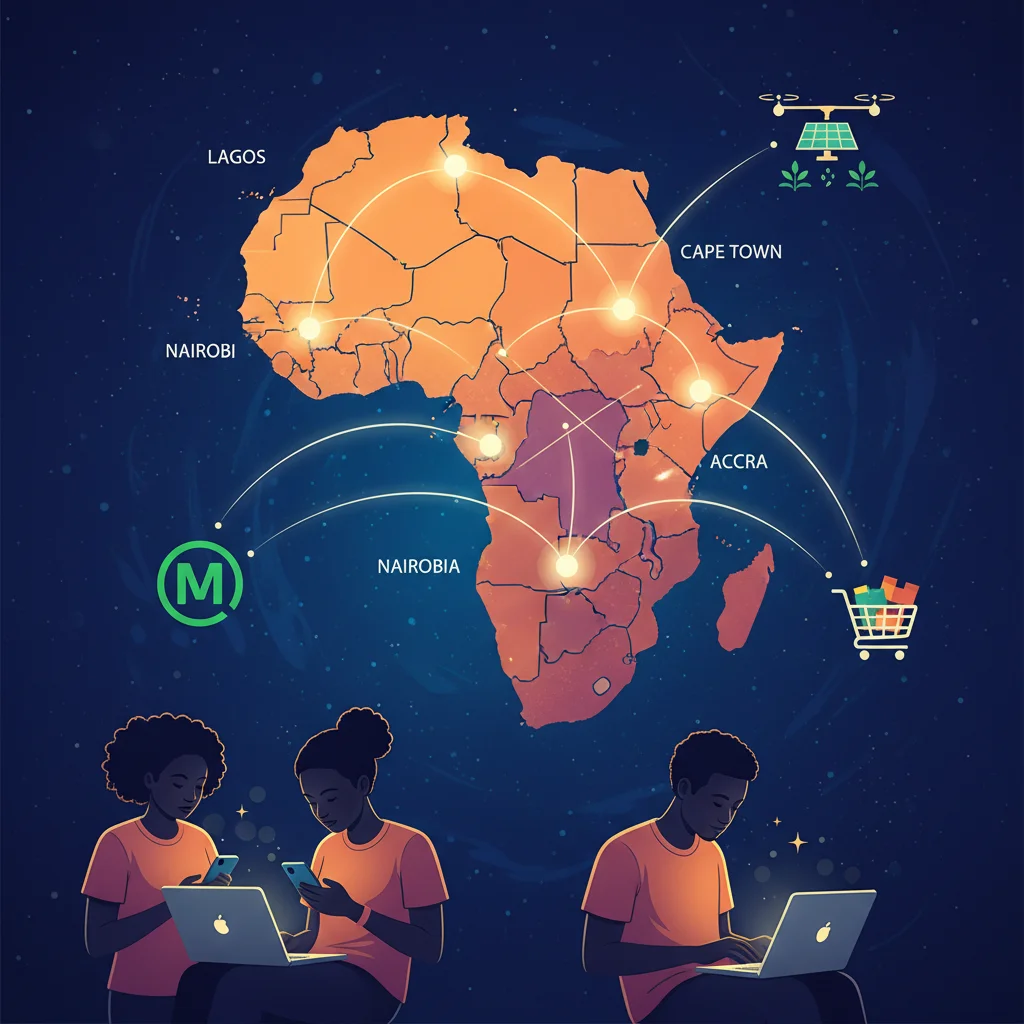
Over the last decade, Africa has witnessed explosive growth in its startup
Africa's Startup Boom: 2,400+ Ventures and the Future of Digital Transformation
By a Senior Technical/Financial Audit Journalist
---
Over the past decade, the African continent has recorded a quantitative and qualitative surge in new venture creation. According to a comprehensive report by Disrupt Africa, more than 2,400 startups were founded across the continent between 2010 and 2020 (Source 1: Disrupt Africa report). This article dissects the structural drivers, sectoral concentrations, capital flows, and persistent bottlenecks that define this ecosystem. It further examines the strategic logic behind platform-based leapfrogging and the conditions required for regional and global scaling.
---
The Decade of Explosive Growth: 2,400+ Startups
The formation of over 2,400 startups in a single decade marks a structural shift in Africa’s economic fabric. The density of new ventures is not uniformly distributed. Nigeria, Kenya, South Africa, Egypt, and Ghana account for the highest concentration of startup activity, driven by a combination of large urban populations, improving mobile internet penetration, and the presence of early-stage capital pools.
The foundational drivers are well documented: smartphone penetration in sub-Saharan Africa rose from roughly 20% in 2015 to over 50% by 2020, and mobile internet subscriptions crossed the 500 million mark. The continent’s median age of under 20 years creates a demographic tailwind for digital product adoption. These factors lowered the cost of customer acquisition and enabled lean, tech-enabled business models to emerge in sectors previously dominated by informal, cash-based transactions.
Timeline inflection point: The 2014–2018 period saw the fastest acceleration, coinciding with the global fintech boom and the proliferation of mobile money rails, particularly M-Pesa in East Africa and similar platforms in West Africa.
---
Sectoral Trends: Where Innovation is Happening
Digital Financial Inclusion as the Dominant Sector
Fintech remains the largest and most mature vertical, absorbing over 40% of total startup funding in the decade. The logic is clear: an estimated 60% of sub-Saharan Africa’s adult population remains unbanked or underbanked. Mobile money platforms—led by M-Pesa—have built interoperable payment infrastructure that allows startups to offer credit, savings, insurance, and remittance services without traditional brick-and-mortar branches. The unit economics are favorable: digital acquisition costs are a fraction of physical branch expansion, and average revenue per user (ARPU) from lending and transaction fees has proven sustainable in countries like Kenya and Ghana.
E-commerce and Logistics: Adapting to Fragmented Retail
Sub-Saharan Africa’s retail sector is dominated by informal, open-air markets—accounting for roughly 80% of consumer goods sales. Startups such as Jumia, Copia Global, and Wasoko have built platform models that aggregate demand from underserved urban and rural consumers, then optimize last-mile delivery using motorcycle networks and community pick-up points. The challenge is unit economics: low average order values combined with high logistics costs require high repeat rates and cross-selling of financial services to achieve profitability.
Healthtech, Agri-tech, and Renewable Energy
These three verticals address critical infrastructure gaps rather than merely digitizing existing services.
- Healthtech: Startups like mPharma and Zipline use data analytics and drone delivery to improve supply chain reliability for essential medicines and blood products. The absence of reliable cold chains and inventory management systems in public hospitals creates a clear pain point.
- Agri-tech: Platforms such as Twiga Foods and Apollo Agriculture provide smallholder farmers with access to quality inputs, credit scoring based on satellite data, and market linkages. The target market is enormous: over 60% of the continent’s labor force is in agriculture, but productivity remains among the lowest globally.
- Renewable energy: Off-grid solar companies (e.g., M-KOPA, d.light) use pay-as-you-go mobile money models to sell solar home systems to households lacking grid electricity. The total addressable market exceeds 600 million people.
Platform Business Models and Leapfrogging
A unifying thread across all sectors is the reliance on platform business models that bypass traditional physical infrastructure. Instead of building retail stores, fintech startups use USSD and smartphone apps. Instead of building a national grid, solar companies use distributed generation. Instead of building a logistics fleet from scratch, e-commerce players aggregate existing motorcycle taxi drivers. This logic—which can be characterized as infrastructure bypass via digital orchestration—reduces capital expenditure requirements and allows startups to scale rapidly within specific corridors.
---
The Funding & Support Ecosystem: Key Players and Government Initiatives
Venture Capital and International Inflows
Venture capital activity in Africa has grown from less than $200 million annually in the early 2010s to over $4 billion by 2021 (with a tightening in 2023 due to global macro conditions). The key active firms include:
- Partech Africa (pan-African, focused on Series A to C)
- Savannah Fund (East Africa, early-stage)
- eVentures (South Africa, early-stage)
- 500 Startups (global accelerator with Africa-focused funds)
The data indicates that foreign VC investors—particularly from the U.S., Europe, and China—comprise the majority of large-ticket rounds. Local institutional capital remains scarce, which creates a vulnerability: when global risk appetite shrinks, the funding pipeline narrows sharply.
Incubators and Accelerators
Programs such as Y Combinator (which has accepted over 100 African startups), 500 Startups, and the Tony Elumelu Foundation Entrepreneurship Programme provide seed capital, mentorship, and network access. These programs are critical in bridging the gap between idea and institutional investment. The Tony Elumelu Foundation, for example, has disbursed over $100 million in non-voting seed capital to more than 10,000 entrepreneurs across 54 countries since 2015.
Government Initiatives
Two notable policy instruments have emerged:
- Nigeria’s Startup Act (2019): Creates a legal framework for startup registration, offers tax incentives (e.g., three-year tax holidays), and establishes regulatory sandboxes for fintech experimentation. Implementation, however, has been uneven due to bureaucratic inertia.
- South Africa’s Small Business Finance Agency (SEDA): Provides loans, grants, and business development services. While not exclusively for tech startups, it supports early-stage ventures in manufacturing, services, and technology.
The impact of these initiatives remains modest relative to the scale of the funding gap. Government interventions are most effective when they reduce regulatory friction (e.g., simplified business registration) rather than providing direct capital, which often comes with political constraints.
---
Persistent Challenges: Funding, Infrastructure, Regulation, Talent
The ‘Series A Crunch’
A well-documented pattern is that African startups raise seed and pre-seed rounds relatively easily, but face a sharp drop-off at Series A and beyond. The reason is structural: local venture capital funds are small (average fund size under $50 million), and international VCs demand proof of unit economics and path to profitability that many early-stage companies cannot yet demonstrate. The result is a high failure rate between seed and growth stage. Data from Partech Africa shows that only about 15% of startups that raised seed funding in 2018–2019 secured a Series A within three years.
Inadequate Digital Infrastructure
Core infrastructure—reliable electricity, low-latency internet, and data center capacity—remains inconsistent outside capital cities. Frequent power outages force many startups to invest in diesel generators and redundant battery systems, increasing operating costs by 15–30%. Internet bandwidth is expensive relative to income: the cost of 1GB of mobile data in sub-Saharan Africa averages 4.5% of monthly GDP per capita, compared to less than 1% in Southeast Asia.
Complex Regulatory Environments
Regulatory fragmentation across 54 countries creates high compliance costs. For example, a fintech startup wanting to operate in Nigeria, Kenya, and South Africa must obtain separate licenses from each central bank, comply with different anti-money laundering rules, and manage cross-border payment restrictions. The lack of a harmonized digital single market remains a major barrier to pan-African scaling.
Talent Scarcity
The demand for software engineers, data scientists, and product managers far exceeds supply. While coding bootcamps and university programs are expanding (e.g., Andela, ALX), the top talent is often recruited by global tech giants offering salaries 3–5 times higher than local startups can afford. Startups must invest heavily in training and retention, which strains burn rates.
---
The Hidden Economic Logic: Mobile Money and Platform Dynamics
The most robust economic insight from the past decade is that mobile money has become the backbone of digital commerce rather than a standalone product. M-Pesa’s API, for instance, is used by more than 200,000 third-party developers across Kenya, Tanzania, and Ghana. This has enabled a network effect dynamic: as more users adopt mobile money, the cost of integrating payments drops, which attracts more merchants and app developers, which in turn attracts more users.
The platform business model in Africa is distinct from Silicon Valley’s advertising-led model. Most African startups rely on transaction fees, lending spreads, and subscription revenue rather than advertising because smartphone penetration is high but digital advertising spends remain low. This makes the business model more predictable but also more sensitive to user churn and transaction volume.
Leapfrogging occurs when a platform bypasses a legacy infrastructure investment. For example, a fintech lender can disburse and collect loans via mobile money without building any physical branches—a cost advantage that traditional banks cannot replicate. However, leapfrogging is not automatic: it requires a minimum density of users to make the platform viable, which is why most successful startups are initially focused on dense urban corridors (Lagos, Nairobi, Johannesburg, Cairo) before expanding outward.
---
Market Predictions and the Path Forward
Based on current trajectories, several outcomes are likely over the next five years (2025–2030):
- Consolidation will accelerate. As the Series A crunch persists, we expect increased M&A activity, with larger startups acquiring smaller ones for technology or user base rather than for revenue. Regional champions (e.g., Flutterwave, Interswitch, Jumia) will likely roll up adjacent verticals.
- Government policy will become more decisive. Countries that implement clear, stable regulatory frameworks (licensing, data protection, tax incentives) will attract disproportionate investment. Nigeria’s Startup Act, if effectively enforced, could catalyze a second wave. Conversely, regulatory unpredictability (e.g., recent cryptocurrency restrictions in multiple countries) will deter capital.
- Deep tech (AI, IoT, drone logistics) will enter the mainstream. As satellite internet (Starlink) expands and 5G rolls out in key markets, startups focused on autonomous drones for agriculture, AI-driven diagnostics for health, and IoT-based grid management for renewable energy will see increasing adoption.
- The talent bottleneck will ease—but slowly. Initiatives that train software engineers at scale (e.g., ALX’s aim to train 1 million developers by 2030) will gradually increase supply, but global remote work will continue to poach top talent. The key unknown is whether local economic growth can generate enough high-paying jobs to retain talent.
- Funding will remain cyclical. The global venture capital slowdown of 2023–2024 will likely bottom out by 2025, but the recovery will be moderated by geopolitical risk and competition from other emerging markets. African startups will need to demonstrate stronger unit economics and path to profitability to attract capital on favorable terms.
Conclusion: The 2,400+ startups founded between 2010 and 2020 have built the foundation of a digital economy that is structurally different from both developed markets and other emerging regions. Mobile money and platform models have enabled genuine leapfrogging in finance, commerce, and energy. Yet the ecosystem remains fragile—dependent on foreign capital, vulnerable to infrastructure gaps, and constrained by regulatory fragmentation. The next decade will test whether the continent can convert its demographic dividend and mobile infrastructure into self-sustaining innovation clusters rather than remaining an outsourced testing ground for global investors.