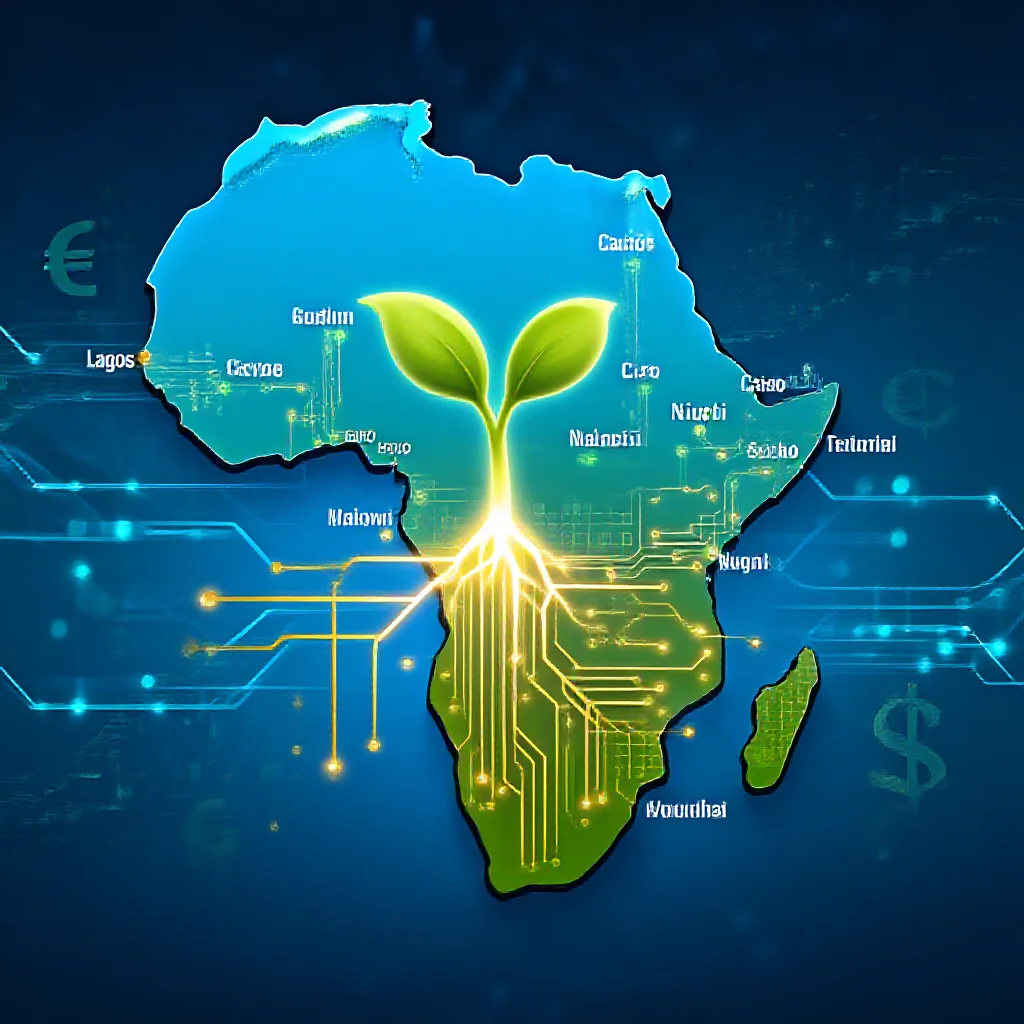
An analysis of how energy transition, EVs, IoT, and Industry 5.0 are reshaping Africa's economic landscape and what it means for investors and policymakers.
Executive Summary
The global economy is entering 2026 at a structural inflection point. Carbon emissions have reached 37.79 billion tonnes, yet capital is rapidly reallocating: USD 2 trillion flowed into the energy transition last year, sustainable bond issuance is approaching USD 1 trillion annually, and renewables generate USD 1.5 trillion in revenue. Demographic ageing and rapid urbanization are redefining productivity and infrastructure demand, while the rise of AI, IoT, and Industry 5.0 is transforming production systems.
For Africa, these global megatrends are not distant phenomena—they are immediate forces reshaping the continent's economic trajectory. The challenge is whether African economies can proactively harness these shifts to accelerate industrialization, digital transformation, and intra-African trade. This article analyzes the intersections between global megatrends and Africa's long-term development, offering actionable intelligence for investors, policymakers, and corporate strategists.
1. The Energy Transition: Africa's Opportunity to Leapfrog
Global investment in the energy transition exceeded USD 2 trillion for the first time in 2024, growing 11% year-on-year. Electrified transport was the largest investment driver at USD 757 billion, while renewable energy and power grids attracted USD 728 billion and USD 390 billion respectively. For Africa, this shift represents a dual opportunity: to build resilient and sustainable energy systems and to position the continent as a key supplier of energy transition minerals.
Africa holds vast potential for renewable energy generation—solar, wind, hydropower, and geothermal. Yet, the continent still faces a significant energy access gap, with more than 600 million people lacking electricity. The falling cost of renewable technologies offers a path to energy leapfrogging, enabling decentralized, off-grid solutions that are faster to deploy than traditional grid extension.
The energy transition also elevates Africa's strategic importance in global supply chains for critical minerals. The Democratic Republic of Congo dominates cobalt production, while Zambia, South Africa, and Zimbabwe hold substantial reserves of copper, platinum, and lithium. As global demand for battery minerals soars, African countries have a chance to move up the value chain—processing minerals locally, developing refining capacity, and manufacturing battery components instead of merely exporting raw ores.
2. Electric Vehicles: A Catalyst for Manufacturing
EV sales are projected to reach 20 million units globally by 2026, and this momentum is forcing automakers to secure supply chains for lithium, nickel, cobalt, and manganese. Africa is central to this supply chain, but the continent must also prepare to become a destination for EV manufacturing and mobility solutions. South Africa already has an established automotive industry that is transitioning toward electric and hydrogen fuel-cell vehicles. North African countries like Morocco are expanding their automotive export platforms, leveraging proximity to European markets and existing trade agreements.
Beyond manufacturing, the EV transition creates opportunities for new mobility business models—ride-hailing fleets, electric public transport, and e-motorcycles—which are expanding in cities across East and West Africa. The rapid adoption of two- and three-wheelers in countries like Kenya, Rwanda, and Ethiopia is an early indicator of Africa's potential to lead in sustainable mobility solutions.
3. IoT and the Digital Economy: Building Connectivity and Intelligence
The Internet of Things (IoT) is transforming sectors from agriculture to infrastructure. In Africa, where internet penetration is growing but still lags global averages, the expansion of IoT presents significant opportunities for digital leapfrogging. Smart agriculture, remote monitoring of infrastructure, and connected supply chains can boost productivity and resilience.
Africa's digital economy is projected to reach USD 180 billion by 2025, driven by mobile money, e-commerce, and fintech. The proliferation of IoT devices will further accelerate data generation, fueling demand for data centers, cloud computing, and edge infrastructure. This, in turn, attracts investment in digital infrastructure, including fiber-optic networks, submarine cables, and 5G rollout.
However, the digital transformation also amplifies risk. With global cybercrime damage projected at USD 10.5 trillion in 2025, African countries must invest in cybersecurity capabilities to protect businesses and citizens. Strengthening digital governance and building trust are essential for long-term digital prosperity.
4. Industry 5.0: Human-Centric and Resilient Manufacturing
The fifth industrial revolution builds on Industry 4.0 by placing human well-being, sustainability, and resilience at the core of manufacturing. For Africa, Industry 5.0 aligns with the continental agenda for industrialization and diversification. Africa's manufacturing sector remains underdeveloped, contributing only about 11% of GDP on average. Yet, the shift toward localized and resilient supply chains—partially a response to global trade fragmentation—offers African countries a chance to attract investment in export-oriented manufacturing.
Automation, robotics, and AI are becoming more accessible, even for SMEs. The challenge is to harness these technologies while creating employment opportunities. Africa's young and growing workforce is an asset, but it requires upskilling and vocational training to adapt to new production paradigms. Public-private partnerships and investment in technical education are critical.
Trade fragmentation and the reshaping of global supply chains are already prompting multinational companies to diversify risk. Africa, with its abundant natural resources, growing consumer markets, and favorable demographics, is positioned as a potential alternative manufacturing hub—if infrastructure, logistics, and policy environments improve.
5. Demographic Shifts and Urbanization: Africa's Urban Revolution
While many regions face ageing populations, Africa is experiencing a youth bulge. The UN projects that by 2030 there will be 265 million people aged 80 or older globally, but Africa's median age is about 20. This demographic dividend presents enormous potential for a productive workforce, consumer markets, and entrepreneurial innovation. However, it also demands job creation and education investment.
Urbanization is another defining trend. The global urban population will rise to 68% by 2050, with much of this growth occurring in Africa. Cities like Lagos, Nairobi, and Abidjan are expanding rapidly, straining infrastructure but also driving demand for housing, transport, and digital services. To close the USD 15 trillion global infrastructure gap, African governments must prioritize infrastructure investment, leveraging private capital and public-private partnerships.
Smart city initiatives are emerging across the continent, from Kenya's Konza Technopolis to South Africa's Tshwane Innovation Hub. These projects aim to integrate IoT, data analytics, and renewable energy into urban planning, creating more efficient and sustainable cities.
Business Impact
For businesses operating in Africa, these megatrends have profound implications. Access to reliable and affordable energy is a key determinant of competitiveness, and investing in renewable energy can reduce operational risks and operational costs. Companies that embrace circular economy principles and sustainable practices will better position themselves in global supply chains that increasingly demand ESG compliance.
The digital transformation expands market reach and operational efficiency. Fintech companies from M-Pesa to new entrants are driving financial inclusion, opening access to credit and insurance for SMEs. IoT-enabled logistics can reduce costs and improve supply chain resilience.
At the same time, companies must navigate geopolitical uncertainty, currency volatility, and regulatory shifts. Partnerships with local firms and governments are essential to mitigate risks and gain market intelligence. Investing in local talent and capacity building aligns with both business interests and sustainable development goals.
Regional Perspective
Africa's regional integration agenda, anchored by the African Continental Free Trade Area (AfCFTA), is the framework for translating global megatrends into local opportunities. The AfCFTA creates a single market of over 1.4 billion people and a combined GDP of over USD 3 trillion. By reducing tariff and non-tariff barriers, it encourages intra-African trade and regional value chains, reducing dependence on external markets.
East Africa is a leader in mobile money and renewable energy innovations. Ethiopia's industrial parks are expanding manufacturing in textiles and leather. West Africa is leveraging oil/gas wealth to diversify into agribusiness and services. Southern Africa, with its mining sector and advanced infrastructure in South Africa, is positioned to drive critical minerals processing. North Africa's proximity to Europe gives it a competitive edge in automotive and electronics manufacturing. Central Africa, while rich in resources, faces infrastructure and governance challenges that must be addressed.
International partnerships, including China's Belt and Road Initiative, the European Union's Global Gateway, and the US Prosper Africa, are supporting infrastructure development and investment. These partnerships should align with Africa's own development priorities, ensuring mutual benefits.
Future Outlook
Over the next 3–5 years, Africa's engagement with global megatrends will intensify. The energy transition will shift from policy commitments to tangible projects, with the African Development Bank and other institutions financing large-scale renewable initiatives. Green hydrogen is emerging as a new frontier, with countries like Namibia and Mauritania developing ambitious projects.
The EV ecosystem will expand beyond raw material exports to include local assembly and manufacturing in several countries. A vibrant startup ecosystem will continue to produce solutions in fintech, agritech, healthtech, and mobility, attracting venture capital and global tech companies.
Industry 5.0, driven by AI and IoT, will transform African manufacturing, making it more adaptive and efficient. Special economic zones will evolve into smart industrial parks, integrating renewable energy, digital logistics, and automated production. The growth of data centers and cloud services will strengthen Africa's digital sovereignty.
However, these opportunities are not guaranteed. Policy coherence, infrastructure investment, and institutional capacity are critical. Governments must implement transparent regulatory frameworks that attract investment while protecting public interests. Educational systems must be reformed to produce skills in science, technology, engineering, and mathematics.
The global order is fragmenting, but Africa can forge its own path by deepening regional integration and building a diversified, resilient economy. The pace of change will be determined by decisions made today.
Conclusion
Africa is not a passive observer of global megatrends; it is an active participant and a potential trendsetter. The energy transition offers an opportunity to power development sustainably. EVs and IoT offer pathways to industrial leapfrogging. Industry 5.0 aligns with Africa's vision of industrialization and job creation. The demographic shift and urbanization, while challenges, provide a young and dynamic population that can drive innovation.
Leaders in government, business, and civil society must seize this moment. By prioritizing regional integration, investing in infrastructure and education, and fostering innovation ecosystems, Africa can transform these global forces into engines of sustainable and inclusive growth. The decisions made now will shape the continent's economic destiny for decades. Africa's long-term transformation is not just a possibility; it is an imperative.
Key Takeaways
- Global energy transition investment surpassed USD 2 trillion in 2024, creating opportunities for Africa in renewable energy and critical minerals.
- EV adoption and battery demand position Africa as a key player in the supply chain, but value addition and local manufacturing must be developed.
- IoT and digital infrastructure are enabling Africa's digital economy, requiring investments in cybersecurity and data centers.
- Industry 5.0 and resilient supply chains offer Africa a chance to expand manufacturing and participate in global value chains.
- Demographic shifts and urbanization demand investments in infrastructure, education, and job creation to harness Africa's youth dividend.
- AfCFTA is critical for accelerating intra-African trade and regional integration, unlocking the continent's economic potential.
- Businesses must adapt strategies to align with sustainability, digitalization, and regional integration to stay competitive.
- Policy-makers need to create transparent regulations, close infrastructure gaps, and promote public-private partnerships.