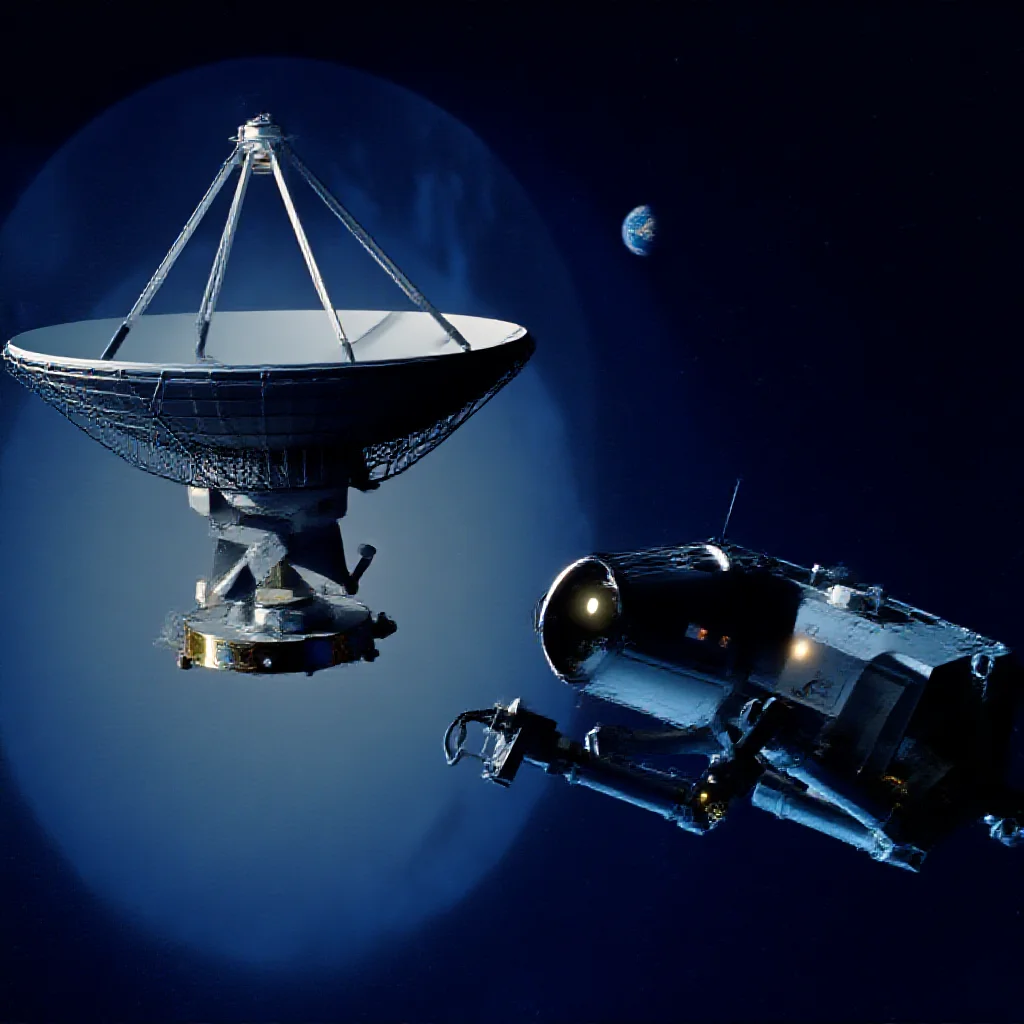
Starfish Space''s $100 million Series B funding round, led by Point72 Ventures
Beyond the $100M: How Starfish Space's Funding Signals a Shift to Space Infrastructure-as-a-Service
Summary: Starfish Space's $100 million Series B funding round, led by Point72 Ventures and Activate Capital, is more than a capital injection for a single company. It represents a pivotal validation of the satellite servicing and in-orbit logistics market, transitioning from experimental demonstrations to contracted, operational reality. This analysis explores how the convergence of successful tech demos, landmark government contracts like the SDA's $52.5M disposal deal, and strategic commercial partnerships is creating a new economic layer in space: Infrastructure-as-a-Service. We examine the long-term implications for satellite operators, national security, and the underlying supply chain, arguing that Starfish's momentum marks the beginning of a fundamental shift in how space assets are managed, monetized, and secured.
---
The $100M Vote of Confidence: Decoding the Investor Syndicate
The $100 million Series B financing for Starfish Space (Source 1: [Primary Data]) is distinguished by the composition of its investor syndicate. The round was led by Point72 Ventures, Activate Capital, and Shield Capital, with broad participation from Industrious Ventures, NightDragon, NFX, Munich Re Ventures, Toyota Ventures, PSL Ventures, Nomi Capital, Gaingels, and Overlap Holdings (Source 1: [Facts]). This consortium is not a typical venture capital grouping.
The lead investors profile indicates a strategic bet on dual-use technology. Point72 Ventures, which first invested in 2024 (Source 1: [Facts]), and Activate Capital, alongside defense-focused Shield Capital and NightDragon, signal a primary interest in technologies with clear applicability to national security and government operations. The simultaneous participation of Munich Re Ventures, a reinsurance entity, and Toyota Ventures, a corporate venture arm focused on mobility and robotics, reveals a secondary, equally significant thesis: the recognition of in-orbit servicing as a foundational utility with cross-sector commercial implications. The syndicate’s depth suggests a consensus that the technical and business model risks associated with satellite servicing have been sufficiently mitigated to warrant large-scale, growth-stage capital.
From Demo to Dollar: The Pivot to Contracted Operations
The funding narrative is inextricably linked to a proven sequence of technological validation followed by revenue-generating contracts. Starfish Space’s technical milestones, including the Remora demonstration mission in 2025 and the ongoing Otter Pup 2 mission (Source 1: [Facts]), provided critical proof-of-concept for its autonomous rendezvous and proximity operations (RPO) capabilities. This technical de-risking directly enabled the subsequent acquisition of paid contracts.
The pivotal event was the January 2026 award of a $52.5 million contract with the U.S. Space Development Agency (SDA) for end-of-life satellite disposal (Source 1: [Facts]). This contract is more than a revenue line; it functions as a blueprint for future government procurement in space logistics and debris mitigation. It provides a non-dilutive capital source to fund operational development and establishes a precedent for the U.S. government as a foundational customer for space infrastructure services. The causal chain is explicit: successful demos led to a landmark contract, which in turn catalyzed the Series B round announced in April 2026 (Source 1: [Timeline]). As co-founder Austin Link stated, “Closing this round shows the real momentum we’re seeing in both our tech and our customers. We have Otter missions under contract, successful demos, and our first operational mission launching this year” (Source 1: [Quotes]).
The Hidden Economic Logic: Building Space's First 'Infrastructure-as-a-Service' Layer
The capital allocation—to expand the Otter satellite servicing vehicle business line and execute contracts (Source 1: [Key Points])—reveals the underlying economic shift. Starfish Space is not merely manufacturing and selling spacecraft; it is commercializing a service portfolio. The Otter vehicle, designed for geostationary satellite servicing and low Earth orbit disposal (Source 1: [Facts]), is the platform for delivering life-extension, relocation, inspection, and end-of-life disposal as subscription-style or transaction-based services.
This model mirrors the terrestrial shift from capital expenditure (Capex) to operational expenditure (Opex). Satellite operators can potentially preserve capital by paying for servicing as needed, rather than building excessive redundancy or launching costly replacement satellites prematurely. This creates the first true “Infrastructure-as-a-Service” (IaaS) layer in space, a utility model that could fundamentally alter satellite design, insurance underwriting, and mission lifetime economics. The long-term implication for the supply chain is significant: satellite manufacturers may begin designing for serviceability and upgradability, knowing a sustainable servicing ecosystem exists.
Implications for the Orbital Ecosystem: Security, Sustainability, and Scale
The maturation of this market carries systemic implications. For national security, reliable in-orbit logistics, as noted by Point72’s Chris Morales, is “increasingly relevant to space operations and national security” (Source 1: [Quotes]). The ability to inspect, repair, relocate, or dispose of assets enhances resilience and operational flexibility for government constellations.
From a sustainability perspective, the SDA disposal contract directly monetizes debris mitigation, aligning economic incentive with environmental stewardship in orbit. A proven, commercial disposal service could become a regulatory prerequisite for new satellite deployments, embedding sustainability into the space economy’s architecture.
Finally, the scaling of this IaaS layer lowers barriers to entry and operation for all space actors. With total funding now exceeding $150 million (Source 1: [Facts]) and an employee base growing from 85 in January 2026 (Source 1: [Facts]), Starfish Space is positioned to transition from a technology demonstrator to an operational service provider with its first full Otter mission planned for 2026 (Source 1: [Timeline]). Its partnerships with entities like SES, the U.S. Space Force, and NASA (Source 1: [Facts]) provide a diversified customer base to validate and refine the service model across different orbital regimes and use cases.
Conclusion: The Inflection Point for Asset Management in Orbit
The $100 million Series B round for Starfish Space represents an inflection point where satellite servicing ceases to be a speculative technology and becomes a contracted industrial capability. The convergence of strategic investment, government procurement, and proven technology has validated a new economic model for space. The emerging Infrastructure-as-a-Service paradigm promises to transform space asset management from a static, launch-and-forget model to a dynamic, maintainable, and sustainable enterprise. The subsequent phase will be defined by the execution of contracted missions, the emergence of competitive and complementary service providers, and the gradual rewiring of the broader space industrial base to accommodate this new, foundational layer of orbital logistics.