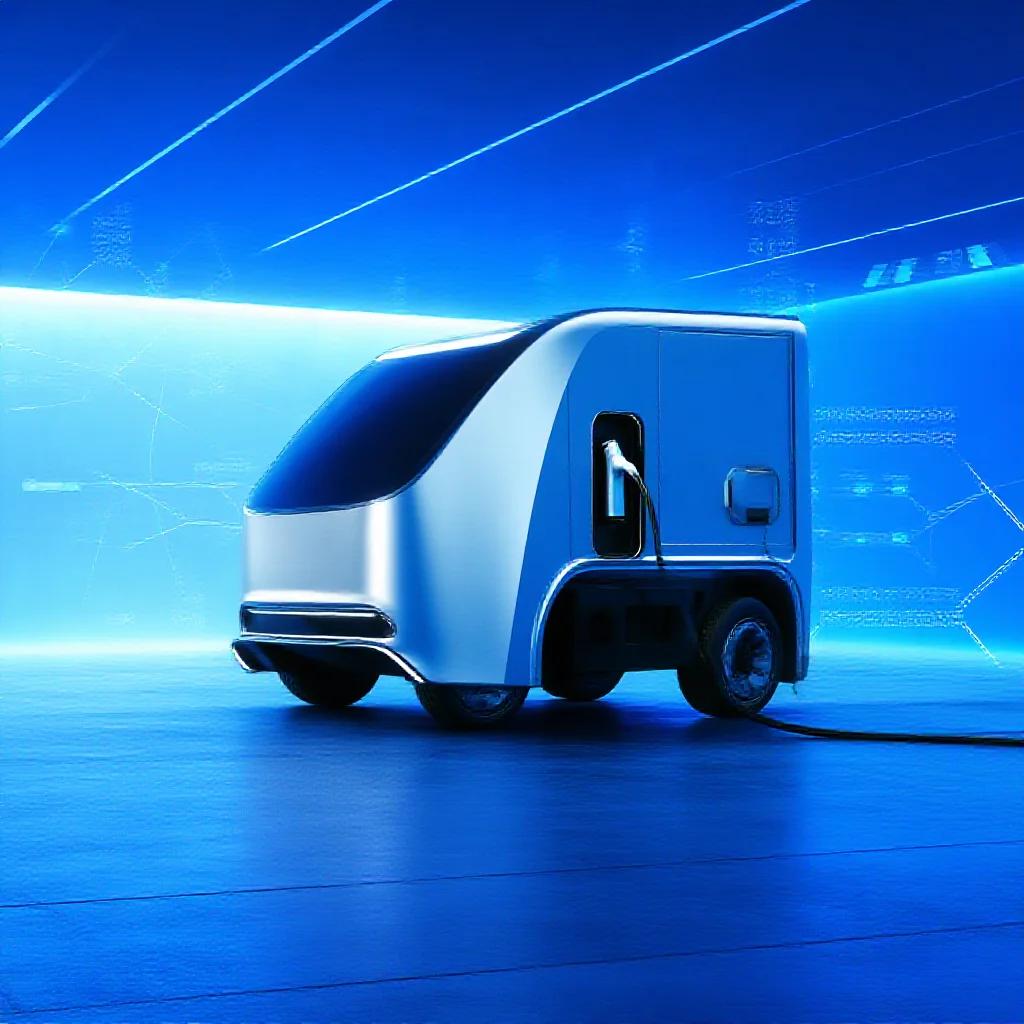
Slate''s recent $650 million funding round, led by climate investors and
Beyond the $650M: How Slate's Electric Truck Funding Signals a Supply Chain Revolution
Opening Summary
Slate, an electric vehicle manufacturer, has secured $650 million in a funding round led by a consortium of climate-focused investors and major logistics companies (Source 1: [Primary Data]). The capital is designated to scale production and reduce costs for its Class 6 electric truck, which features a range of up to 200 miles (Source 1: [Primary Data]). The company’s stated objective is to achieve cost-competitiveness with diesel trucks within three years (Source 1: [Primary Data]). This transaction represents a significant capital infusion into the commercial EV sector, but its structural composition and strategic intent indicate a deeper market shift.The $650M Bet: Decoding the Investor Consortium's Strategy
The composition of the investor consortium is the primary indicator of strategic intent. The simultaneous participation of climate-focused capital and operational logistics firms creates a convergence of environmental, social, and governance (ESG) objectives with tangible operational necessity. For climate investors, the bet is on the decarbonization of a high-emissions sector. For the logistics companies involved, the investment is a tactical maneuver to secure early production capacity and exert influence over vehicle design specifications to meet their unique operational profiles.The funding size—$650 million—transcends typical research and development scaling. This scale of capital is requisite for securing long-term supply chain agreements for critical components like battery cells and electric drivetrains. By financing these commitments, Slate de-risks its own production pathway while providing component suppliers with the demand certainty needed to invest in specialized capacity. The involvement of logistics giants as strategic investors effectively transforms them from passive end-users into co-architects of their own decarbonization roadmap, pre-emptively locking in assets critical for their future operations.
The Three-Year Parity Goal: A Supply Chain Assault, Not Just an Engineering Feat
The goal of cost-competitiveness with diesel within three years is fundamentally a supply chain and procurement challenge, not solely an engineering one. Achieving parity requires re-engineering the entire cost structure of the vehicle, which is dominated by the battery pack and electric powertrain. The capital raised is instrumental in financing the volume-based, long-term contracts necessary to drive down per-unit costs for these components.The economic disruption occurs at the level of total cost of ownership (TCO). While the upfront purchase price is a barrier, TCO for electric vehicles is heavily influenced by lower fuel and maintenance expenses. Achieving upfront cost parity would eliminate the primary adoption hurdle, accelerating fleet turnover based on pure economic calculus rather than regulatory mandates or ESG sentiment. This would trigger a rapid reallocation of capital within the freight sector.
The 200-Mile Range Trucks: Designed for a New Logistics Pattern
Slate’s focus on a 200-mile range for its Class 6 truck is a deliberate targeting of a specific logistics segment. Data from freight operations indicates this range encompasses the vast majority of urban and regional “middle-mile” routes, including last-mile delivery clusters, drayage operations between ports and regional hubs, and intracity distribution. This operational sweet spot is a calculated design constraint.This range specification enables the use of a smaller, less expensive battery pack, which is the single most significant factor in achieving cost parity. It also reduces raw material demand per vehicle, alleviating pressure on the lithium, cobalt, and nickel supply chains. The design choice reflects a market segmentation strategy: dominating the dense, predictable route markets first, where the operational and economic case for electrification is strongest and most immediately viable.
The Long-Term Ripple Effect: Reshaping Industries Beyond Trucking
The successful execution of Slate’s strategy would generate systemic ripple effects across adjacent industries.* Automotive Retail & Service: The direct relationship between manufacturer and large fleet customers, facilitated by strategic investors, challenges the traditional franchised dealership model. Maintenance, reliant on software diagnostics and modular electric powertrain swaps, would migrate toward specialized service centers, disrupting the existing diesel-centric service network.
* Energy Infrastructure: The electrification of commercial fleets will concentrate energy demand at depot locations. These charging depots will evolve into significant grid assets, requiring new demand management solutions and potentially acting as distributed energy resources. Their power needs will influence utility infrastructure planning and investment.
* Component Manufacturing: The push for cost parity and scale will force innovation not only in battery chemistry but also in secondary systems like power electronics, thermal management, and lightweight materials, reshaping the automotive supply chain hierarchy.