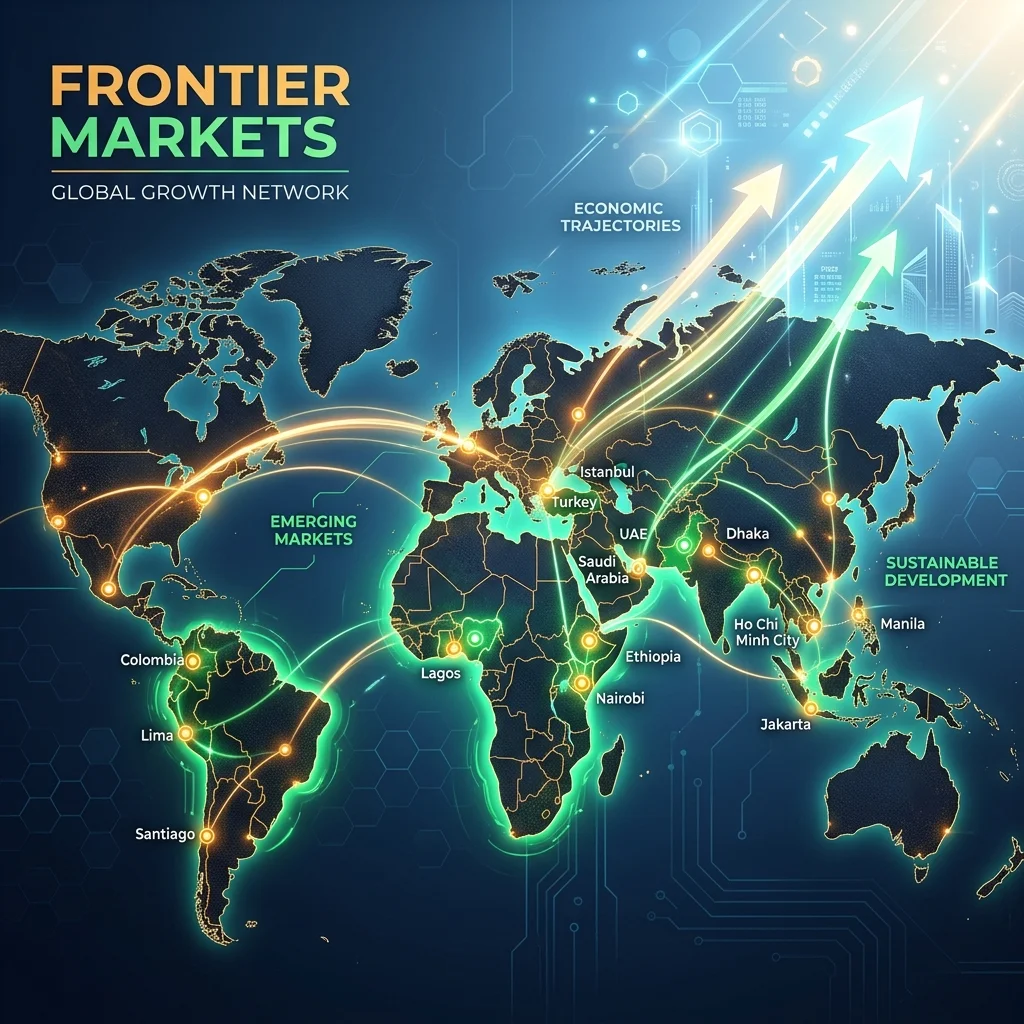
Frontier markets—home to 25% of the global population and 11% of world GDP—are
Frontier Markets: Demographic Tailwinds and GDP Shifts in the World’s Next Economic Powerhouses
For decades, global investors have focused their attention on developed markets and the well-trodden BRICs. Yet beneath the radar, a quieter but potentially more explosive opportunity is taking shape: frontier markets. These economies—often smaller, less liquid, and riskier than their emerging counterparts—are home to 25 percent of the world’s population and generate 11 percent of global GDP. Their aggregate market capitalization now exceeds $500 billion. Contained within this universe is a demographic dividend, an information arbitrage advantage, and a long-term GDP shift that could reshape the global economic landscape. This article examines the data, the historical track record, and the strategic case for looking beyond conventional indices.
1. Defining the Frontier: More Than Just a Classification
Frontier markets sit between developed and emerging economies. They offer higher growth potential but come with limited liquidity, less regulatory transparency, and greater political risk. However, the category itself is surprisingly narrow. Recognized frontier indices, such as the MSCI Frontier Markets Index, cover only about 24 percent of the population that resides in frontier-like countries. Broadening the definition to include 83 countries that meet basic criteria of economic openness and growth potential captures a vastly larger opportunity: 25 percent of the world’s population and 11 percent of global GDP.
[IMAGE: World map with color-coded regions: frontier markets highlighted in orange, emerging in green, developed in blue.]
The inclusion of Saudi Arabia in the MSCI Emerging Markets Index in 2019 was a watershed moment. Saudi Arabia’s market cap exceeded $800 billion at the time of inclusion, with daily trading volume above $2.8 billion. Its reclassification underscored how rapidly these markets can evolve. Brazil offers a powerful blueprint: its stock market grew from roughly $100 billion to $1 trillion in a single decade, demonstrating that frontier-sized economies can become major players in a short time. The lesson for investors is clear: early entry into markets that are still “frontier” can capture exponential growth phases.
2. Historical Performance: Outperforming the Giants
The notion that frontier markets are merely volatile, underperforming assets is contradicted by the data. Over the 10-year cycle ending June 2012, frontier markets delivered an annualized return of 5.8 percent, while the MSCI World index returned just 2.2 percent. The standout region was Africa, where frontier markets posted an annualized return of 10.5 percent during the same period.
[IMAGE: Bar chart comparing annualized returns: frontier markets (5.8%), African frontiers (10.5%), MSCI World (2.2%), and IFC Private Equity (22.2% for later section).]
This performance parallels the early BRIC cycle. BRIC markets underperformed until December 2004 before exploding into a boom that produced 12 percent annualized returns over the subsequent decade. Early European investors in BRIC funds saw assets jump from €100 million to €4 billion in a single year—a clear signal of capital flow momentum. Frontier markets today exhibit several characteristics reminiscent of that inflection point: low valuations, limited analyst coverage, and a growing base of institutional interest. The information arbitrage opportunity is especially pronounced in frontier equities, where fewer than 10 analysts may cover an entire national market.
3. The Demographic Dividend and Long-Term GDP Shift
Perhaps the most powerful driver of frontier market growth is demographics. These economies already hold 25 percent of the global population, and by 2100 the “Silk Road” corridor—stretching across Asia, Africa, and the Middle East—will account for 39 percent of the world’s people. This demographic tailwind translates directly into economic expansion.
[IMAGE: Infographic timeline from 1981 to 2100 showing GDP share shift: developing vs developed, frontier markets highlighted.]
Projections indicate that frontier markets will contribute 18 percent of global GDP by 2050 and 34 percent by 2100. This shift is already underway. Developing economies as a whole now constitute more than 50 percent of world GDP, up from just 31 percent in 1981. Within that, the Silk Road corridor alone is expected to produce 29 percent of global GDP by the end of the century. For perspective, India currently accounts for only 5 percent of world GDP. The room for expansion is enormous.
The demographic dividend is not automatic. It requires sufficient investment in education, infrastructure, and governance to convert a young population into a productive workforce. Yet frontier markets are beginning to attract the capital needed to make that conversion happen. Foreign direct investment flows into Sub-Saharan Africa, for example, have risen steadily, and mobile banking innovations in Kenya and Nigeria have leapfrogged traditional financial infrastructure.
4. Private Equity: The Information Arbitrage Advantage
For investors with a longer time horizon and a willingness to accept illiquidity, private equity in frontier markets has delivered outsized returns. The International Finance Corporation (IFC), part of the World Bank Group, achieved a remarkable 22.2 percent annualized return on its private equity investments in these regions. This performance stems from what is often called the “information arbitrage” advantage: limited analyst coverage means that disciplined, on-the-ground research can uncover value that public markets overlook.
Frontier private equity funds typically focus on sectors tied to domestic consumption, such as financial services, telecommunications, consumer goods, and infrastructure. The lack of efficient public equity markets also means that companies often rely on private capital for growth, giving investors the chance to negotiate favorable terms and build companies from early stages. The IFC’s track record demonstrates that with careful due diligence and local partnerships, the risk-reward profile can be highly attractive.
However, private equity in frontier markets requires patience. Exits can take longer, and currency volatility must be managed through hedging or local-currency financing. The payoff, as the IFC’s numbers show, can be substantial.
5. Africa’s Frontier: A Deep Dive into the Continent’s Growth Engines
Africa is home to 14 of the 30 largest frontier markets by population. Nigeria, Ethiopia, Kenya, Ghana, and Côte d’Ivoire are among the most dynamic. The continent benefits from a median age of under 20—the youngest population in the world. By 2050, half of the global population growth will occur in Africa, adding roughly 1.3 billion people.
[IMAGE: Heat map of Africa showing GDP growth rates by country, with key frontier markets (Nigeria, Kenya, Ethiopia, Ghana) highlighted.]
Africa’s frontier market insights extend beyond demographics. Mobile money penetration in Kenya exceeds 70 percent of adults, providing a template for financial inclusion that other markets are emulating. Nigeria’s tech ecosystem has attracted over $1.5 billion in venture capital since 2019, while Ethiopia’s recent economic reforms have opened its telecommunications and banking sectors to foreign investment.
Yet Africa also exemplifies the risks: political instability in the Sahel, currency depreciation in Ghana, and regulatory uncertainty in South Africa. Investors must differentiate between countries and focus on those with improving governance, infrastructure investment, and diversified economies. MSCI’s Frontier Markets Africa index has historically exhibited lower correlation with global equities, offering portfolio diversification benefits.
6. Strategic Entry Points: What Savvy Investors Are Watching
Forward-looking investors are already positioning in several thematic areas within frontier markets. The first is digital infrastructure. Countries like Bangladesh, Vietnam (now reclassified as emerging), and Pakistan have seen explosive growth in e-commerce and fintech. The second is natural resources. Frontier markets in the “Silk Road” corridor—Kazakhstan, Uzbekistan, Mongolia—are rich in minerals critical to the green energy transition, including copper, lithium, and rare earth elements.
[IMAGE: Photo of a container port in Mombasa, Kenya, with new cranes and shipping containers—symbolizing infrastructure growth.]
The third theme is manufacturing relocation. As rising wages in China push production to lower-cost destinations, frontier markets such as Ethiopia and Myanmar have become attractive for light manufacturing. Garment factories in Ethiopia’s industrial parks now export to global brands, and the government offers tax incentives for foreign investors.
Finally, there is the “MSCI Frontier Markets 100” index, which remains the most liquid vehicle for broader exposure. Yet smart investors recognize that the most compelling opportunities lie outside the index—in countries that are too small or too illiquid for inclusion but where local knowledge can yield outsized returns.
Conclusion: The Case for Early Positioning
Frontier markets are not for every investor. They require patience, higher risk tolerance, and a willingness to navigate unfamiliar terrain. But the historical evidence—5.8 percent annualized returns versus 2.2 percent for developed markets over the decade to 2012—suggests that the risk premium has been rewarded. The demographic tailwinds, projected GDP capture of 18 percent by 2050 and 34 percent by 2100, and the information arbitrage advantage in private equity all point to a structural opportunity that institutional capital is only beginning to exploit.
As developing economies already account for more than half of global GDP, the frontier markets represent the next wave: a growth story that combines youthful populations, rising consumer spending, and the digital leapfrogging that bypasses legacy infrastructure. The investors who take the time to understand these markets today may well be the ones unearthing the hidden growth of tomorrow.
---
Keywords: frontier markets, investment opportunities, emerging markets, Africa frontier market insights, IFC private equity, demographic dividend, MSCI frontier markets, GDP growth projections