Elorian''s recent $55 million funding round, led by Insight Partners, is
Beyond Computer Vision: Why Elorian's $55M Signals the Rise of Industrial Visual Reasoning AI
Opening Summary
On March 21, 2024, Elorian, a San Francisco-based artificial intelligence company, announced the closure of a $55 million funding round (Source 1: [Primary Data]). The investment was led by Insight Partners, with participation from existing investors Index Ventures and Eclipse Ventures (Source 2: [Primary Data]). Founded in 2021, Elorian develops the "Lumina" platform, an AI system engineered to interpret and reason about real-time visual data from industrial cameras and sensors (Source 3: [Primary Data]). The capital is designated for scaling operations and expanding market reach, with a focus on manufacturing, logistics, and infrastructure inspection applications (Source 4: [Primary Data]).---
The Funding as a Market Signal: Betting on the 'Reasoning' Layer
The $55 million investment round represents a significant capital allocation toward a specific and emerging niche within industrial AI: the reasoning layer. This move by Insight Partners, Index Ventures, and Eclipse Ventures functions as a vote of confidence that transcends basic computer vision. The broader computer vision market, now commoditized in areas like defect detection or object classification, addresses perception. This investment targets the subsequent, higher-value stratum of the industrial stack: cognitive interpretation and decision-making derived from visual inputs.The participation of established, multi-stage venture firms provides institutional verification of the technology's perceived scalability and economic potential. Their capital commitment indicates a calculated belief that the bottleneck for advanced industrial automation is no longer raw data capture or simple pattern recognition, but the ability to synthesize and reason across disparate visual data streams to generate actionable operational commands.
!Infographic comparing Computer Vision to Visual Reasoning

Deconstructing 'Lumina': From Pixels to Operational Commands
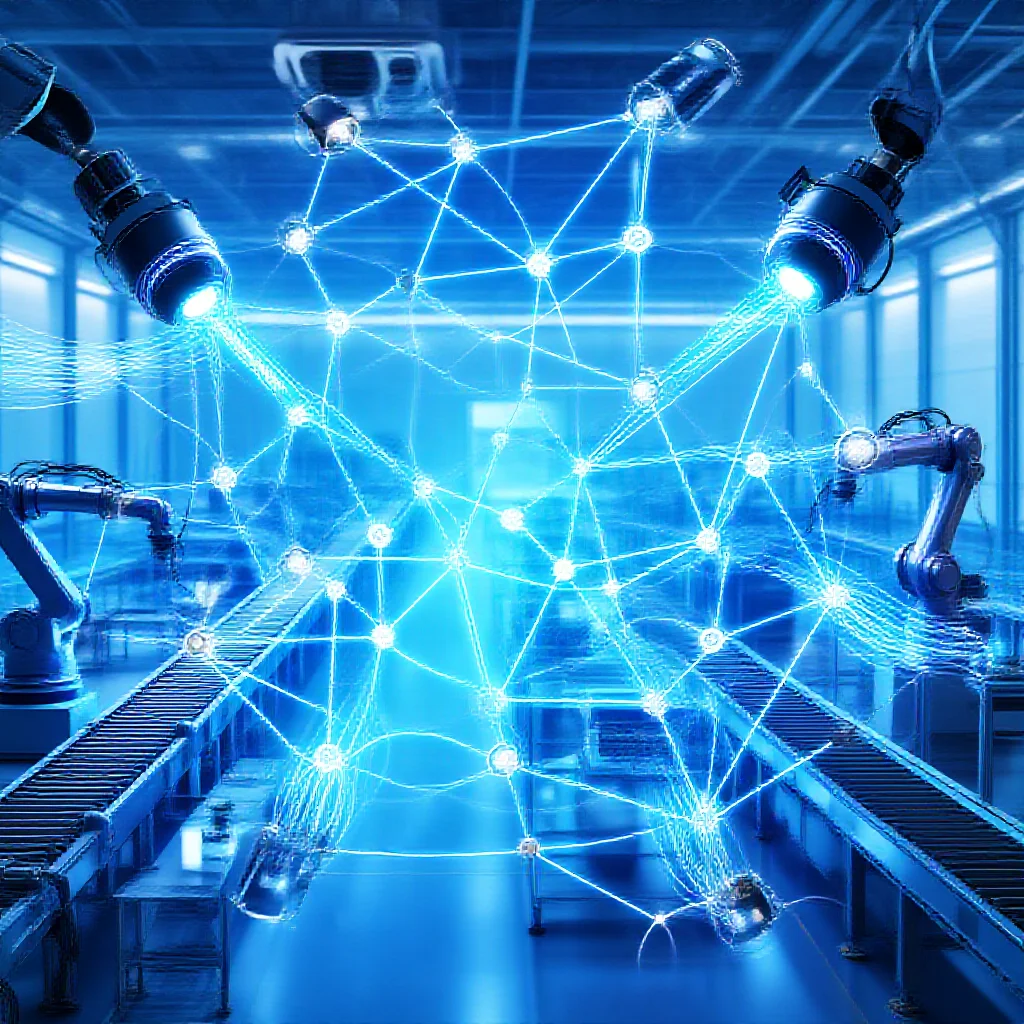
Elorian's Lumina platform is architected to move beyond pixel-based pattern recognition. The technical premise of "real-time interpretation and reasoning" implies a system capable of context-aware scene understanding. This involves constructing a dynamic, multi-dimensional model of an industrial environment by fusing data from diverse camera angles and sensor types. The output is not merely a label—"crack" or "pallet"—but a contextual understanding: "a 2mm thermal crack propagating at a critical weld junction under current load" or "a pallet obstructing the primary navigation path of Autonomous Guided Vehicle (AGV) #3."The implied architectural shift is from 2D image analysis to 3D scene graph generation, where objects, their properties, and their spatial and functional relationships are continuously mapped. The long-term operational impact is not marginal efficiency gain but systemic resilience. An AI capable of visual reasoning can autonomously adapt to unstructured disruptions—a fallen package, an anomalous machine vibration, an unexpected assembly sequence—by generating and executing compensatory actions without human intervention, thereby creating more adaptive and robust supply chains and production systems.
!Conceptual diagram of Lumina's data processing pipeline

The Industrial Triad: Manufacturing, Logistics, and Infrastructure's Unmet Need
Manufacturing, logistics, and infrastructure constitute the primary target verticals for a reason. These sectors generate vast quantities of visual data but are plagued by complex, variable problems that defy deterministic, rule-based automation. Quality inspection, warehouse sortation, and structural health monitoring present scenarios with near-infinite variability, where exceptions are the norm.Elorian's 2021 founding coincides with a post-pandemic industrial landscape characterized by an urgent demand for flexible, automated, and remotely operable systems. The stated target applications ground the technology in high-stakes, high-value verticals where the cost of error is significant. This marks a strategic pivot in industrial AI deployment, moving from generic horizontal tools to deeply integrated, vertical-specific reasoning engines that address core operational and safety challenges.
!Triptych of industrial applications for visual reasoning AI

The Competitive Landscape and Technological Barriers
The competitive field for visual reasoning is nascent but delineating. It positions Elorian against two cohorts: generalized AI research labs exploring foundational models for vision, and incumbent industrial automation providers bolting basic computer vision onto legacy systems. The defensible moat is not in algorithm publication but in the integration and validation of a full-stack platform that reliably operates in safety-critical, physically dynamic environments.The principal technological barriers are substantial. They include achieving robust performance under variable lighting, weather, and occlusion conditions; ensuring ultra-low latency for real-time control loops; and developing explainable AI outputs that build necessary trust for deployment in human-coexistent workspaces. Success in this domain is contingent on overcoming these engineering-intensive challenges, not merely demonstrating proof-of-concept accuracy in controlled settings.
Neutral Market and Industry Predictions
The funding event for Elorian is a leading indicator for the industrial automation market. The logical trajectory points toward the convergence of visual reasoning with other data modalities—thermal, LiDAR, spectral, and operational technology (OT) data—to form comprehensive "physical world models." The cause (need for adaptive automation) and effect (investment in reasoning AI) relationship suggests a new wave of productivity gains will be unlocked by systems that understand, not just see.Market adoption will likely follow a phased path, beginning with decision-support applications in controlled environments before progressing to fully autonomous closed-loop control in non-critical tasks, and eventually, to supervised autonomy in complex safety-critical operations. The capital infusion into Elorian validates this technological pathway and anticipates increased competitive activity and strategic partnerships within the industrial AI ecosystem over the next 18-24 months. The ultimate measure of success will be the demonstrable reduction of unplanned downtime and operational exceptions across global industrial assets.