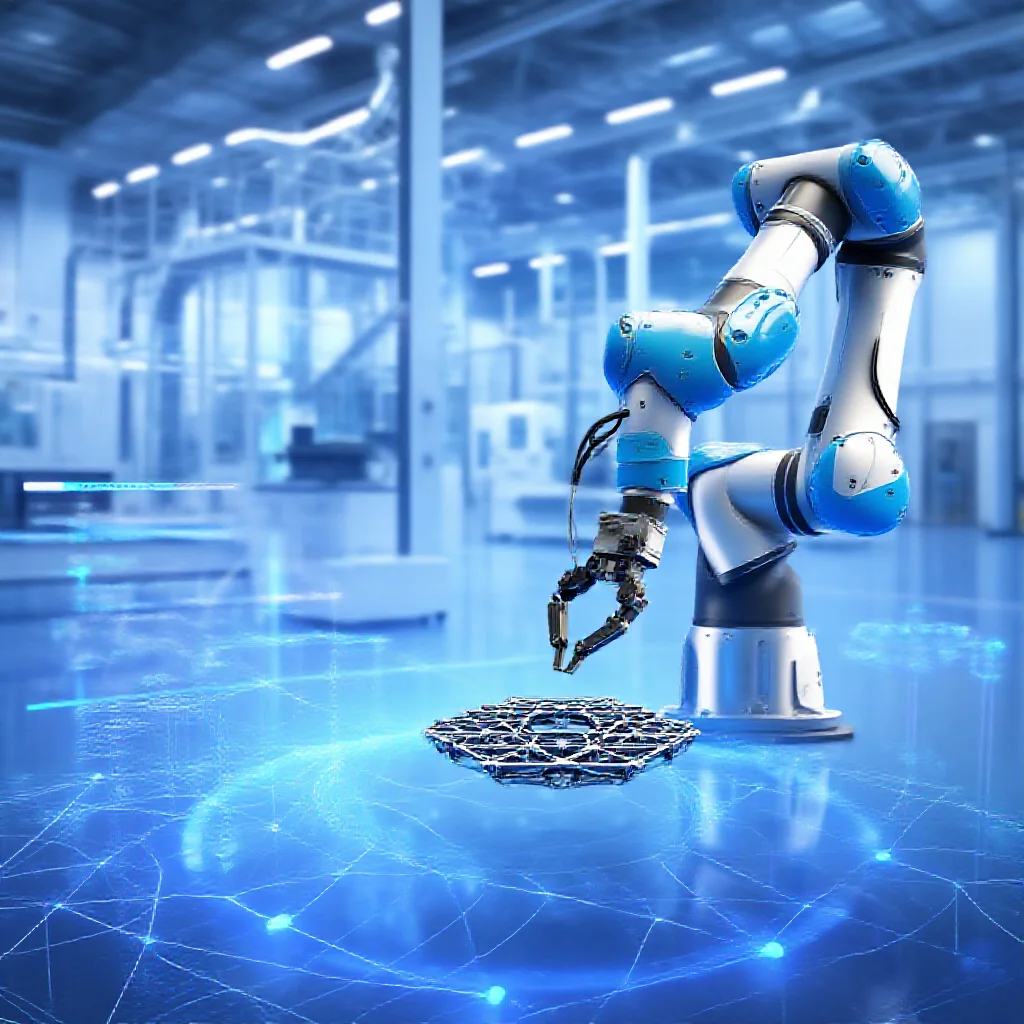
Eclipse Ventures' $1.3 billion fundraise is more than a venture capital headline;
Beyond the Code: Why Eclipse's $1.3B Bet on Physical AI Signals a New Industrial Revolution
Opening Summary
Eclipse Ventures has secured $1.3 billion in new capital across two funds. (Source 1: [Primary Data]) This capital will be deployed with a specific mandate: investing in startups that integrate artificial intelligence with physical-world industries, including manufacturing, logistics, and transportation. (Source 1: [Primary Data]) The firm’s total assets under management now exceed $4 billion. (Source 1: [Primary Data]) This fundraise is not an isolated event but a concentrated bet on a sector Eclipse terms "Physical AI," representing a strategic pivot within venture capital toward tangible, infrastructure-level innovation.
The $1.3B Thesis: Decoding Eclipse's 'Physical AI' Mandate
The capital structure reveals a dual-stage strategy. A $720 million fund is allocated for early-stage investments, while a $580 million opportunity fund is reserved for scaling proven portfolio companies. (Source 1: [Primary Data]) This two-tiered approach indicates a commitment to both seeding innovation and supporting the capital-intensive growth phases inherent in physical technology companies.
The firm’s definition of "Physical AI" extends beyond mere automation. It constitutes systems where artificial intelligence directly controls, optimizes, or creates physical outcomes. This involves the integration of machine learning, computer vision, and advanced robotics into the operational core of GDP-generating industries. The fundraise, bringing Eclipse’s total AUM past $4 billion, signals established pattern recognition and conviction in a sector historically characterized by high barriers to entry and long development cycles.
The Hidden Economic Logic: From Digital Disruption to Physical Productivity
The investment thesis addresses identifiable economic pressures. Pure software innovation, while transformative, has largely optimized digital workflows. The current macroeconomic landscape—defined by persistent supply chain fragility, structural labor shortages, and geopolitical incentives for onshoring—creates demand for solutions that enhance physical productivity. (Logical Deduction)
Venture capital is consequently pivoting toward tangible assets and hard tech. The economic logic is clear: digitizing the "analog gap" in global industrial infrastructure presents a vast, under-optimized market. Success in this domain creates significant enterprise value through the development of deep technological moats, as solutions require integration of specialized hardware, proprietary software, and domain-specific data.
Deep Audit: Why This is a 'Slow Analysis' Industry Shift
This shift must be analyzed through a "slow analysis" framework, contrasting with the rapid iteration cycles of consumer software. Physical system integration involves protracted research and development, rigorous safety validation, and longer enterprise sales cycles. Adoption is measured in years, not months.
The trend is corroborated by the thematic focus of other specialized investment firms, such as DCVC and Lux Capital, which have long prioritized foundational technology and deep tech. Corporate research and development budgets in industrial automation and smart manufacturing are also expanding concurrently. Eclipse Ventures’ own portfolio history provides validation; its continued conviction is based on prior experience navigating the complexities of hardware-heavy startups, offering credible source evidence for this scaled commitment. (Logical Deduction)
The Unseen Impact: Ripples Through the Global Supply Chain
The implications of widespread Physical AI adoption extend beyond individual factory floors. AI-driven logistics and transportation networks promise to fundamentally reshape inventory management and delivery economics through dynamic routing and predictive warehousing.
A second-order effect could be the accelerated regionalization of manufacturing. As automation mitigates traditional labor cost advantages, the economic calculus for geographically dispersed supply chains changes. This could lead to increased production nearshoring or onshoring, altering global trade patterns.
This evolution also creates new dependencies. A critical new layer of technology infrastructure—the software and intelligence controlling physical assets—would emerge. This introduces both risk, in terms of new vectors for systemic disruption, and opportunity, by creating a platform for continuous optimization and data-driven resilience across entire industrial ecosystems.
Neutral Market and Industry Predictions
Based on the capital deployment and sector focus, several predictions can be logically deduced. The convergence of AI and physical operations will likely accelerate, with increased competition for talent in robotics, mechatronics, and industrial software. Investment in this sector will remain bifurcated, favoring firms with specialized technical due diligence capabilities over generalist investors.
Enterprise adoption will be sequential, beginning with discrete process optimization before expanding to full-system autonomy. The long-term outcome is not merely automated factories but fundamentally redesigned industrial processes, where AI acts as a core component of physical infrastructure, leading to a new phase of productivity growth within the real economy. The success of this thesis will be measured not in monthly active users, but in systemic reductions in waste, energy use, and latency across global production and distribution networks.